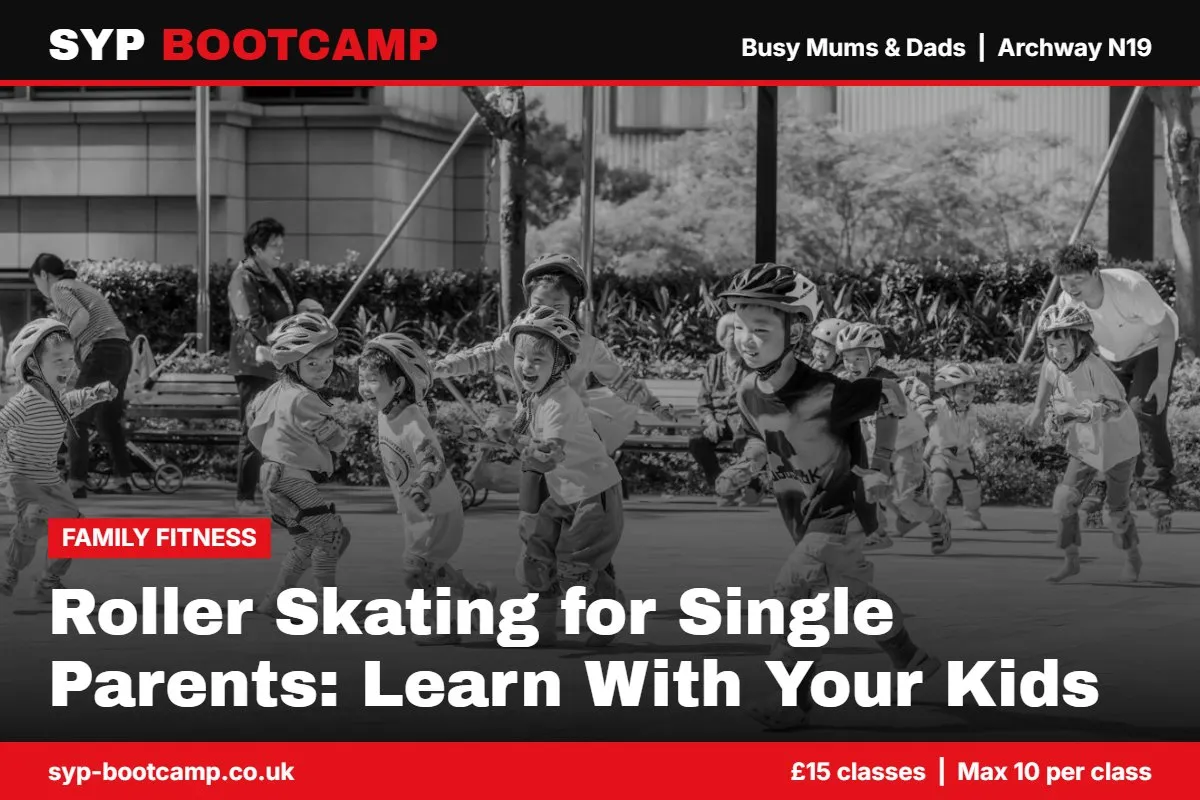
Roller Skating for Single Parents: Learn With Your Kids
Your kids got skates for their birthday, and now every weekend is you jogging alongside, holding a sticky hand and bending double to stop them falling. What if you put a pair on too? Roller skating for single parents is one of the few activities where you get a proper workout, the kids get your full attention, and nobody needs a babysitter. It is also a brilliant leveller: when you are all learning together, the kids get to see you wobble, fall over safely and get back up. This guide covers the safety kit, the leg and balance work skating gives you and exactly where to start.
Why skating works so well for solo parents
- It is a workout disguised as fun. Skating works your thighs, glutes, inner and outer hips, ankles and core. After 30 minutes, your legs will know about it.
- It is family time, not “me time”. No guilt about leaving the kids. You are doing it together.
- It builds balance. The kind of balance we lose quietly in our 30s and 40s, the kind that stops you slipping on a wet pavement with a toddler in your arms.
The safety kit (non-negotiable)
Adults fall differently from kids. We are taller, heavier and more likely to put a hand out. Wrists are the classic injury. Before your first session, get:
- Helmet that fits snugly and sits level, two fingers above your eyebrows
- Wrist guards, the most important bit of kit for adult beginners
- Knee pads and elbow pads
- Skates that fit: snug at the heel, toes not crushed. Try quad skates (two wheels at the front, two at the back) if you want more stability, or inline skates if you want speed later.
Kids need the same set. Make “pads on before skates on” a family rule. If you have osteoporosis, balance problems or a past wrist, knee or ankle injury, check with your GP or a physio before starting. The NHS has clear information on osteoporosis if you are unsure about your bone health.
Roller skating for single parents: where to start
Step 1: start on grass or carpet
Put your skates and pads on indoors or on the grass. Stand up, bend your knees and march on the spot. Get used to the feeling of wheels under you without them rolling much. Five minutes is enough.
Step 2: learn to fall
Yes, practise it. On grass, from a low squat, drop forward onto your knee pads, then your wrist guards. The rule is: bend your knees, go down forwards, land on your pads. Falling backwards onto your bottom or putting a straight arm behind you is how wrists and tailbones get hurt. Make it a game with the kids: who can do the best “pad fall”.
Step 3: the ready position
Feet hip-width apart, knees bent, weight slightly forward over the balls of your feet, hands in front of you as if holding a tray. If you feel yourself tipping back, bend your knees more and reach forwards.
Step 4: duck walk then glide
On a smooth, flat surface, turn your toes out slightly into a V and take small steps, like a duck. Once that feels OK, push off one foot and let the other glide for a second, then switch. Short pushes, lots of them.
Step 5: learn to stop before you learn to go fast
On quad skates, start with the toe stop drag or a “plough” stop with toes in. On inline skates, learn the heel brake. Practise on flat ground first, not on any slope.
Where to skate
Look for a flat, smooth surface with no traffic and room to fall: wide park paths, empty basketball or tennis courts where skating is permitted, or large school playgrounds that open to the public at weekends. Always check signs, as some parks and courts do not allow skates, and give way to walkers and buggies. Avoid hills completely until all of you can stop confidently.
Indoor rinks and adult beginner sessions are worth a look too, especially in winter. Search for sessions near you and check age rules before you take the kids.
The leg and balance work it builds, and how to boost it at home
Skating asks a lot of your hips and ankles. Three home moves, done twice a week after bedtime, make learning faster and safer:
- Single-leg balance: stand on one foot for 30 seconds, knee soft. Harder: close your eyes or turn your head slowly. 3 each side.
- Skater lunges: step back and diagonally behind you into a curtsy lunge. 3 x 8 each side. It trains the exact push-and-glide muscles.
- Wall sit: 3 x 30 seconds. Skating is basically a long, mobile wall sit.
- Side-lying leg raises: 2 x 15 each side for the outer hip.
For more balance work you can do on your own, see my guide to balance exercises for adults. If you have a teenager who has moved on to boards, my post on skateboarding for single parents covers that too.
A 30-minute family skate session
- 5 minutes: pads on, march on the grass, two practice falls each.
- 10 minutes: duck walks and glides on flat ground. Count glides: who can glide longest?
- 5 minutes: stopping practice. Roll slowly, stop on a line or a chalk mark.
- 5 minutes: “follow the leader”. Kids lead, you copy. Then swap.
- 5 minutes: skates off, quick stretch for hips, calves and quads.
Stop while everyone is still having fun. You want them asking to go again next weekend. For more ways to be active as a family, see exercising with your kids.
Where a bootcamp class fits
Skating is a great weekend activity, but it is easier and safer when your legs, hips and core are already strong. In my classes we do lunges, single-leg work and core training that transfer straight onto wheels. Our SYP Unlock hip and back mobility class is especially useful if your hips feel stiff when you try to push and glide. For the full picture of training as a solo parent, read my single parent fitness guide.
FAQs
Is roller skating good exercise for adults?
Yes. It works the legs, hips and core, builds balance and gets your heart rate up, especially once you can skate continuously.
Is it too late to learn roller skating as an adult?
Not at all. Adults often learn faster than they expect. Start on flat ground, wear full pads and learn to stop early.
Quad skates or inline skates for beginners?
Quad skates feel more stable for most adult beginners. Inline skates are faster and better for longer distances once you are confident.
What age can kids start roller skating?
Many children start around 3 to 5 with adjustable beginner skates and full pads. Go at their pace and keep sessions short.
Book your first class
Build the leg strength and balance that makes weekends on wheels more fun. SYP Bootcamp runs 45-minute small-group classes indoors in a church hall in Archway N19, max 10 people, £15 a class, with easier and harder options for every exercise. Book your £15 class here or call or WhatsApp me on 07301 512215. If you would prefer one-to-one sessions later, have a look at private personal training in Archway.
About the author
Artem Olekhnovych is a personal trainer in Archway and the founder of SYP Fitness and SYP Bootcamp. He has coached clients in Archway, Highgate and across North London for over 10 years, and runs small-group bootcamp classes for busy mums and dads. Read reviews from his 1-1 clients.
