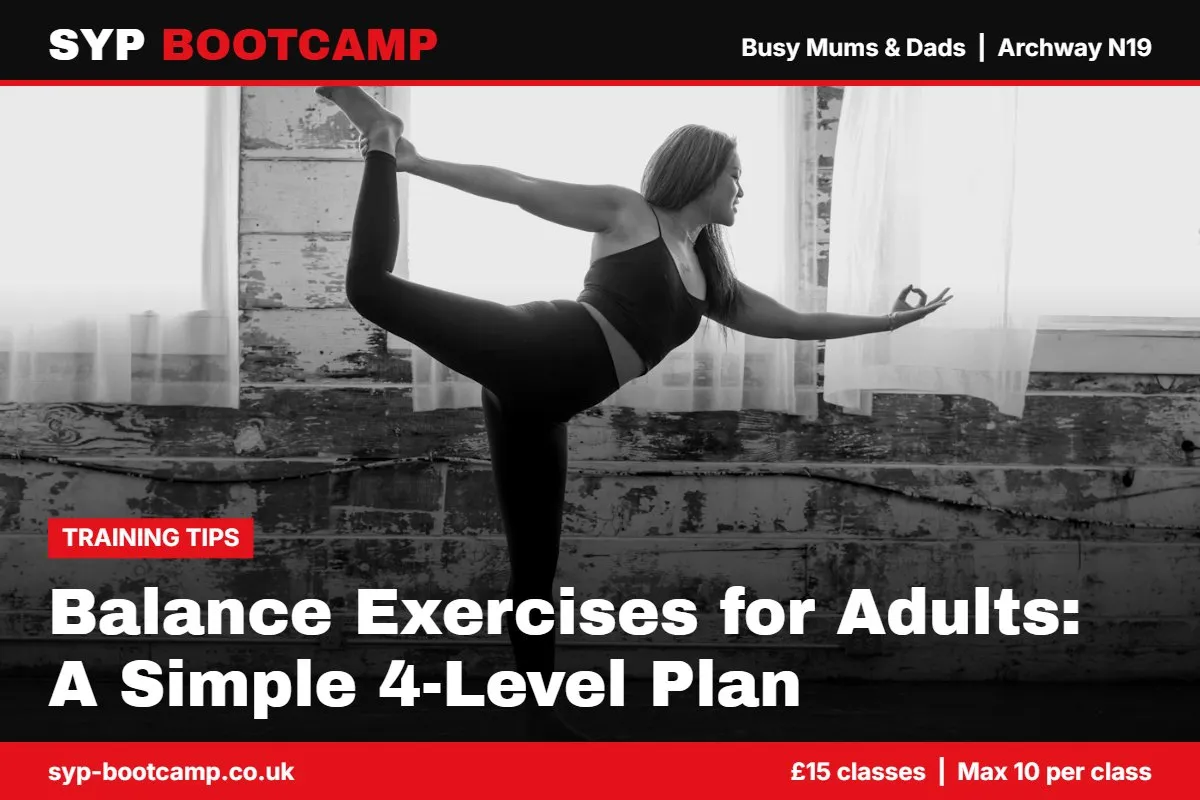
Balance Exercises for Adults: A Simple 4-Level Plan
Balance is one of those things you do not think about until it lets you down. A wobble on the stairs while carrying the laundry. Catching your foot on a scooter left in the hallway. Struggling to stand on one leg to put your shoes on. Balance is a skill, and like any skill it fades if you never practise it. The good news is that balance exercises for adults take just a few minutes, need no kit, and can easily be done while the kettle boils. Here is the progression I use with parents in Archway.
Why balance matters in your 30s, 40s and 50s
We tend to think of balance training as something for older people. But many of the parents I coach are surprised by how wobbly they are when they first try standing on one leg with their eyes closed. Years of sitting, wearing supportive shoes and moving in the same few patterns all take their toll.
Better balance helps with:
- Everyday confidence on stairs, wet pavements and icy mornings
- Sport and play, from a kickabout in the park to chasing the kids
- Strength training, because lunges, step-ups and single-leg work all need it
- Staying independent and steady as you get older, which is easier if you start now
Quick test: how is your balance?
Stand next to a wall or worktop, in bare feet. Lift one foot off the floor and time how long you can hold it without touching down or grabbing the support. Try both sides. Then try it with your eyes closed (keep a hand hovering near the support).
There is no perfect number, but if you struggle to hold 30 seconds with your eyes open, or the two sides are very different, balance training will help. Retest every month to track progress.
If you feel dizzy, light-headed, or have fallen without a clear reason, please see your GP before doing balance work. Dizziness can have medical causes that need checking. The same goes if you have an inner ear problem, a neurological condition, or a recent ankle, knee or hip injury.
Balance exercises for adults: a 4-level progression
Always do these next to a wall, worktop or sturdy chair. The NHS balance exercise guidance recommends doing them near support, moving slowly and with control, building up gradually, and aiming for at least twice a week (see the NHS balance exercises page). Move up a level when the current one feels steady on both sides.
Level 1: steady foundations
- Heel-to-toe stand: one foot directly in front of the other, as if on a tightrope. Hold 30 seconds, swap feet.
- Heel-to-toe walk: walk 10 steps along a line, looking ahead, not down.
- Sideways walking: 10 slow, controlled steps each way.
Level 2: single leg
- One-leg stand: lift one foot, keep your hips level. Build from 10 seconds to 30 to 45 seconds, 3 times each side.
- Toothbrush balance: stand on one leg while brushing your teeth, one minute per side. The easiest habit you will ever build.
Level 3: add movement
- Clock reach: stand on one leg and tap your other foot out to the front, side and back. 3 rounds each side.
- Single-leg reach: on one leg, hinge forward and reach your hand towards a chair seat, then stand tall. 6 to 8 reps each side.
- Step-ups: step up onto the bottom stair slowly, pause on one leg at the top, step down with control. 8 each side.
Level 4: challenge your senses
- One-leg stand, eyes closed: only with a support right next to you. Start with 5 seconds.
- One-leg stand on a cushion: a folded towel or sofa cushion makes your ankle work harder.
- Head turns: on one leg, slowly turn your head side to side.
A 10-minute balance routine, 3 times a week
- Heel-to-toe walk: 2 lengths of the hallway
- One-leg stand: 3 x 30 seconds each side
- Clock reach: 3 rounds each side
- Single-leg reach: 2 sets of 6 each side
- Step-ups with a pause: 2 sets of 8 each side
- Finish with 30 seconds each side of your hardest Level 4 drill
Most people notice they feel steadier within a few weeks of practising regularly.
Strength and balance go together
Balance is not only about your inner ear and ankles. Strong legs, glutes and core give you the control to recover when you wobble. That is why I always pair balance drills with strength work. My guide to functional strength exercises for over-35s covers the key moves, and my core exercises for beginners help you stay steady through your middle. If you are in your forties and wondering where to start, my post on fitness for parents over 40 puts it all together.
Practise balance with us in class
Balance drills are built into my SYP Built To Last functional strength class for over-35s. We do single-leg work, carries and controlled lunges every week, with support close by and easier options whenever you need them. It is much easier to stick with balance training when it is part of a class you enjoy.
FAQs
How long should an adult be able to stand on one leg?
Many fit adults can hold 30 seconds or more with their eyes open. Struggling with less than that is a sign to start practising. If you have trouble for medical reasons or feel dizzy, see your GP.
How can I improve my balance quickly?
Practise a little and often. A few minutes of single-leg work most days, such as balancing while brushing your teeth, plus twice-weekly strength training, gives the fastest progress.
Why is my balance getting worse?
Often it is lack of practice and strength, especially if you sit a lot. But worsening balance, dizziness or falls can also have medical causes, so get it checked by your GP.
Does walking improve balance?
Walking helps, especially on uneven ground like park paths. Adding specific balance exercises gives a bigger improvement.
Book your first class
SYP Bootcamp runs 45-minute small-group classes indoors in an Archway N19 church hall. There are never more than 10 people, classes cost £15, and every exercise has an easier and harder option. The timetable is sent when you book. Book your £15 class here or call or WhatsApp me on 07301 512215. If an old injury is affecting your balance or confidence, my injury-safe personal training in Archway is a careful way to rebuild.
About the author
Artem Olekhnovych is a personal trainer in Archway and the founder of SYP Fitness and SYP Bootcamp. He has coached clients in Archway, Highgate and across North London for over 10 years, and runs small-group bootcamp classes for busy mums and dads. Read reviews from his 1-1 clients.
