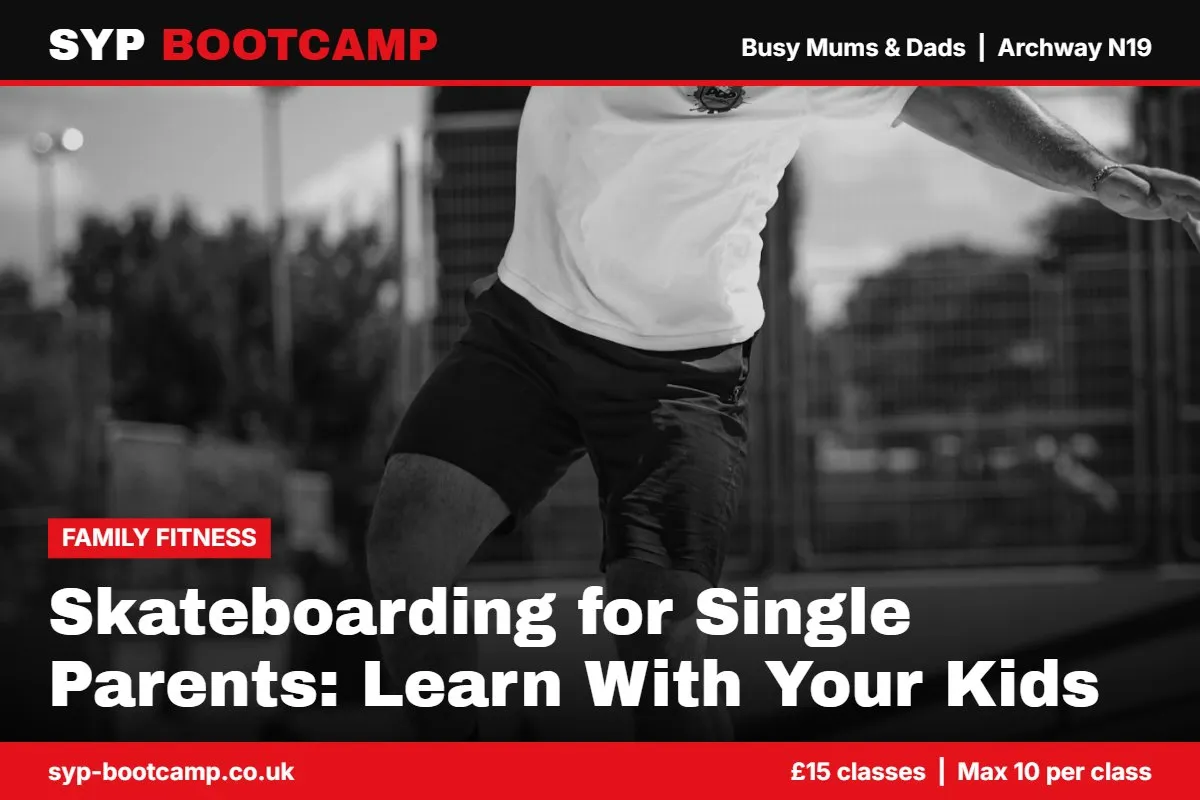
Skateboarding for Single Parents: Learn With Your Kids
Your child has been skating for six months. You have spent most of that time standing at the edge of the skatepark holding a coffee and a spare jumper. At some point you wonder: could I have a go? The short answer is yes. Skateboarding for single parents is a brilliant way to turn those hours on the sidelines into time you share, and adult beginners learn faster than they expect, as long as they wear the right kit, train their balance and learn how to fall.
Why skateboarding for single parents works
- It turns waiting time into active time. When you are the only parent, every hour counts. Skating with them means you are both active, together.
- Your child becomes the teacher. Being better than a parent at something is a huge confidence boost for kids, and they will love showing you how.
- It is a great balance and leg workout. Pushing works your legs and hips, and staying on the board trains balance and core control, both of which the NHS encourages in its balance exercises guide.
- It is cheap once you have the kit. Skateparks are usually free to use.
- It counts. An hour of pushing around counts towards the NHS physical activity guidelines.
Let us be honest about the risk
Skateboarding has a higher injury risk than most activities in this blog. The common injuries are wrist sprains and fractures, ankle sprains, and grazes, mostly from falling forwards onto outstretched hands. Adults also heal more slowly than kids. So I would not recommend it if you have osteoporosis, a recent injury, balance problems, or are pregnant. If any of that applies, or you have a health condition, check with a GP or physio first. If you do get a sprain, the NHS page on sprains and strains explains what to do, and you should get any suspected fracture checked straight away.
The good news is that most of that risk can be cut down with the three things below: kit, balance and learning to fall.
Protective kit: what to buy first
- Helmet. Non-negotiable. A properly fitted skate or multi-sport helmet that sits level just above your eyebrows.
- Wrist guards. The single most useful bit of kit for adult beginners, because wrists take most falls.
- Knee pads. Proper hard-cap pads let you slide out of falls on ramps instead of landing on your knees.
- Elbow pads. Worth it while you learn.
- Flat-soled shoes. Skate shoes or flat trainers with grippy soles. Not running shoes with thick, rounded heels.
- A wider board. A slightly wider deck with softer wheels is more stable and forgiving for adults learning on rough pavements.
Set the example: if you wear a helmet and pads, your children are far more likely to keep theirs on.
Balance drills before you push off
Do these at home on carpet or grass, where the board cannot roll away. Five minutes a day for a week makes a real difference.
- Find your stance: stand naturally and have someone gently push you from behind. The foot you step forward with usually goes at the front of the board.
- Board on grass: stand on the board on grass or carpet, feet over the bolts, knees soft. Shift weight from toes to heels slowly. 1 minute.
- Squat on the board: 3 sets of 8 slow squats on the board on grass. This is the low, stable position you will ride in.
- Single-leg balance: on the floor, 30 seconds each leg, 3 times. Pushing means balancing on one leg on a moving board.
- Calf raises and ankle circles: 2 sets of 15 raises and 10 circles each way. Strong ankles cope better with wobbles.
If you want more balance work, my post on balance exercises for adults has a full routine.
How to fall safely
You will fall. Plan for it. Practise these on grass, in full kit, before you need them.
- Get low early. If you feel a wobble, bend your knees and lower your centre of gravity. Lower falls hurt less.
- Step off if you can. Most beginner “falls” can be turned into a run off the board. Practise stepping off forwards and running it out.
- Do not reach out with straight arms. This is how wrists break. Keep elbows bent and tuck your arms in.
- Roll, do not slap. Fall onto the fleshy side of your body and roll onto your shoulder or back, spreading the impact.
- Use your pads. On ramps, fall forwards onto your knee pads and slide, rather than putting hands down.
- Let the board go. Never chase a rolling board into a path or road.
Your first four sessions
- Session 1: balance drills, then standing on the board on a smooth flat surface while your child holds your hand. Practise riding a metre and stepping off.
- Session 2: pushing. One foot on the board over the front bolts, push gently with the back foot, then place it on the board and glide. 10 to 15 glides.
- Session 3: stopping. Practise the foot-drag stop at walking pace, and stepping off safely.
- Session 4: gentle turns by leaning toes and heels. Stay on the flat. Ramps can wait.
Go to the skatepark at quieter times, like early on weekend mornings, while you are learning, and stay away from the bowls and big ramps. Skatepark etiquette matters: wait your turn and do not stand in the landing spots.
Making it work as a solo parent
Skating together means you do not need childcare, which is a big win. But if you have more than one child and only one of them skates, bring a scooter or bike for the other, or keep sessions short. Sessions of 30 to 45 minutes are plenty for adult beginners anyway, because your legs will be tired. My single parent fitness guide has more ideas for building activity around the kids, and exercising with your kids has family-friendly options for days when skating is not happening.
Where a bootcamp class fits
Stronger legs and better balance make skating less wobbly and falls less likely. My SYP Unlock hip and back mobility class and general strength classes help you get lower and more stable on the board.
FAQs
Am I too old to learn to skateboard?
No. Plenty of people learn in their thirties, forties and beyond. Start slowly, wear full protective kit and focus on balance and falling technique first.
Is skateboarding good exercise?
Yes. It works your legs, hips and core, improves balance and gets your heart rate up when you are pushing around.
What protective gear do adult beginners need?
At minimum a helmet and wrist guards, ideally knee and elbow pads too, plus flat-soled shoes.
How long does it take to learn to skateboard?
Most adults can push and glide comfortably after a few sessions. Turning and stopping confidently usually takes a few weeks of regular practice.
Book your first class
Want stronger legs and better balance for skating, or just for life? SYP Bootcamp runs 45-minute small-group classes indoors in a church hall in Archway N19, maximum 10 people, £15 a class, and all fitness levels are welcome. Book your £15 class here or call or WhatsApp me on 07301 512215. If you want a bigger change with 1-1 support, take a look at the SYP Fitness transformation programme.
About the author
Artem Olekhnovych is a personal trainer in Archway and the founder of SYP Fitness and SYP Bootcamp. He has coached clients in Archway, Highgate and across North London for over 10 years, and runs small-group bootcamp classes for busy mums and dads. Read reviews from his 1-1 clients.
