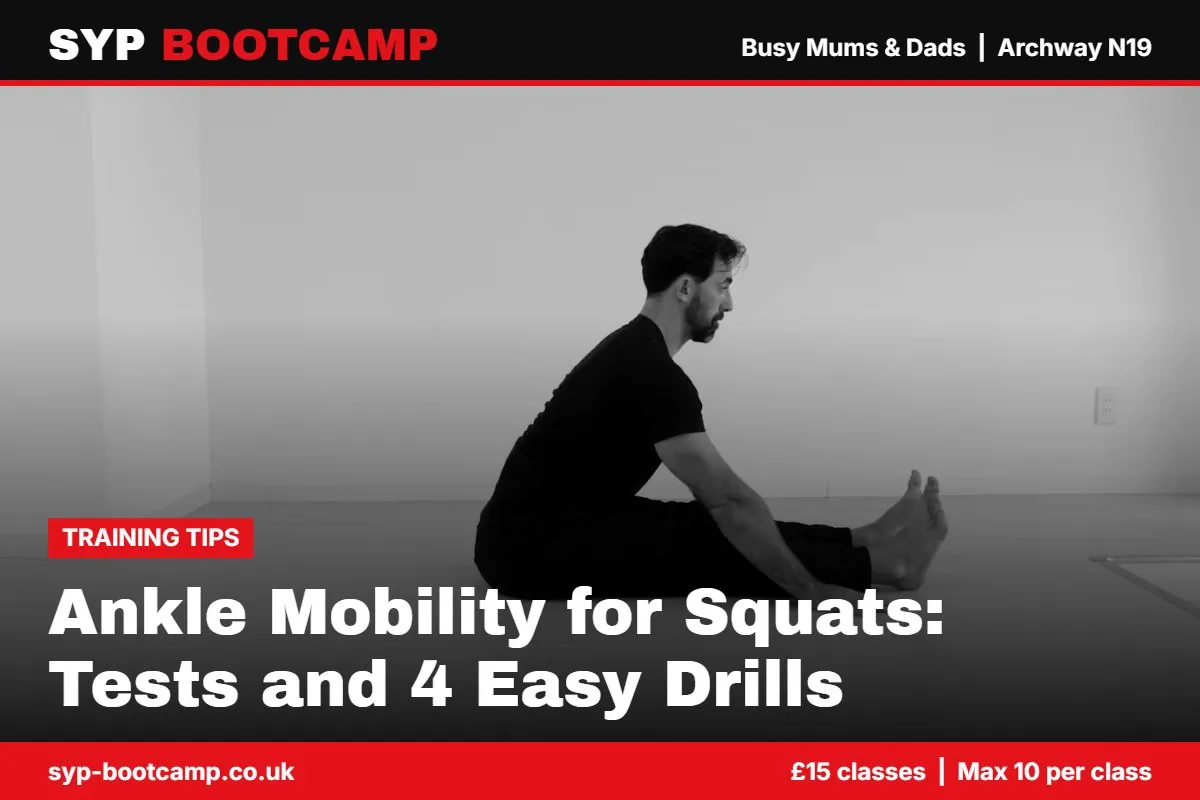
Ankle Mobility for Squats: Tests and 4 Easy Drills
You have watched the videos, fixed your stance and tried to keep your chest up, but your squat still feels awkward. Your heels lift, you tip forward, or you hit a wall halfway down. Very often the problem is not your hips or your back. It is your ankles. Stiff ankles are common in adults, especially if you sit a lot, wear raised-heel shoes or have had an old sprain. This post is all about ankle mobility for squats: how to test it, the drills that help, and what to do while you work on it.
Why ankles matter in a squat
As you squat down, your knees travel forward over your toes. For that to happen, your shin has to tilt forward over your foot. That movement is called ankle dorsiflexion. If your ankle will not bend enough, your body finds another way down: your heels lift, your feet turn out, your knees cave in or your chest falls forward. None of those are ideal, and they make squats feel harder than they should.
Knees going past your toes is normal, by the way. It is not dangerous for healthy knees. What matters is that your heels stay down and your knees track in line with your toes.
Test your ankle mobility in 2 minutes
The knee-to-wall test
- Kneel facing a wall in a half-kneeling position, front foot flat, toes pointing at the wall.
- Place your big toe about 10 cm (roughly a hand’s width) from the wall.
- Keeping your heel firmly on the floor, push your knee forward to touch the wall.
- If you can touch the wall easily, slide your foot back a little and try again. Find the furthest distance where your knee still touches with the heel down.
- Test both sides.
What it tells you: as a rough guide, many coaches look for around 10 cm or more. If you are well below that, or one side is clearly worse than the other, ankle work is worth adding. Write the distance down so you can retest every couple of weeks.
The squat heel test
Do a slow bodyweight squat barefoot, then do it again with your heels on a thin book or a pair of small weight plates. If the raised-heel squat feels much deeper and smoother, ankle mobility is probably a big part of your squat problem.
Ankle mobility for squats: 4 drills that work
Do these 4 or 5 days a week, or as part of your warm-up before leg training. The whole thing takes about 8 minutes.
1. Knee-to-wall rocks (2 sets of 10 each side)
Same position as the test. Rock your knee towards the wall and back, heel down the whole time. Aim slightly over your middle toes, not inward. Pause for 2 seconds at the end each time.
2. Elevated calf stretch (2 x 30 seconds each side)
Stand with the ball of one foot on a step, heel hanging off. Let the heel drop slowly. Then bend that knee a little and hold again, which shifts the stretch lower into the calf. Both versions matter for squatting.
3. Loaded ankle rocks (2 sets of 8 each side)
Half-kneel and rest a kettlebell or a heavy bag on top of your front thigh. Rock forward over the ankle slowly. The light weight helps push the shin forward. Keep it controlled, no bouncing.
4. Calf raises with a slow lower (2 sets of 12)
Stand on a step, rise up on your toes, then take 3 seconds to lower your heels below the step. Mobility you have strength in is mobility you keep, so this one is important.
How to squat well while you improve
Ankle mobility takes weeks to change. You do not need to stop squatting in the meantime. Try these:
- Raise your heels slightly. A thin plate or wedge under your heels lets your shin travel further. It is a perfectly good long-term option for many people.
- Use a goblet squat. Holding a weight in front helps you sit upright. My goblet squat guide shows how.
- Widen your stance a little and turn your toes out slightly. This asks a bit less of your ankles.
- Squat to a box or bench. Only go as deep as you can with heels down, and lower the box over time.
If your problem is more about your knees caving or your back rounding, have a look at common squat mistakes, which covers the other big issues.
A 4-week plan
- Week 1: test both ankles and write down the numbers. Do the drill routine 4 days. Squat with heels raised.
- Week 2: drills 5 days. Add one set of loaded rocks.
- Week 3: drills 5 days. Try squatting with a thinner heel lift.
- Week 4: retest. Many people see a few centimetres of improvement. If one side is still much worse, keep focusing on it.
When to get it checked
If you have had a bad ankle sprain that never felt right, a pinching feeling at the front of the ankle when you squat, or swelling and pain, see a GP or physio rather than pushing through. The NHS page on sprains and strains covers when to get help. Stop any drill that causes sharp pain.
Where bootcamp fits
We squat in almost every class, and ankle drills are part of our warm-up for exactly this reason. I can watch your squat from the side and tell you whether it is your ankles, hips or something else. If stiff joints are holding you back generally, our SYP Unlock hip and back mobility class pairs ankle and hip work with strength. My post on squat variations for beginners also helps you pick the version that suits your body.
FAQs
Why do my heels come up when I squat?
Most often because your ankles do not bend forward enough, so your body lifts the heels to get deeper. Ankle drills, a small heel lift and a goblet squat usually help.
Should I squat in weightlifting shoes?
They have a raised heel, which helps if your ankles are stiff. They are not necessary for beginners, though. A thin plate under your heels does a similar job.
How long does it take to improve ankle mobility?
With regular practice, many people notice a difference within 3 to 6 weeks. Old injuries can take longer.
Is it bad if my knees go past my toes when I squat?
No. For most people it is a normal part of squatting. Keep heels down and knees in line with your toes.
Book your first class
Want someone to look at your squat in person? SYP Bootcamp runs 45-minute small-group classes indoors in Archway N19, max 10 people, £15 a class, all fitness levels. Book your £15 class here or call or WhatsApp me on 07301 512215. If you are coming from Tufnell Park, I also offer 1-1 personal training in Tufnell Park.
About the author
Artem Olekhnovych is a personal trainer in Archway and the founder of SYP Fitness and SYP Bootcamp. He has coached clients in Archway, Highgate and across North London for over 10 years, and runs small-group bootcamp classes for busy mums and dads. Read reviews from his 1-1 clients.
