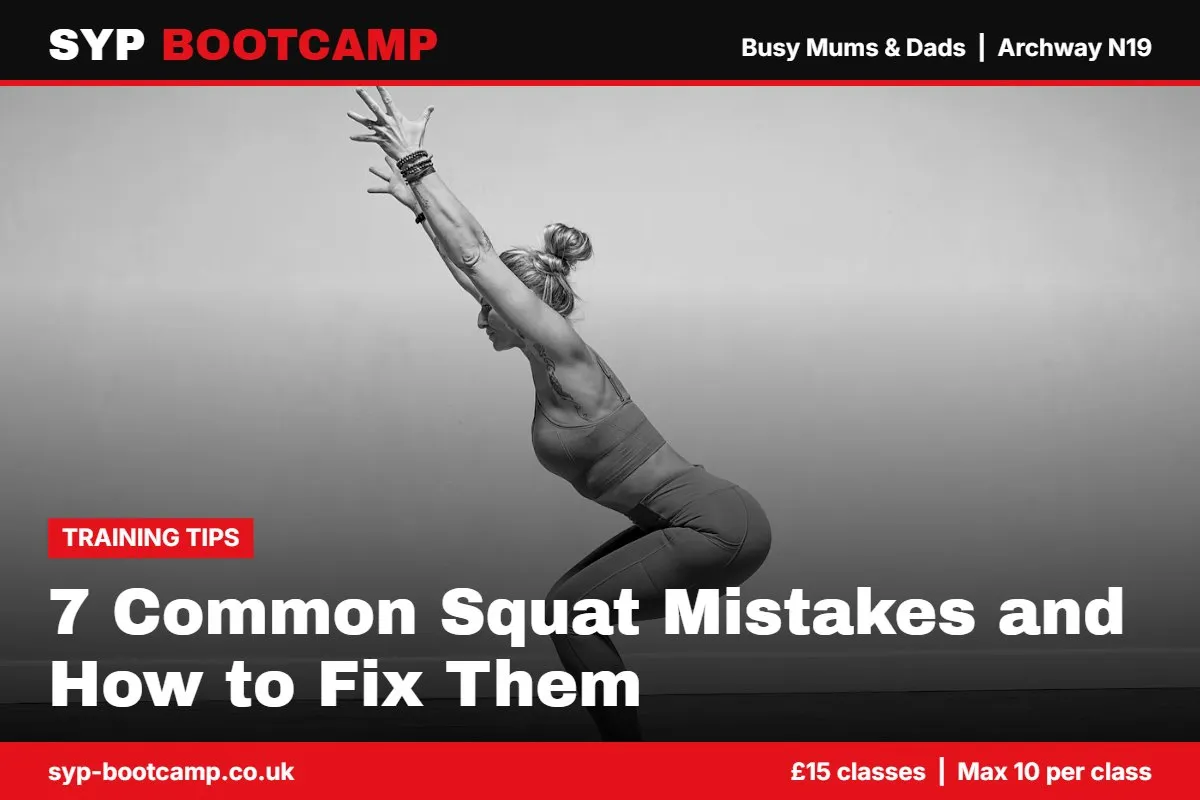
7 Common Squat Mistakes and How to Fix Them
You probably squat dozens of times a day without thinking about it. Picking up toys, lifting a toddler out of the bath, getting off the sofa. So when you start doing squats as an exercise, it feels like it should be easy. Then your knees ache, your lower back complains or you just cannot feel it in your legs. Nine times out of ten, it comes down to a handful of common squat mistakes. Here are the ones I see most often in my classes in Archway, and the simple fixes.
First, a quick picture of a good squat
Before we pick things apart, here is what we are aiming for:
- Feet roughly hip to shoulder width, toes turned out a little.
- Weight spread across the whole foot, heel, big toe and little toe.
- Hips go back and down at the same time as the knees bend.
- Knees travel in line with your toes.
- Chest proud, spine long, eyes looking ahead.
- Go as low as you can while keeping all of the above, then stand up by pushing the floor away.
If you want the full step-by-step, read my guide on how to squat properly. This post is about troubleshooting.
7 common squat mistakes and how to fix them
1. Knees caving inwards
On the way up, the knees drift towards each other. It is very common, especially when legs get tired.
Fix: think “spread the floor” with your feet, as if you are trying to rip the mat apart. Put a light mini band just above your knees for a few practice sets so you feel the outer hips working. Slow the lowering down to 3 seconds.
2. Heels lifting off the floor
Your weight rocks forward onto your toes, which puts more stress on the knees and makes you wobble.
Fix: keep your toes light. Try wiggling them at the bottom of the squat. If tight ankles are the issue, place your heels on a small weight plate or a thin book for now, and work on calf stretches after training.
3. Bending only at the knees
The knees shoot forward and the hips barely move. Your thighs burn, your bottom does nothing.
Fix: squat to a chair or bench. Reach your hips back as if you are sitting down on it, lightly touch, then stand. This teaches the hips and knees to work together.
4. Leaning too far forward
The chest drops towards the floor and the squat becomes more of a back exercise.
Fix: hold a light weight at your chest (a goblet squat). The weight in front acts as a counterbalance and makes it easier to stay upright. My goblet squat guide walks you through it.
5. Rounding the lower back at the bottom
At the very bottom, the pelvis tucks under and the lower back rounds. Some of this is normal and harmless without weight, but with a load it is worth controlling.
Fix: only go as deep as you can while keeping your back long. Brace your stomach gently, as if someone is about to poke you, before each rep. Depth will improve with practice.
6. Holding your breath the wrong way, or not breathing at all
Some people hold their breath for a whole set and go red in the face.
Fix: for bodyweight and light squats, breathe in on the way down and out on the way up. If you have high blood pressure or a pelvic floor concern, avoid long breath holds and check with your GP or physio about what is right for you.
7. Rushing the reps
Dropping fast and bouncing out of the bottom feels efficient but hides every other mistake on this list.
Fix: use a 3-1-1 tempo. Three seconds down, one second pause, one second up. It is humbling, and it works.
A 10-minute squat fix session
Do this two or three times a week before your normal workout, or on its own on a busy evening:
- Box squat to a chair: 2 sets of 8, light touch, no plonking down.
- Squat with a 3-second lowering: 2 sets of 6.
- Goblet squat with a light kettlebell, dumbbell or a full water bottle: 2 sets of 8.
- Bottom-of-squat hold: 2 holds of 20 seconds, holding a door frame if needed, gently pushing your knees out with your elbows.
Rest 45 to 60 seconds between sets. Film one set from the side on your phone. It is the fastest way to see what is actually happening. Once this feels solid, you can start adding a little weight or trying new variations to keep things interesting.
When it is not just your technique
Sometimes squat mistakes are your body telling you something. If you have pain in your knees, hips or back that is sharp, gets worse each session or lingers into the next day, stop squatting for now and get it checked by your GP or a physio. The NHS physical activity guidelines for adults also advise speaking to your GP before starting if you have a medical condition or have not exercised for a while. If your knees are already grumpy, my post on knee-friendly workouts has gentler options.
How a small class helps you fix your squat
It is very hard to see your own form. In a group of 10 or fewer, I can watch every rep and give you one simple cue at a time. That is often all it takes. In my SYP Built To Last functional strength class for over-35s, squats are a staple, with an easier and harder option for every level, from sitting to a box upwards.
FAQs
Should your knees go over your toes when squatting?
For most people, yes, it is fine and normal for the knees to travel forward over the toes, as long as your heels stay down and the knees track in line with your feet. If it causes pain, reduce depth and get it checked.
Why do I feel squats in my knees and not my glutes?
Usually because the hips are not moving back enough and the knees are doing all the work. Practise box squats, sitting your hips back, and slow the lowering down.
How deep should a beginner squat?
As deep as you can while keeping your heels down, knees in line and back long. For many beginners that is roughly thighs parallel to the floor, or a chair height. Depth comes with practice.
Why do my heels come up when I squat?
Most often it is tight ankles or weight shifting to the toes. Raise your heels slightly on a plate or book for now and stretch your calves after training.
Book your first class
Want someone to watch your squat and fix it in person? SYP Bootcamp runs 45-minute small-group classes in Archway N19, max 10 people, £15 a class, with easier and harder options for every exercise. Book your £15 class here, or call or WhatsApp me on 07301 512215. If you would prefer one-to-one attention on your technique, have a look at private personal training in Archway.
About the author
Artem Olekhnovych is a personal trainer in Archway and the founder of SYP Fitness and SYP Bootcamp. He has coached clients in Archway, Highgate and across North London for over 10 years, and runs small-group bootcamp classes for busy mums and dads. Read reviews from his 1-1 clients.
