Goblet Squat Guide: Form, Weight and a 4-Week Plan
If I could only teach a busy parent one strength exercise, it would probably be the goblet squat. You need one weight, a square metre of floor and about ten minutes. It strengthens your legs, bottom and core, it is kind to most backs, and it is very hard to do badly because the weight in front of you nudges you into a good position. Here is everything you need to get started, whether you train at home after bedtime or in a gym.
What is a goblet squat?
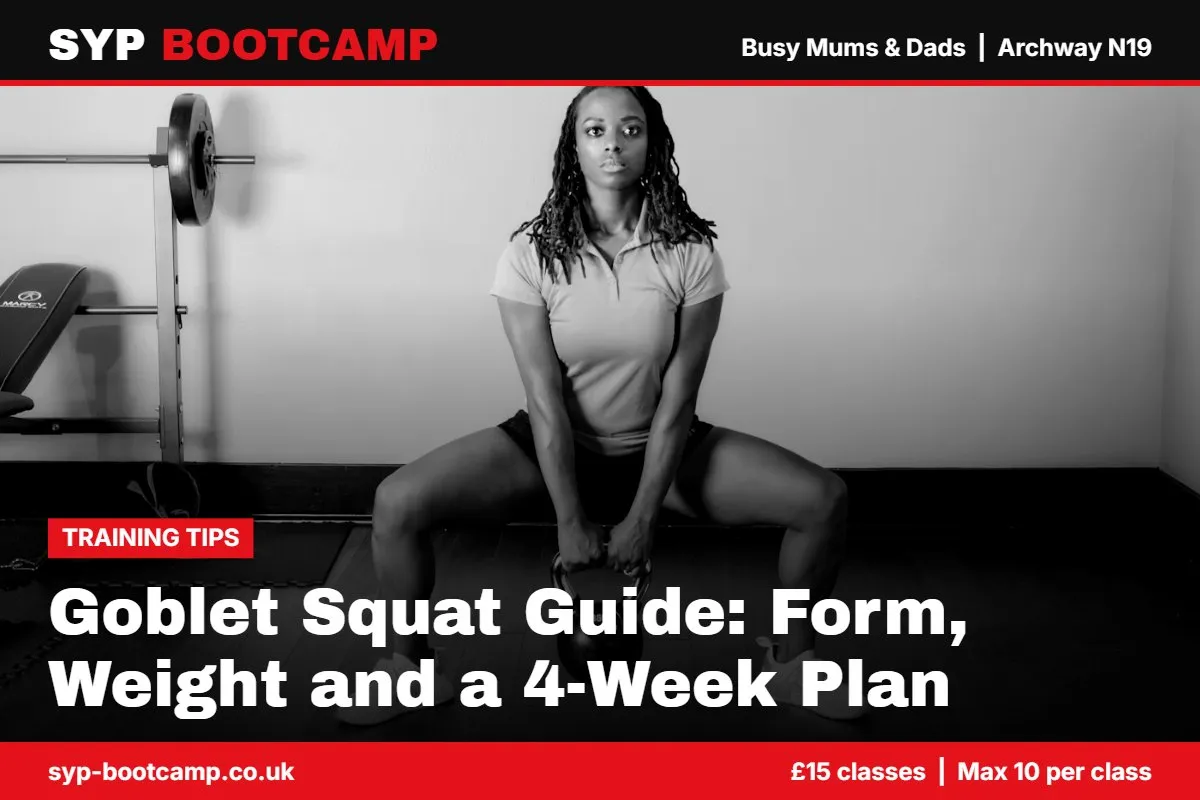
It is a squat where you hold a single kettlebell or dumbbell close to your chest with both hands, like holding a big goblet (or, more realistically, a heavy toddler). The name comes from that hand position.
Because the weight sits in front of you, it acts as a counterbalance. That makes it easier to keep your chest up and sit your hips down between your knees, rather than tipping forward. For many beginners it actually feels easier than a bodyweight squat, which surprises people.
Muscles worked
- Thighs (quads), the main movers.
- Glutes, especially as you drive up from the bottom.
- Adductors (inner thighs).
- Core and upper back, which work hard to keep you upright with the weight in front.
- Arms and grip, holding the weight in place.
How to do a goblet squat, step by step
- Pick up the weight safely. Squat down to lift it off the floor, do not round over and yank it up.
- Hold it high. With a kettlebell, hold the handle by the “horns” (the sides), bell facing down, close to your breastbone. With a dumbbell, hold one end vertically with both palms underneath the top plate.
- Set your feet. About shoulder width or a bit wider, toes turned out slightly.
- Brace. Take a breath in, tighten your stomach gently and keep your elbows tucked under the weight.
- Lower. Sit your hips down between your heels, letting your knees travel forward and out in line with your toes. Take about 2 to 3 seconds.
- Find your depth. Go as low as you can while your heels stay down and your back stays long. Many people can let their elbows lightly brush the inside of their knees.
- Stand up. Push the floor away through your whole foot and breathe out as you rise. Squeeze your bottom at the top without leaning back.
If your knees cave in, your heels lift or you tip forwards, have a read of my post on common squat mistakes for simple fixes.
How heavy should your goblet squat be?
Lighter than you think, to begin with. As a rough guide for complete beginners:
- Many women start well with 4 to 8kg.
- Many men start well with 8 to 12kg.
Those are starting points, not rules. Strength varies enormously, and plenty of mums who carry toddlers all day are stronger than they think. Choose a weight you can lift for 10 controlled reps with 2 or 3 reps left in the tank. If you are buying your first kettlebell, my guide on what weight kettlebell to start with goes into more detail.
No weights at home? A full 2-litre water bottle is about 2kg, and a backpack with a few books in it, held against your chest, works as well.
A simple 4-week plan
Do this twice a week, ideally with 2 days in between. Rest 60 to 90 seconds between sets.
- Week 1: 3 sets of 8 with a light weight, 3 seconds down.
- Week 2: 3 sets of 10, same weight.
- Week 3: 3 sets of 12, same weight, with a 1-second pause at the bottom.
- Week 4: go up to the next weight and drop back to 3 sets of 8.
This “add reps, then add weight” pattern is called double progression, and it is the simplest way to keep getting stronger without guessing.
Easier and harder versions
Easier
- Goblet box squat: squat to a chair or bench and lightly touch it before standing. Great if depth or confidence is an issue.
- Heels raised: put your heels on a small plate if tight ankles stop you going down.
Harder
- Pause goblet squat: hold the bottom for 3 seconds.
- 1.5 rep goblet squat: go down, come halfway up, go down again, then stand. That is one rep.
- Goblet split squat: same hold, one leg forward and one back.
For more ideas on how to build up from basic squats, see my guide to squat variations for beginners.
Safety first
Stop if you feel sharp pain in your knees, hips or back. If you have a known injury, are pregnant, or have recently had a baby, check with your GP or physio before adding weight. The NHS advises speaking to your GP before starting exercise if you have a medical condition or have not been active for a while (see the NHS physical activity guidelines).
Where a bootcamp class helps
Squats come up again and again in my SYP Bootcamp classes in Archway. Having a coach right there to adjust your elbows, depth or foot position for the first few sessions saves weeks of guesswork. Our SYP Built To Last functional strength class focuses on squatting, hinging, pushing and carrying to build the kind of strength that makes everyday parent life easier.
FAQs
Are goblet squats better than back squats?
For beginners, often yes. They are easier to learn, need less equipment and put less load through the spine. Back squats let you lift heavier later on, but the goblet squat is a brilliant foundation.
Do goblet squats work your glutes?
Yes. Your glutes work hard as you push up from the bottom, especially if you squat to a good depth and drive through your whole foot.
How many goblet squats should I do?
For most people, 3 sets of 8 to 12 reps, twice a week, is a great start. When 3 sets of 12 feel controlled, move up to a slightly heavier weight.
Can I do goblet squats with a dumbbell?
Yes. Hold one end of the dumbbell vertically with both hands cupped under the top plate, close to your chest. It works just as well as a kettlebell.
Book your first class
Want to learn the goblet squat with a coach watching? SYP Bootcamp runs 45-minute small-group classes in Archway N19, max 10 people, £15 a class, and every move has an easier and a harder option. Book your £15 class here or call or WhatsApp me on 07301 512215. For women who would like a strength plan tailored to them, take a look at personal training for women in Archway.
About the author
Artem Olekhnovych is a personal trainer in Archway and the founder of SYP Fitness and SYP Bootcamp. He has coached clients in Archway, Highgate and across North London for over 10 years, and runs small-group bootcamp classes for busy mums and dads. Read reviews from his 1-1 clients.
