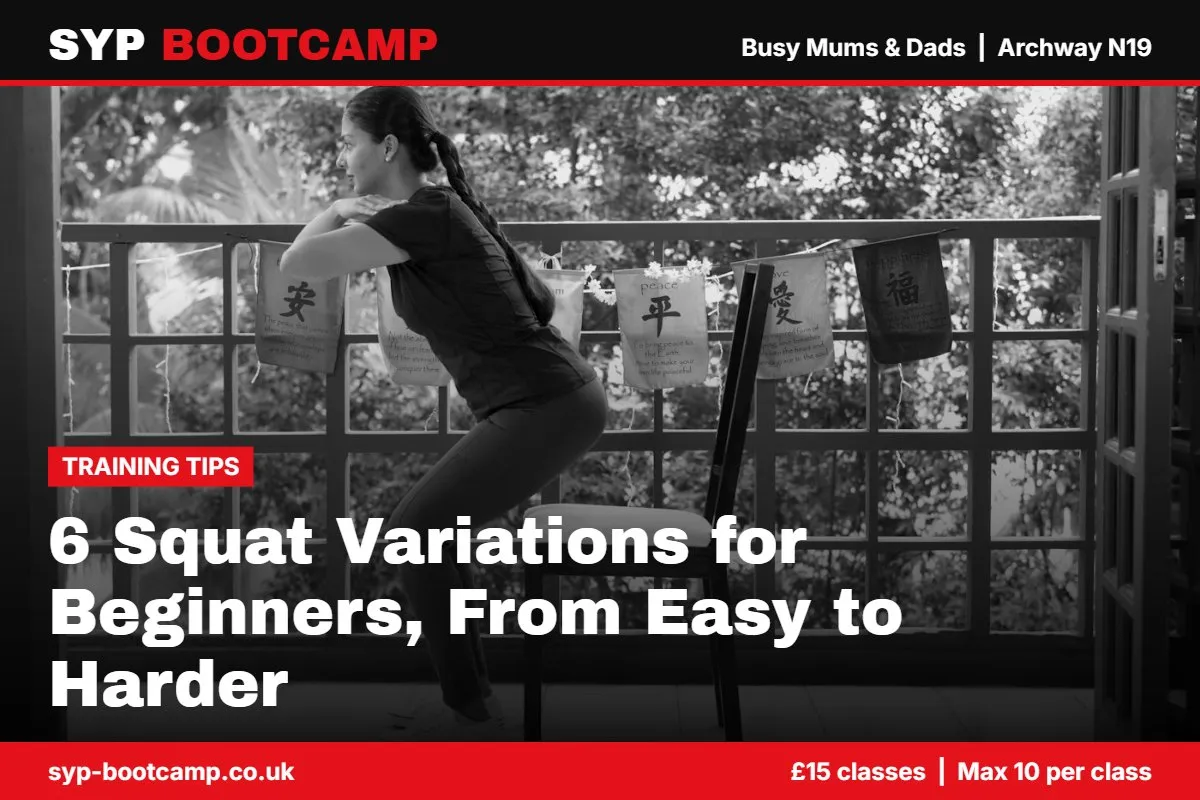
6 Squat Variations for Beginners, From Easy to Harder
“I can’t do squats, they hurt my knees.” I hear this from parents almost every week. Usually the problem is not squatting itself, it is the wrong squat for where they are right now. The good news is that there are plenty of squat variations, from sitting to a chair to holding a kettlebell, and at least one of them will suit your body, your space and your energy levels today. Here is how I take complete beginners from “I can’t” to confident squatters, step by step.
Why bother with squats at all?
Squats train your thighs, bottom and core at the same time, and they copy something you do all day as a parent: getting down to the floor and back up again. Picking up a car seat, lifting a sleeping child out of the car, getting up off the playroom floor. Stronger legs make all of that easier, and the NHS physical activity guidelines recommend muscle-strengthening activities on at least 2 days a week. A few sets of squats ticks a big part of that box.
If you have a knee, hip or back problem, or you are pregnant or postnatal, check with your GP or a physio before starting. Stop any variation that causes sharp pain.
6 squat variations for beginners, easiest first
Work through these in order. Move to the next one when you can do 3 sets of 10 reps with good control and no pain.
1. Sit-to-stand
Sit on a sturdy chair, feet flat and hip width apart. Lean forward slightly and stand up without using your hands. Sit back down slowly, taking 3 seconds. This is a real squat, just with a safety net.
Try: 3 sets of 8 to 10.
2. Supported squat
Hold the edge of a kitchen worktop, a door frame or a sturdy rail. Sit your hips back and down as far as feels comfortable, then stand up. Your hands take some of the weight and help you balance, so you can go a bit deeper.
Try: 3 sets of 10.
3. Box squat
Same as sit-to-stand, but now you only lightly touch the chair with your bottom and stand straight back up. No resting, no plonking. This teaches control at the bottom.
Try: 3 sets of 10, with a 2-second lowering.
4. Bodyweight squat
No chair. Feet about shoulder width, toes slightly turned out, arms out in front for balance. Sit back and down, keep your heels on the floor and your knees in line with your toes, then push the floor away to stand. If something feels off, my post on common squat mistakes will help you spot it.
Try: 3 sets of 10 to 15.
5. Goblet squat
Hold a kettlebell, dumbbell or even a bag of shopping against your chest with both hands. The weight in front actually makes it easier to stay upright, which is why I love this as the first loaded squat. Start light, around 4 to 8kg for most beginners. Read the full goblet squat guide for set-up and progressions.
Try: 3 sets of 8 to 12.
6. Split squat
Step one foot forward and one back, like a long stride. Keeping your chest tall, lower your back knee towards the floor, then push back up. Hold a wall for balance at first. This builds strength one leg at a time and shows up any imbalance between sides.
Try: 2 to 3 sets of 8 per leg.
Other squat variations to try later
Once you are comfortable with the six above, you can add variety:
- Sumo squat: wider stance, toes turned out more. Feels good for many people with long legs and targets the inner thighs a bit more.
- Pause squat: hold the bottom position for 2 to 3 seconds. Great for control and confidence at depth.
- Tempo squat: 4 seconds down, 1 second up. Makes light weights feel much heavier.
- Squat to calf raise: stand up from the squat and rise onto your toes. A nice extra for balance.
I would leave jump squats until you have a solid base, and skip them altogether if you have pelvic floor symptoms like leaking, heaviness or dragging. Talk to your GP or a women’s health physio about those first.
A simple 3-week squat plan
Do this on 2 or 3 days a week, with at least a day between sessions.
- Week 1: sit-to-stand 3 x 10, supported squat 2 x 10.
- Week 2: box squat 3 x 10, bodyweight squat 2 x 8.
- Week 3: bodyweight squat 3 x 12, light goblet squat 2 x 8.
If a week feels too hard, repeat it. There is no prize for rushing. Before each session, do a short warm up: a few minutes of marching, some hip circles and 5 slow practice squats.
How squats fit into a bootcamp class
In my small-group classes, squats come up in almost every session, but never in a one-size-fits-all way. If you are new, you might be doing box squats while the person next to you does goblet squats, and that is exactly how it should be. Our SYP Built To Last functional strength class is built around these everyday movements for people over 35, with a variation for every level. If lunges are your next challenge, have a look at my lunges for beginners guide too.
FAQs
Which squat is best for beginners?
For most beginners, the box squat to a chair is the best starting point, because it gives you a target depth and a safety net. Once that feels easy, move to bodyweight squats and then goblet squats.
How many squats should a beginner do?
Start with 2 to 3 sets of 8 to 10 reps, 2 or 3 times a week. Quality matters more than quantity. Add reps or a light weight once all sets feel controlled.
Are squats good for losing belly fat?
No exercise burns fat from one specific area. Squats build strength in big muscles, which is valuable, but changes in body fat come from your overall activity, food, sleep and consistency over time.
Is it OK to do squats every day?
Gentle bodyweight squats every day are fine for most people. If you are using weights or feeling sore, leave a day between harder sessions so your legs can recover.
Book your first class
Not sure which squat is right for you? Come and find out in person. SYP Bootcamp runs 45-minute small-group classes in Archway N19 for busy parents, max 10 people, £15 a class, all fitness levels. Book your £15 class here or call or WhatsApp me on 07301 512215. If you want a longer-term plan built around you, see the SYP Fitness transformation programme.
About the author
Artem Olekhnovych is a personal trainer in Archway and the founder of SYP Fitness and SYP Bootcamp. He has coached clients in Archway, Highgate and across North London for over 10 years, and runs small-group bootcamp classes for busy mums and dads. Read reviews from his 1-1 clients.
