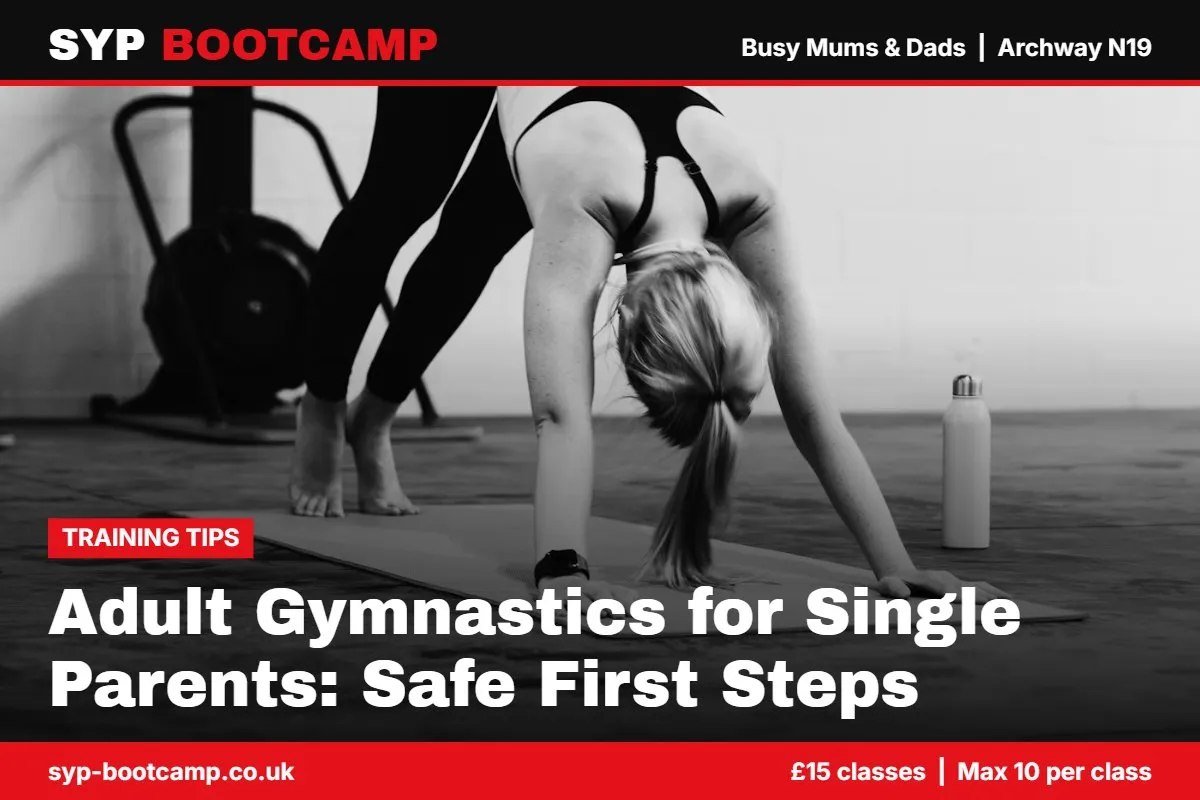
Adult Gymnastics for Single Parents: Safe First Steps
Maybe it started at the leisure centre. Your daughter was cartwheeling across the mat in her gymnastics class and you thought, “I used to be able to do that.” Or maybe you never could, and part of you has always wanted to. Then the sensible voice kicks in: you are 38, you have a stiff back, and you are the only adult at home. Who starts gymnastics now? Plenty of people, as it happens. Adult gymnastics for single parents is less about flips and more about control, flexibility and feeling at home in your body again. You just have to start at the right level.
I coach parents in Archway every week, and I am honest with them: you will not be doing back handsprings by Easter. But you can learn to roll, balance, hold your body weight and move with more freedom than you have had in years. Here is how I would start.
Can you really start gymnastics as an adult?
Yes, with the right expectations. Compared with kids, adults are heavier relative to our strength, our wrists are less used to bearing weight, and fear is a bigger factor. We also have advantages. Adults listen, follow a plan and understand why a drill matters.
What adult gymnastics looks like for most beginners:
- Holding positions (hollow body, plank, support holds)
- Rolling safely (rocking, side rolls, then forward rolls if suitable)
- Balance work (single-leg, on a line, later on a low beam)
- Flexibility (hips, hamstrings, shoulders and wrists)
- Upside-down preparation (wall walks, then handstand drills)
If you have a history of neck, back, wrist or shoulder injury, or any medical condition, check with your GP or a physio before you start. The NHS flexibility exercises page is a good gentle starting point if you are very stiff.
Flexibility prep: 10 minutes before anything else
Gymnastics shapes need range. Before trying any skill, spend a few weeks on this short routine, four or five times a week. It fits nicely after bedtime on the living room floor.
- Wrist warm-up: on hands and knees, gently rock forward and back over your hands, then turn fingers sideways and backwards. 10 rocks each position. Wrists take a lot of load in gymnastics and they are often the first thing to complain.
- Cat-cow: 10 slow reps to loosen the spine.
- Deep squat hold: hold a door frame and sit down into a squat, 3 rounds of 30 seconds.
- Pike stretch: sit with legs straight, reach towards your shins with a long back, 3 rounds of 30 seconds. Bend your knees as much as you need.
- Half-kneeling hip flexor stretch: 30 seconds each side.
- Shoulder opener: hands on a kitchen counter, walk back and let your chest sink, 3 rounds of 20 seconds.
For hips in particular, my 10-minute mobility routine works well alongside this.
Adult gymnastics for single parents: the safe basics
Do these on a soft surface: a thick rug, a folded duvet or a cheap exercise mat. Move the coffee table. Do them when you are fresh, not at the end of a long day.
1. Hollow body hold
Lie on your back, press your lower back into the floor, lift your head and shoulders slightly and raise your legs. Start with knees bent and arms by your sides. Hold 3 rounds of 15 to 20 seconds. This is the foundation shape of almost every gymnastics skill. If your lower back lifts off the floor, bend your knees more.
2. Rocking and rolling
Sit with knees hugged in, round your back and rock back to your shoulder blades and up again. 10 rocks. Then try side rolls: lie stretched out like a pencil and roll across the mat in a straight line, 4 lengths. Only move on to a forward roll if your neck is healthy, and always tuck your chin to your chest so the roll goes over your upper back, not your head. If you feel any neck pressure, stop. Plenty of adults skip forward rolls entirely and that is fine.
3. Support hold
Sit between two sturdy chairs or on the edge of the sofa, hands beside your hips, and press down to lift your bottom slightly, arms straight. Hold 3 rounds of 10 seconds. Feet can stay on the floor to help.
4. Balance line
Put a strip of masking tape on the floor and walk along it heel to toe, arms out. Then try it backwards. Then pause on one leg every third step. Kids love this one too.
5. Wall walk (only when the above feels easy)
Start in a plank with feet against the wall, then walk your feet a little way up the wall while walking your hands back. Go only as high as you can control. Hold 5 seconds and walk down. This is the first step towards a handstand, and my post on handstands for single parents takes it further.
A simple session: flexibility routine, then 2 to 3 rounds of the five basics. Twenty-five minutes, twice a week.
Doing it with kids in the house
This is one sport where children are a help, not a distraction. They are usually more flexible than you and delighted to show you how it is done. A few tips:
- Set a “mat rule”: one person on the mat at a time, so nobody lands on anybody.
- Take turns being the coach. Let your child call out “hold, hold, and rest”.
- If they attend a gym club, ask their coach about adult classes. Some clubs run them.
Where bootcamp fits in
Gymnastics skills need strength underneath them: a strong trunk, shoulders that can hold you up and hips that move freely. That is exactly what my small-group classes build. The SYP Unlock hip and back mobility class is a great partner to your home gymnastics practice, and plank and core work runs through every session. For more on core, see my plank progression for beginners. And for the bigger picture of training as a solo parent, start with my single parent fitness guide.
FAQs
Is it too late to learn gymnastics at 40?
No. You can learn balance, holds, rolls and flexibility at any age. High-impact tumbling is a different story and needs proper coaching and a good base of strength first.
Can adults learn to do the splits?
Many can get much closer with regular, gentle stretching over months. Some people’s hip structure limits how far they go. Never force a stretch into pain.
Do I need a gym to start adult gymnastics?
For the basics, no. A mat, a wall and some floor space are enough. For tumbling, vaulting or bars, find a club with qualified coaches and proper matting.
How often should a beginner practise?
Two or three short sessions a week, with flexibility work on most days, is plenty to see progress without sore wrists.
Book your first class
Want a stronger, more mobile base for your gymnastics? Come along to SYP Bootcamp. Classes are 45 minutes, small groups of max 10, £15 a class, indoors in a church hall in Archway N19, with an easier and harder option for every move. Book my £15 class here or call or WhatsApp me on 07301 512215. If you would like to see how 1-1 coaching works for skill goals like this, have a look at how personal training with SYP Fitness works.
About the author
Artem Olekhnovych is a personal trainer in Archway and the founder of SYP Fitness and SYP Bootcamp. He has coached clients in Archway, Highgate and across North London for over 10 years, and runs small-group bootcamp classes for busy mums and dads. Read reviews from his 1-1 clients.
