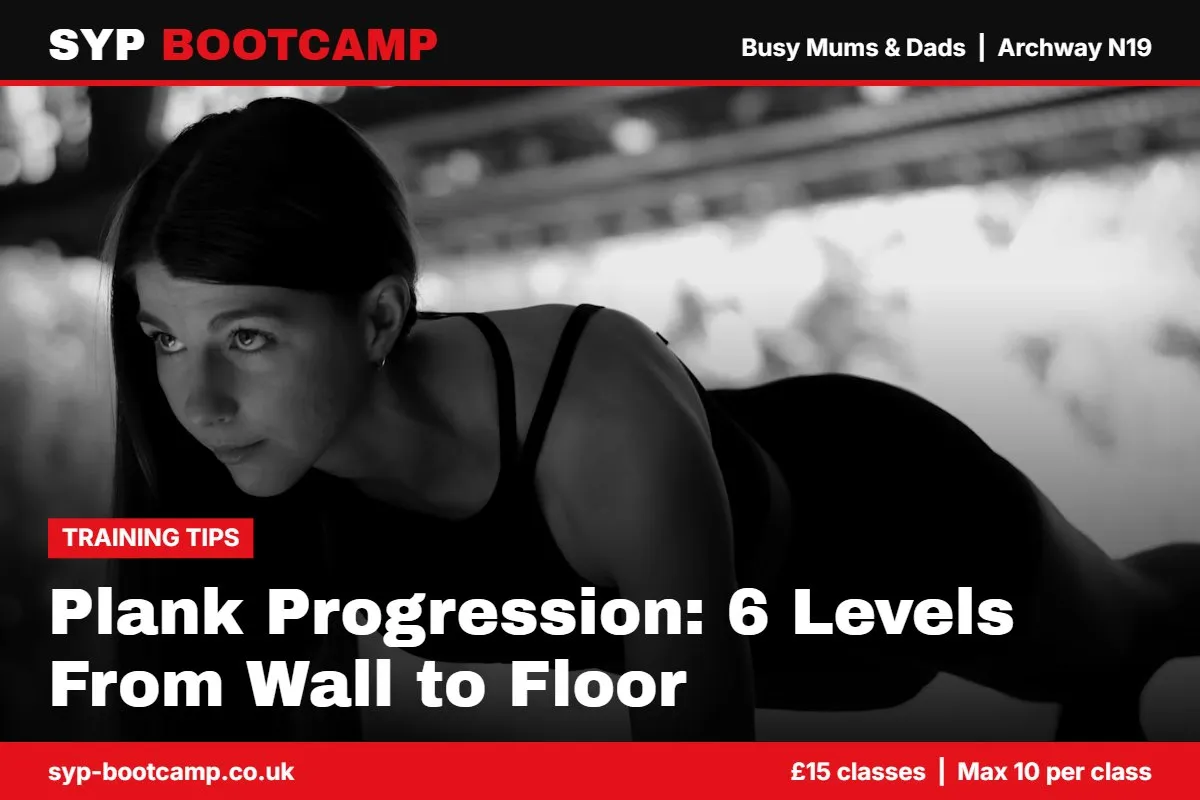
Plank Progression: 6 Levels From Wall to Floor
Most parents I meet have tried planking at some point. They get down on the floor, hold on for dear life, shake for 30 seconds, feel it in their lower back and decide planks are not for them. The problem is not the plank. It is starting at the wrong level. A sensible plank progression takes you from an easy, comfortable version to a strong full plank in small steps, and it teaches your core to do its real job: keeping your spine steady while you lift kids, car seats and shopping bags all day.
What a good plank actually looks like
Before you worry about time, get the position right. A good plank is:
- Elbows under shoulders (or hands under shoulders for a high plank).
- A straight line from your head through your hips to your heels or knees. No sagging hips, no bum in the air.
- Ribs tucked down and bum gently squeezed. This takes the strain off your lower back.
- Breathing. Slow breaths in and out. If you have to hold your breath, the level is too hard.
If you feel it in your lower back rather than your tummy, the plank has stopped working for you. End the set, or drop back a level.
Check before you start
If you have had a baby, get your postnatal check first, usually around 6 to 8 weeks after the birth, and ask your GP before returning to exercise. Full planks put a lot of pressure through the tummy, so if you have a gap down the middle of your tummy muscles or notice doming along the midline when you plank, see a GP or women’s health physio and start with the early levels below. My post on the tummy gap after pregnancy explains more. If you have back pain or a shoulder injury, check with a GP or physio first.
The 6-level plank progression
Work at one level until you can hold good form for 3 sets of 30 to 40 seconds, then move up. Rest 30 to 60 seconds between sets.
Level 1: wall plank
Stand an arm’s length from a wall, forearms on the wall at shoulder height, and walk your feet back until your body is at a slight angle. Brace and breathe. Perfect if you are brand new or getting back into exercise after a baby (once you have been cleared).
Level 2: incline plank on a worktop or sofa
Forearms or hands on a kitchen worktop or the arm of a sturdy sofa, feet back, body straight. The lower the surface, the harder it gets.
Level 3: kneeling plank on the floor
Forearms on the floor, knees down, body straight from head to knees. This is where most beginners start on the floor.
Level 4: full forearm plank
Up on your toes. Start with short holds, like 3 sets of 15 to 20 seconds, and build up. It is fine to do part of a set on your toes and finish it on your knees.
Level 5: plank with movement
Once you can hold a full plank for 40 seconds with good form, add movement, which is closer to real life:
- Plank shoulder taps: from a high plank, tap one shoulder with the opposite hand, slowly, without your hips swaying. 8 to 10 each side.
- Plank leg lifts: lift one foot a few centimetres off the floor for 2 seconds, then swap. 6 to 8 each side.
Level 6: side plank and walkouts
- Side plank: start on your knees, then progress to your feet. Hold 15 to 30 seconds each side. Great for the muscles that steady you when you carry a toddler on one hip.
- Plank walkouts: from standing, walk your hands out to a high plank, hold for a breath, walk back. 5 to 8 reps.
A 10-minute plank progression session
Do this 2 or 3 times a week. It works well after the kids are in bed, and it is quiet.
- Dead bugs: 2 sets of 8 each side (lie on your back, slowly lower opposite arm and leg)
- Plank at your current level: 3 sets of 20 to 40 seconds
- Glute bridges: 2 sets of 12
- Side plank at your level: 2 sets of 15 to 20 seconds each side
- Bird dogs: 2 sets of 8 each side
Want more ideas? See my core exercises for beginners.
Why longer is not always better
You may have seen people boasting about 5-minute planks. For most busy parents, that is not a good use of time. Once you can hold a solid plank for 40 to 60 seconds, you will get more from harder versions and movement-based core work than from simply holding longer. Several short, high-quality sets beat one long, shaky one. Strong core muscles also help you lift and carry better, which is useful if you have read my post on back pain from lifting kids.
Where a bootcamp class fits
Planks are easy to get wrong when nobody is watching. In my classes I check every plank and move people up or down a level on the spot. Core work features in every session, and the SYP Built To Last class puts a lot of focus on the kind of core strength that protects your back in everyday life.
FAQs
How long should a beginner hold a plank?
Start with 3 sets of 10 to 20 seconds at a level where you can keep good form, such as a kneeling or incline plank. Build up to 30 to 40 seconds before moving to a harder level.
Is a 1-minute plank good?
Yes, holding a full plank with good form for 60 seconds shows decent core strength. Beyond that, most people get more from harder plank variations than from holding longer.
Should I plank every day?
You can do a little core work most days, but 2 to 3 focused sessions a week is enough for progress. Rest days help your muscles recover and adapt.
Why does my lower back hurt when I plank?
Usually your hips are sagging or the level is too hard. Tuck your ribs down, squeeze your bum and drop back to a kneeling or incline plank. If pain continues, see a GP or physio.
Book your first class
If you want your plank progression checked by a coach, come to a class. SYP Bootcamp runs 45-minute small-group classes in a weatherproof church hall in Archway N19, max 10 people, £15 a class, with options for every level. Book your £15 class here or call or WhatsApp me on 07301 512215. If you are working around an old injury or back pain, look at injury-safe personal training at SYP Fitness.
About the author
Artem Olekhnovych is a personal trainer in Archway and the founder of SYP Fitness and SYP Bootcamp. He has coached clients in Archway, Highgate and across North London for over 10 years, and runs small-group bootcamp classes for busy mums and dads. Read reviews from his 1-1 clients.
