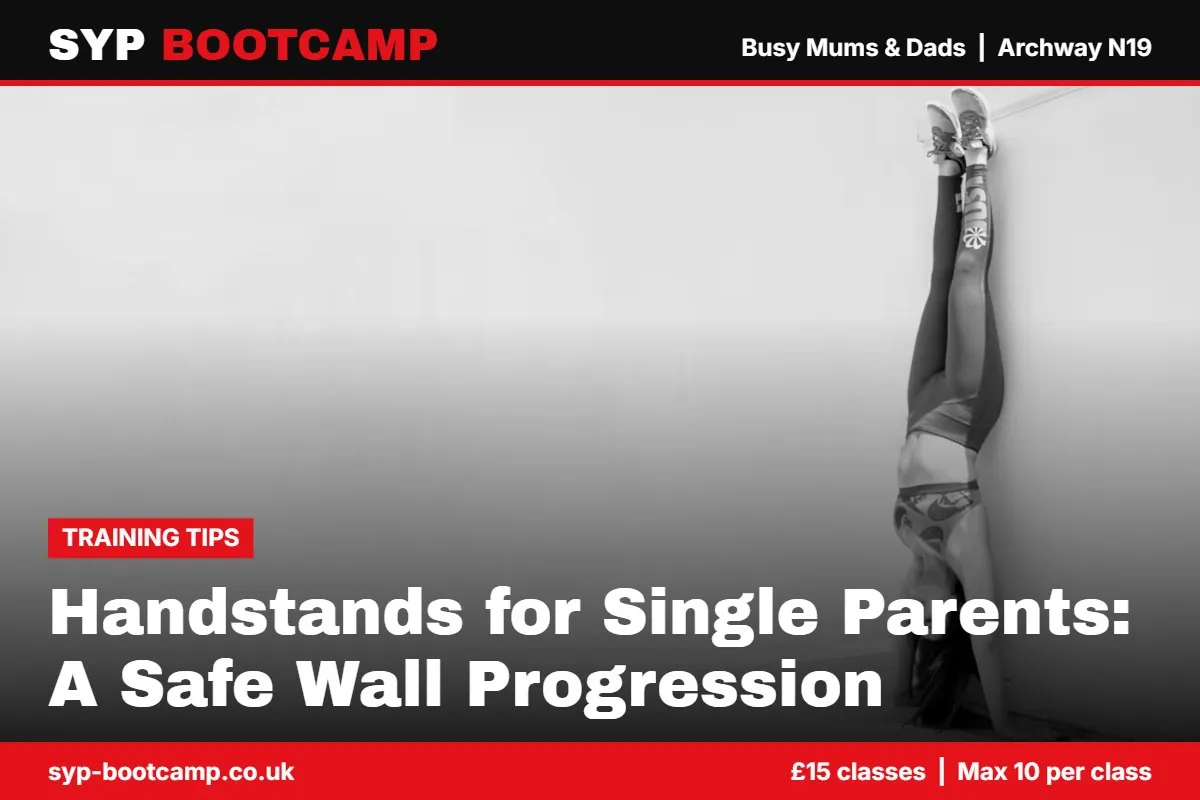
Handstands for Single Parents: A Safe Wall Progression
Your kids are doing cartwheels across the living room and one of them says, “Bet you can’t do a handstand.” It has been 25 years. You are not sure your wrists still work. This post is for that moment. Handstands for single parents is a practical, wall-supported progression you can practise in the hallway in 10 minutes, with proper wrist prep, a clear set of stages and honest advice on when to skip it altogether.
I teach handstand drills to adults in Archway who have not been upside down since school. The ones who get there safely all have one thing in common: they spend more time on the boring prep than on the fun bit.
Why bother with handstands?
- Shoulder strength. Holding your body weight overhead builds strong, stable shoulders.
- Core control. Your trunk has to stay tight to keep you straight.
- Something to do with the kids. Handstands are a shared challenge. They can coach you, and you can spot them.
- Confidence. There is something about getting upside down as an adult that makes the rest of the week feel easier.
But be honest with yourself: a handstand is an advanced move. If you cannot yet hold a 30-second plank or do a few push-ups, start there. My plank progression for beginners and push-up progression are better first steps.
When to skip handstands
Being upside down raises the pressure in your head and eyes and loads your wrists and shoulders. Check with your GP or physio before trying if you:
- have high blood pressure, a heart condition or a history of stroke (see the NHS guidance on high blood pressure)
- have glaucoma, a detached retina or other eye conditions
- are pregnant or within the first months after birth
- have a wrist, elbow, shoulder or neck injury, or get dizzy easily
If any of those apply, the plank and wall-walk prep in Stage 1 may still be fine with approval, but stop short of going fully upside down.
Wrist prep: do this every time
Your wrists are not used to carrying your whole body. Two minutes of prep makes a big difference.
- Wrist circles: 10 each way, fingers laced.
- Kneeling palm rocks: on all fours, hands flat, gently rock your weight forward over your fingers and back. 10 reps.
- Reverse palm stretch: on all fours, turn your hands so fingers point at your knees, back of the hands on the floor, and gently lean back. 20 seconds.
- Finger pulses: on all fours, lift your palms so only your fingers are pressed into the floor, then lower. 10 reps.
The hallway progression: handstands for single parents
Clear the hallway: no toys, no shoes, no pets. Put a folded duvet or cushions on the floor near the wall. Practise when you have full attention, not while also stirring dinner.
Stage 1: Downward dog shoulder press (week 1 to 2)
From a downward dog (hips high, hands and feet on floor), bend your elbows and lower your head towards the floor between your hands, then press back up. 3 sets of 5. This builds the overhead pressing strength you need.
Stage 2: Feet on the stairs pike hold (weeks 2 to 4)
Stand with your back to the bottom stair. Put your hands on the floor and walk your feet up onto the first or second step, hips high, so your body makes an upside-down L. Push the floor away. Hold 15 to 20 seconds, 3 times. A sturdy sofa works too.
Stage 3: Wall walk, part way (weeks 3 to 6)
Start in a plank with your feet against the wall. Walk your feet a little way up the wall while walking your hands a little closer. Only go as far as you feel in control, then walk back down. 3 to 5 reps. Stop when your hands are around a metre from the wall at first.
Stage 4: Chest-to-wall handstand hold (weeks 6 onwards)
Walk all the way up until your hands are 10 to 20 centimetres from the wall and your body is nearly vertical, tummy facing the wall. Squeeze your bum, tuck your ribs in and push the floor away. Hold 10 seconds, build to 30. Walk down with control.
How to bail out: in the chest-to-wall version, just walk your feet down. If you ever lose it, tuck your chin and turn to the side like a cartwheel. Practise this on the duvet before you need it.
Why chest-to-wall instead of kicking up with your back to the wall? It teaches a straighter line, and you cannot over-kick and crash. It is the safer option for adults.
A 10-minute session
- 2 minutes wrist prep
- 2 rounds of 5 downward dog presses
- 3 holds at your current stage
- 30-second plank, 30-second hollow hold on your back
- Shake out your wrists and stretch your chest
Do it two or three times a week. You can practise after bedtime when the hallway is quiet, or with the kids watching and cheering. For other ways to make exercise work as a solo parent, see my single parent fitness guide.
Stop if it hurts
Feeling your shoulders and core working is normal. Wrist pain that lingers, neck pain, a headache, pressure behind the eyes or dizziness are signs to stop and come down. Rest, and go back a stage next time.
Where a bootcamp class fits
In my classes, I teach the building blocks behind a handstand: overhead shoulder strength, core control and wrist and hip mobility, with an easier and harder option for each. My SYP Unlock mobility class is a gentle place to build the wrist and shoulder range that handstands need.
FAQs
Can adults learn to do a handstand?
Yes, many adults can with a wall and a patient progression. It usually takes weeks or months, not days, and some people with health conditions should skip it.
How do I stop my wrists hurting in a handstand?
Warm up your wrists every time, spread your fingers wide and press through your fingertips. Build time upside down gradually and stop if pain lasts.
Is it safe to do handstands with high blood pressure?
Going upside down is often not advised. Check with your GP before trying any inverted move.
How long should a beginner hold a handstand against a wall?
Start with 10 seconds and build to around 30 seconds over several weeks, keeping good form.
Book your first class
Want help building the strength behind a handstand, without the risk of crashing into the radiator? SYP Bootcamp runs 45-minute small-group classes in Archway N19, indoors in a church hall, max 10 people, £15 a class, all fitness levels. Book my £15 class or call or WhatsApp me on 07301 512215. If you have an old wrist, shoulder or back problem, injury-safe personal training at SYP Fitness works around it.
About the author
Artem Olekhnovych is a personal trainer in Archway and the founder of SYP Fitness and SYP Bootcamp. He has coached clients in Archway, Highgate and across North London for over 10 years, and runs small-group bootcamp classes for busy mums and dads. Read reviews from his 1-1 clients.
