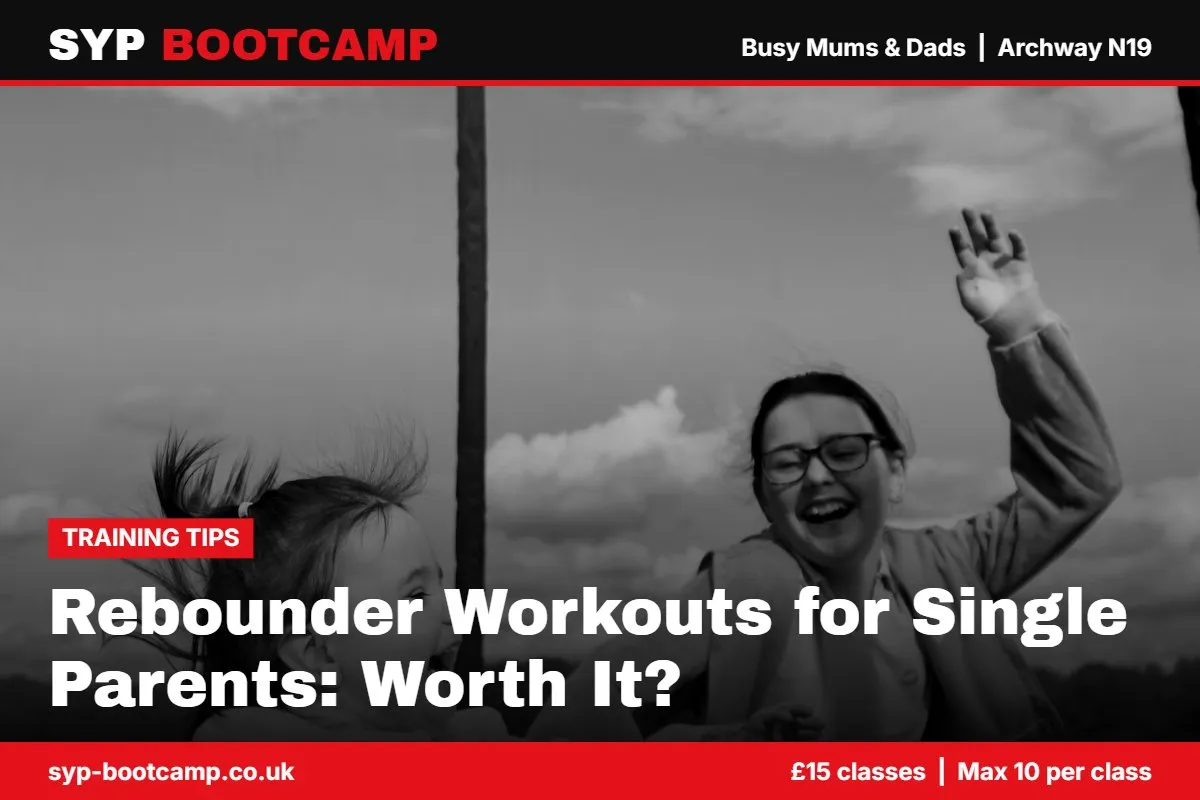
Rebounder Workouts for Single Parents: Worth It?
Mini trampolines are everywhere on social media at the moment, usually with someone bouncing happily in a spotless living room. If you are raising kids alone, the appeal is obvious: a workout you can do at home, in short bursts, without leaving the house. But are rebounder workouts for single parents actually worth the money and the floor space? And what about your pelvic floor, and the kids who will definitely want a go? Here is my honest take as a coach, plus a 15-minute routine if you decide to buy one.
Is a rebounder worth buying?
Reasons it might be:
- It is fun. Bouncing is playful, and fun is a big deal when motivation is low.
- It raises your heart rate quickly. Even gentle bouncing gets you warm and breathing harder.
- It is softer than jumping on the floor. The mat absorbs some of the landing, which many people find easier on knees and ankles than star jumps on a hard floor.
- It lives at home. No travel, no babysitter.
Reasons to think twice:
- Space. You need clear room around it and enough ceiling height. A small flat may not work.
- Noise. Spring rebounders can squeak and thud. Bungee-cord models are usually quieter, which matters if you have downstairs neighbours.
- Pelvic floor. Bouncing puts repeated pressure on your pelvic floor. If you have any leaking or heaviness, this may not be the right tool yet (see below).
- It does not build much strength. It is cardio and coordination, not a replacement for strength training.
What to look for if you buy one
- A stability bar. A handle you can hold makes it far safer for beginners and anyone with balance concerns.
- Bungee cords rather than springs. Softer bounce, less noise, and no springs for little fingers.
- A clear maximum user weight that is well above your own.
- Folding legs so you can store it behind a sofa or under a bed.
Rebounder workouts for single parents: pelvic floor first
This is the bit most social media posts skip. Bouncing is a high-repetition, impact-style movement, even if it feels soft. Leaking when you jump, cough or laugh is common after having children, but it is not something you have to put up with. The NHS has helpful advice on ways to stop leaks, including pelvic floor exercises.
- If you have leaking, a feeling of heaviness or dragging, or pelvic pain, stop bouncing and speak to your GP. They can refer you to a pelvic health physio.
- If you have had a baby, have your postnatal check with your GP (usually around 6 to 8 weeks) first. Impact exercise usually comes later than that, once you have rebuilt strength. The NHS page on your 6-week postnatal check explains more.
- Start with “health bounce” only, where your feet barely leave the mat. Breathe out on effort and avoid holding your breath.
My post on pelvic floor and exercise classes goes into this in more detail.
Keeping kids safe around a rebounder
Your children will see it as a toy. A few house rules help:
- One person on it at a time. Most injuries on trampolines happen when two people bounce together.
- No bouncing when you are on it. Little ones should stay well clear while you exercise, not run around the edge.
- No flips or tricks. A mini trampoline is not built for them.
- Fold it away or stand it up out of reach when you are not using it.
Kids do love doing a few supervised bounces with you holding their hands, and that can be a fun part of the routine. For the bigger question of trampolining as exercise for families, see my post on whether trampolining is good exercise.
A 15-minute rebounder routine
Hold the stability bar for anything that feels wobbly. Keep your knees soft, land through the whole foot and stay in the centre of the mat.
Warm-up (3 minutes)
- 1 minute: health bounce, feet barely leaving the mat, arms relaxed.
- 1 minute: march on the mat, lifting knees gently.
- 1 minute: health bounce with arm circles.
Main block (3 rounds, 3 minutes each)
- 45 seconds jog on the spot. Light, quick feet.
- 15 seconds easy bounce.
- 45 seconds side-to-side twist. Feet together, gently twist your hips left and right as you bounce, shoulders facing forward.
- 15 seconds easy bounce.
- 45 seconds half jacks. Step or bounce feet in and out (no need to raise arms if holding the bar).
- 15 seconds easy bounce.
Off the rebounder: cool-down (3 minutes)
- 10 slow bodyweight squats beside the rebounder.
- Calf stretch, 30 seconds each leg.
- 5 slow breaths with gentle pelvic floor squeezes.
Too much? Do one round, then cool down. Too easy? Add a fourth round, but do not chase height. Bigger bounces mean more load on your pelvic floor and joints without much extra benefit.
Where a bootcamp class fits
A rebounder can be a fun cardio top-up, but on its own it will not make you strong. Strong legs, glutes and core actually help your pelvic floor and joints cope with impact, which is why I would always pair bouncing with two strength sessions a week. In my classes every exercise has a low-impact option, so nobody has to jump if they do not want to. If you want quiet, low-impact home ideas for days you cannot get out, my post on a quiet workout for flats is a good one, and my hub on single parent fitness has plenty more.
FAQs
Is rebounding better than running?
It is lower impact on your joints than running on pavements and easier to do at home. Running gets you outside and builds more endurance. Both are good, and neither replaces strength training.
How long should a rebounder workout be?
Start with 10 to 15 minutes, two or three times a week. Build up gradually if you enjoy it and have no pelvic floor symptoms.
Can I use a rebounder if I leak when I jump?
Leaking is a sign to pause bouncing and get help. Speak to your GP about a pelvic health physio referral and focus on strength and pelvic floor work in the meantime.
Are rebounders safe for kids?
With supervision, one child at a time and no tricks, short bounces can be fine. Never leave young children alone with one.
Book your first class
Want strength work that makes all your bouncing feel better? SYP Bootcamp runs 45-minute small-group classes in a church hall in Archway N19, indoors and weatherproof, max 10 people at £15 a class. Book your £15 class here or call or WhatsApp me on 07301 512215. If you would prefer a quiet, 1-1 space to rebuild strength, take a look at private personal training in Archway.
About the author
Artem Olekhnovych is a personal trainer in Archway and the founder of SYP Fitness and SYP Bootcamp. He has coached clients in Archway, Highgate and across North London for over 10 years, and runs small-group bootcamp classes for busy mums and dads. Read reviews from his 1-1 clients.
