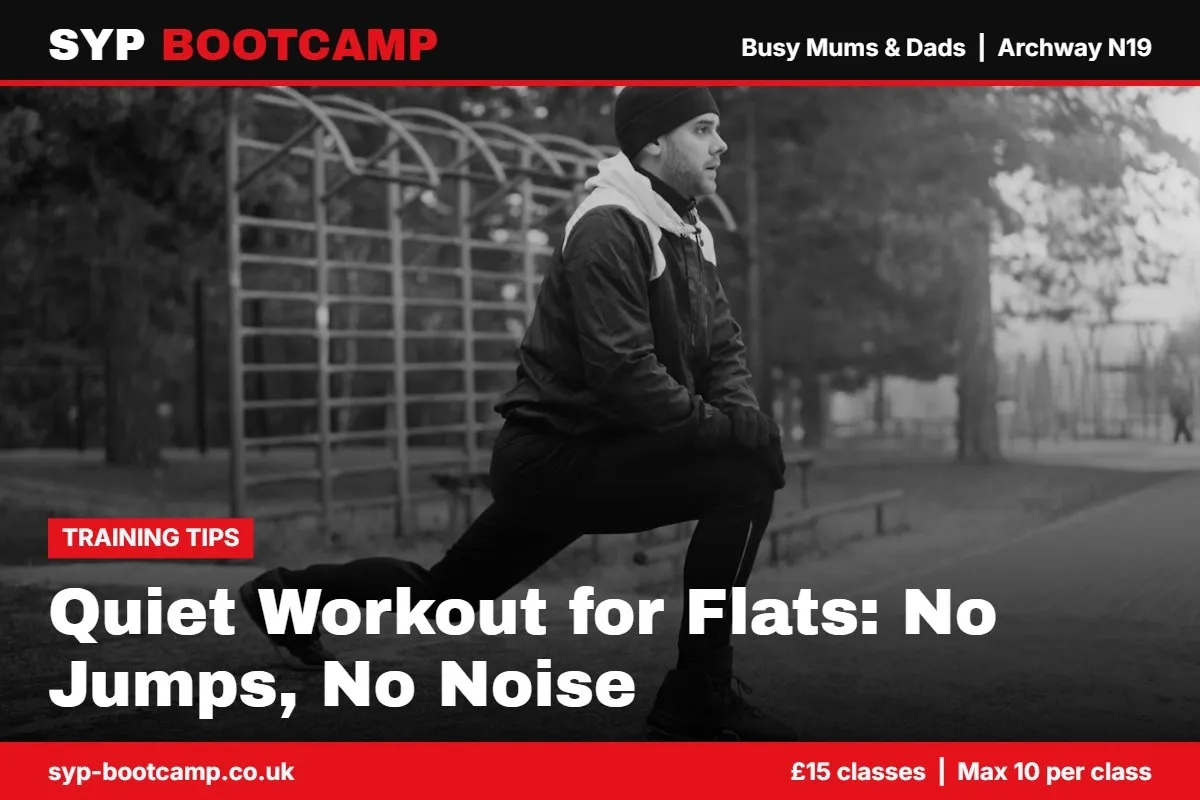
Quiet Workout for Flats: No Jumps, No Noise
It is 9pm. The kids are finally asleep in the next room, the neighbours below have a newborn, and the floorboards creak if you so much as look at them. You want to train, but every workout video starts with jumping jacks. This quiet workout for flats is built for exactly that moment. No jumps, no dropped weights, no thumping, and still a session that leaves your legs shaking.
The secret is not doing less. It is changing how you do each rep: slowing it down, pausing, and holding positions under tension. Done properly, quiet training is some of the hardest work I give clients.
Three tools that make quiet training hard
1. Tempo
Tempo means controlling the speed of each rep. A 3-1-1 tempo on a squat means 3 seconds lowering, 1 second pause at the bottom, 1 second standing up. A set of 8 slow squats like this is often harder than 20 fast ones. Your muscles spend longer working, and there is no momentum to help.
2. Pauses
Stopping at the hardest point of a rep, like the bottom of a lunge or halfway down a push-up, takes away the bounce. It builds strength in the position where most people are weakest.
3. Holds
Isometric holds, like a wall sit or a plank, keep the muscle working without moving at all. They are completely silent. You can make them harder simply by holding longer or picking a tougher angle.
Set up your space
- Use a mat or folded duvet. It softens knees and hands, and dulls any sound.
- Train over a joist or near a wall. Floors creak most in the middle of the room.
- Bare feet or soft socks. Trainers are louder on wooden floors. Socks can slip, so bare feet are best for lunges.
- Put weights down on the mat, never the floor. Or skip weights and use a resistance band, which makes no sound at all.
The quiet workout for flats (about 25 minutes)
Warm-up (4 minutes): slow march on the spot, shoulder rolls, cat-cow on hands and knees, 10 slow bodyweight good mornings, 5 slow squats.
Block 1: Legs (3 rounds)
- Tempo squat: 8 reps at 4 seconds down, 2-second pause, 1 second up.
- Wall sit: 30 to 45 seconds. Thighs as close to parallel as is comfortable.
- Rest 45 seconds.
Block 2: Upper body (3 rounds)
- Slow push-up: 6 to 8 reps, 3 seconds down, pause 1 second just above the floor. Hands on the sofa or kitchen worktop if needed.
- Band row or towel row: 12 reps with a 2-second squeeze at the back. Loop a resistance band round a solid table leg, or wrap a towel round a closed, sturdy door handle and lean back.
- Rest 45 seconds.
Block 3: Glutes and hamstrings (3 rounds)
- Single-leg glute bridge: 8 each side, 3-second hold at the top.
- Split squat hold: 20 seconds each side at the bottom of a lunge, back knee hovering just off the floor.
- Rest 45 seconds.
Block 4: Core finisher (2 rounds)
- Dead bug: 8 slow reps each side, lower back pressed gently into the floor.
- Side plank: 20 seconds each side.
- Hollow hold or tuck hold: 20 seconds.
Cool down: child’s pose, hip flexor stretch and chest stretch, 30 seconds each.
How to progress without making noise
- Add one rep per set each week.
- Slow the lowering phase by one more second.
- Hold the pause twice as long.
- Move to harder versions: split squats instead of squats, feet-elevated bridges, push-ups from the floor.
- Add a resistance band. My resistance band workout at home has more silent band exercises.
If you love holds, the isometric exercises guide takes the idea further.
What about cardio in a flat?
You do not need jumping for your heart to work hard. Fast marching with big arm swings, step-ups on the bottom stair (if you have communal stairs, check nobody minds), shadow boxing and fast step jacks all work. For a full jump-free interval session, see my low impact HIIT post.
A word on breath and blood pressure
Long holds tempt people to hold their breath. Keep breathing steadily throughout. If you have high blood pressure or a heart condition, check with your GP before doing hard isometric work. The NHS page on high blood pressure is a good starting point.
Where bootcamp fits
Home sessions like this are great on the nights you cannot get out. But it helps to have a place where you can move freely, make noise and have someone check your form. Our classes are indoors in a church hall in Archway, so you can jump, punch pads and slam balls without worrying about the neighbours. If you have been holding a lot of stress in all evening, our SYP Release stress relief class is the loud opposite of this workout.
FAQs
How can I work out without disturbing my downstairs neighbours?
Skip jumps, train on a mat near a wall, use slow tempo and holds, and put weights down on soft surfaces only.
Can you build muscle with quiet workouts?
Yes. Slow tempo, pauses and holds create a lot of muscle tension. Keep making them harder over time and you will get stronger.
What time is too late to exercise in a flat?
There is no fixed rule, but a quiet session like this should be fine most evenings. If you share thin floors, a quick chat with your neighbours goes a long way.
Will a late workout affect my sleep?
Gentle to moderate sessions are fine for most people. Very intense work right before bed can make it harder to drop off, so finish with the cool down.
Book your first class
When you are ready to train somewhere you can make some noise, come and join me. SYP Bootcamp runs 45-minute classes in Archway N19, max 10 people, £15 a class, all levels welcome. Book your £15 class here or call or WhatsApp me on 07301 512215. If getting out is the hard part, you can also try online coaching with SYP Fitness and train at home with a plan built for you.
About the author
Artem Olekhnovych is a personal trainer in Archway and the founder of SYP Fitness and SYP Bootcamp. He has coached clients in Archway, Highgate and across North London for over 10 years, and runs small-group bootcamp classes for busy mums and dads. Read reviews from his 1-1 clients.
