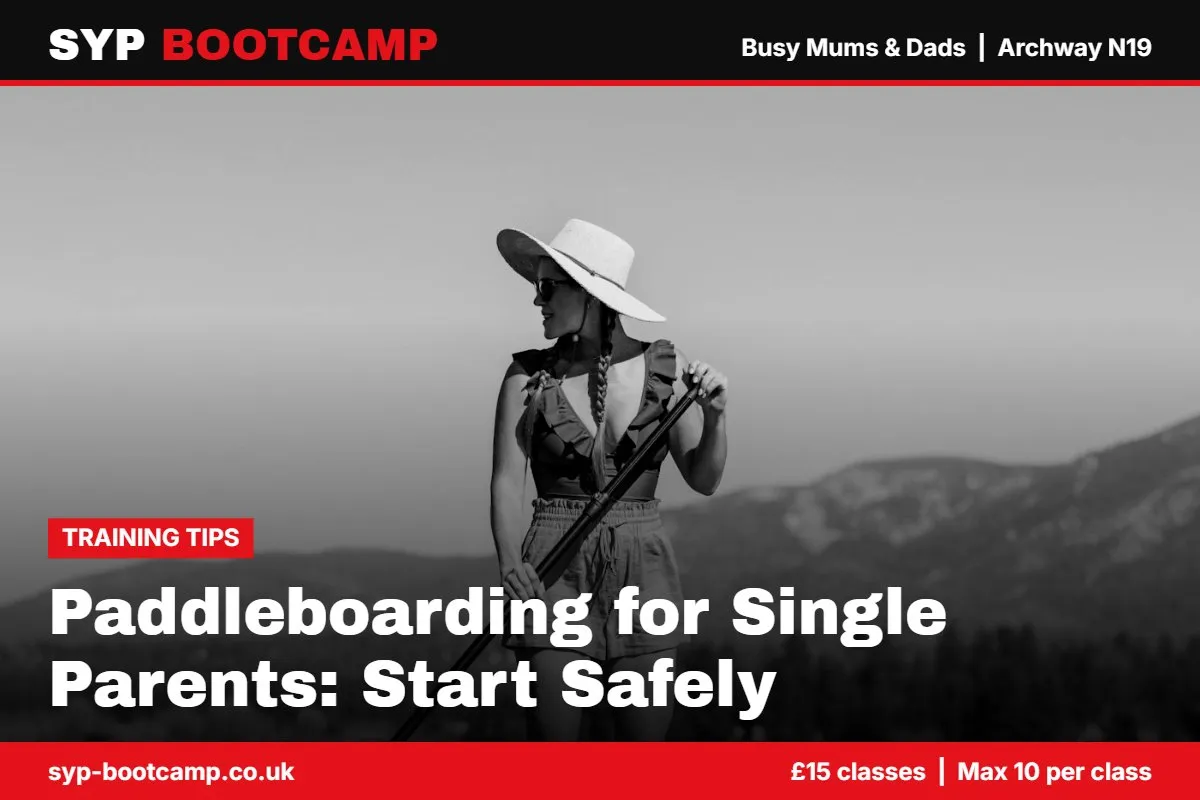
Paddleboarding for Single Parents: Start Safely
Stand-up paddleboarding looks peaceful from the bank. Someone gliding across calm water, no screens, no lunchboxes, no “Mum, where’s my PE kit?” For a lot of solo parents, that hour of quiet is the real appeal. Paddleboarding for single parents can be a wonderful reset, either on your own or as a summer adventure with older children. But it asks more of your body than it looks, and water safety is not optional. So let’s cover what it involves, how to start safely, and a land-based balance routine you can do in your living room before you ever get wet.
I am a fitness coach, not a paddleboard instructor, so please learn on the water from a qualified instructor. What I can help with is getting your body ready, so your first lesson is about enjoying it rather than wobbling and falling in every thirty seconds.
What paddleboarding asks of your body
When clients come back from their first session, they are always surprised where they ache. Here is what is actually going on:
- Feet and ankles are making hundreds of tiny adjustments to keep you balanced on a moving surface.
- Thighs and glutes work constantly, because you paddle with soft, slightly bent knees.
- Core muscles transfer the power from your paddle stroke and stop you toppling as you reach forward.
- Upper back and shoulders pull the paddle through the water, stroke after stroke.
- Grip tires surprisingly quickly if you hold the paddle too tightly.
It is low impact, which is great for joints, but it is a full-body balance workout.
Paddleboarding for single parents: getting started safely
- Book a lesson first. Look for a watersports centre or lake with qualified instructors and beginner tasters. They will provide the board, paddle, buoyancy aid and usually a wetsuit.
- Always wear a buoyancy aid and a leash attached to the board, whatever your swimming ability. The Met Office paddling safety tips, written with Paddle UK, explain why and which kit you need.
- Check the weather and wind. Offshore winds can blow you away from the shore surprisingly fast. If in doubt, do not go out.
- Tell someone where you are and when you expect to be back, and carry a phone in a waterproof pouch.
- Cold water is serious. UK water is cold for most of the year. Dress for falling in, not for the air temperature.
- Be able to swim. If you are not confident in the water, start with swimming lessons. My post on swimming for single parents covers how to fit that in.
Bringing the kids
Many centres run family or junior sessions with age limits, and children must wear buoyancy aids. As a solo parent, you cannot watch two children in the water and paddle your own board safely, so I would suggest booking an instructor-led session where staff are on the water too. Younger children are usually best left with family or a friend for your first few sessions while you learn.
A land-based balance routine to prepare
Do this three times a week for three or four weeks before your first lesson. You need a cushion or folded towel and a broom or mop handle. It takes about 15 minutes and is quiet enough for after bedtime.
Stage 1: steady feet (5 minutes)
- Single-leg stand: 30 seconds each leg, eyes open. Harder: eyes closed or standing on a cushion.
- Heel-to-toe walk: walk a straight line along the hallway, heel touching toe. 3 lengths.
- Calf raises: 2 sets of 12, slow.
Stage 2: paddle stance (5 minutes)
- Soft-knee hold on a cushion: stand on a folded towel or cushion with feet hip-width apart, knees slightly bent, as on a board. Hold for 45 seconds, 3 times.
- Weight shifts: in the same stance, rock gently side to side and front to back, staying in control. 30 seconds, 3 times.
- Kneel to stand: from kneeling on all fours, come up to a squat and then stand, without using your hands on furniture. This is the move you need to get up on a board. 2 sets of 5. Easier: hold a chair.
Stage 3: paddle power (5 minutes)
- Broomstick paddle strokes: stand in your paddle stance, reach forward with the broom handle, “plant” it near your toes and draw it back to your hip, rotating your trunk. 15 strokes each side.
- Bird dogs: on hands and knees, reach opposite arm and leg. 3 sets of 8 each side.
- Side plank: on knees or feet, 20 to 30 seconds each side, 2 sets.
The NHS has a helpful page on balance exercises if you want more ideas, and my post on balance exercises for adults goes further. If you have back pain, are pregnant or recently had a baby, have balance problems or a heart condition, check with your GP or a physio before trying a new water sport. After having a baby, most women have a GP check around 6 to 8 weeks before returning to exercise, as the NHS explains in its guide to your 6-week postnatal check.
Your first lesson: what to expect
- You will usually start kneeling on the board. That is normal and sensible.
- Look at the horizon, not your feet.
- Soft knees, feet hip-width, on either side of the board’s handle.
- You will probably fall in at some point. Fall away from the board, sideways, into deep water.
- Your legs will shake. That is the balance training working.
Where a bootcamp class fits
Paddleboarding is a summer treat for most of us. The balance, leg strength and core control it needs can be built all year round indoors. That is what we do in SYP Bootcamp: single-leg work, trunk stability and upper back strength, with an easier and harder version of everything. Our SYP Unlock hip and back mobility class is especially useful if your lower back gets tired standing for long periods. For more on fitting exercise around solo parenting, read my guide to single parent fitness.
FAQs
Is paddleboarding hard for beginners?
Most beginners can stand up within their first lesson, especially on calm, flat water. Balance improves quickly with practice, and preparing on land helps.
Is paddleboarding a good workout?
Yes. It works your legs, core, back and shoulders and challenges your balance, while being low impact on your joints. How hard it feels depends on wind, distance and pace.
Do you need to be able to swim to paddleboard?
You should be able to swim confidently, and you should always wear a buoyancy aid and a leash, whatever your swimming ability.
Can kids go paddleboarding?
Many centres run junior or family sessions with age limits. Children should always wear a buoyancy aid and be closely supervised by qualified staff.
Book your first class
Build the balance and core strength for summer on the water with us. SYP Bootcamp runs 45-minute small-group classes in Archway N19, with a maximum of 10 people and £15 a class. We train indoors in a church hall, so it is weatherproof all year, and all levels are welcome. Book your £15 class here or call or WhatsApp me on 07301 512215. If you would prefer a programme designed around you, have a look at my personal training for women in Archway at SYP Fitness.
About the author
Artem Olekhnovych is a personal trainer in Archway and the founder of SYP Fitness and SYP Bootcamp. He has coached clients in Archway, Highgate and across North London for over 10 years, and runs small-group bootcamp classes for busy mums and dads. Read reviews from his 1-1 clients.
