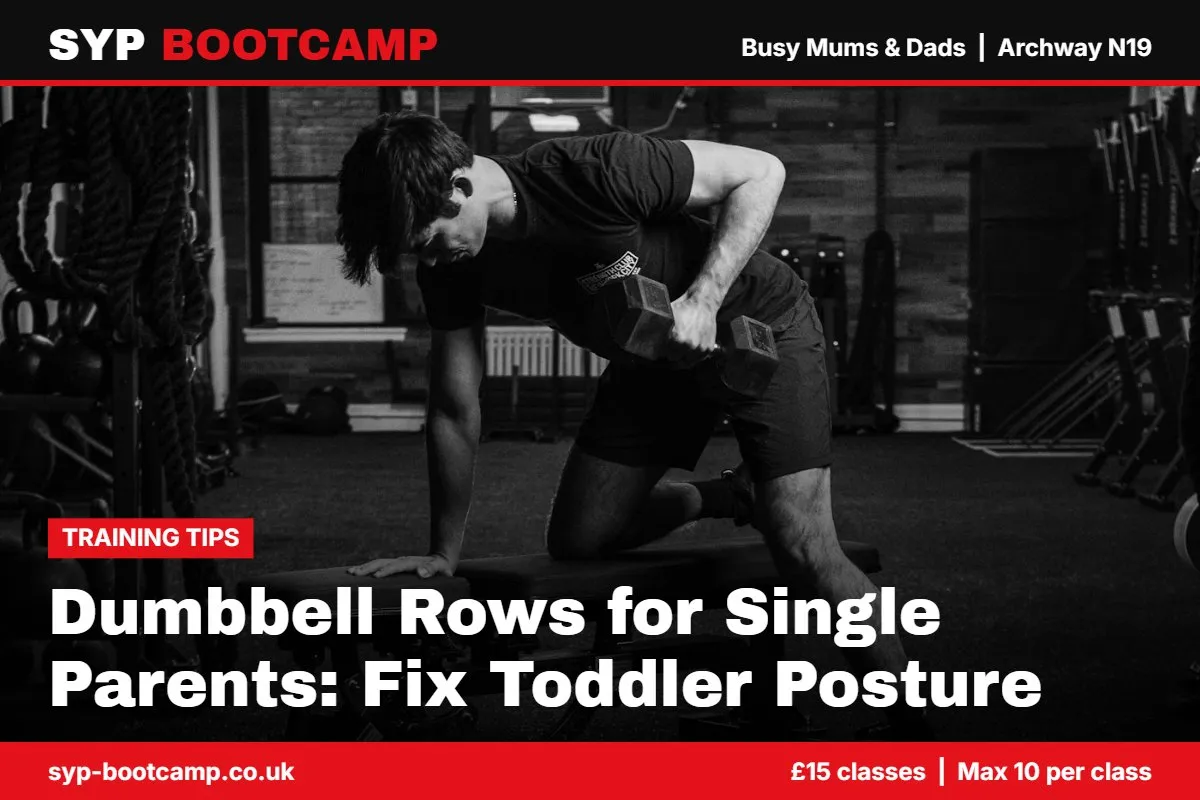
Dumbbell Rows for Single Parents: Fix Toddler Posture
Carry a toddler on one hip for a few years and your body starts to keep the shape. One shoulder sits higher, your upper back rounds, your head drifts forward, and by the end of the day there is a knot between your shoulder blades that no amount of rolling your neck will shift. I see it in almost every parent I coach in Archway, and single parents get it worst because there is nobody to swap the carrying with. The fix I reach for first is simple: dumbbell rows for single parents, using nothing more than a kitchen chair and one dumbbell.
Why rows help a “carrying” posture
Most of what parents do happens in front of the body: lifting, holding, feeding, pushing the buggy, typing. The muscles at the front, chest and front shoulders, get used constantly. The muscles that pull your shoulder blades back and keep your upper back upright, your lats, rhomboids and middle traps, get far less work.
A row trains exactly those back muscles. Done one arm at a time, it also helps even out the left-right imbalance that comes from always carrying on the same hip. It will not magically fix posture on its own, nothing does, but a stronger back makes upright positions easier to hold.
Set-up: a chair and one dumbbell
You need:
- A sturdy chair, sofa arm or the bottom stair. It must not slide or tip.
- One dumbbell or kettlebell. 4 to 10 kg suits most beginners. No weights? A full 5 litre water bottle (about 5 kg) or a heavy shopping bag works fine.
How to do dumbbell rows for single parents
- Stand side-on to the chair. Put your left hand on the seat. Step your right foot back so you are in a staggered stance, knees soft.
- Hinge forward from the hips until your back is flat, roughly at a 45 degree angle or lower. Head in line with your spine, eyes on the floor just in front of the chair.
- Hold the dumbbell in your right hand, arm hanging straight below your shoulder.
- Start with the shoulder blade. Before your elbow bends, draw your shoulder blade back towards your spine a little.
- Pull your elbow towards your back pocket, not straight up to your ear. The weight should travel towards your hip.
- Pause for 1 second at the top and feel the squeeze under your armpit and between your shoulder blades.
- Lower slowly for 2 to 3 seconds, letting the shoulder blade stretch forward at the bottom.
Swap sides after each set. Start with the side you carry your child on less, so your weaker side gets your freshest effort.
Mistakes that stop it working
- Twisting the body to heave the weight up. Keep your chest facing the floor.
- Shrugging. If your neck tightens, your shoulder is creeping up to your ear. Keep it long.
- Curling the weight with your bicep. Think “elbow back”, not “hand up”.
- Rounding your lower back. If it rounds, raise your chest or use a higher surface like the kitchen worktop.
The posture plan: 3 weeks to a stronger back
Three short sessions a week, about 15 minutes each. Do it after bedtime or during nap time.
Week 1: learn the pattern
- Chair-supported dumbbell row: 3 x 10 each side, light
- Wall angels (back to the wall, slide arms up and down): 2 x 8
- Chin tucks: 2 x 10, holding 3 seconds each
Week 2: add time under tension
- Dumbbell row with 2 second pause at the top: 3 x 8 each side
- Reverse fly with the same dumbbell, one arm at a time: 2 x 10 each side
- Suitcase carry: walk around the flat holding the dumbbell on one side, standing tall, 3 x 30 seconds each side
Week 3: go a little heavier
- Dumbbell row, heavier: 4 x 8 each side
- Reverse fly: 3 x 10 each side
- Suitcase carry: 3 x 45 seconds each side
- Doorway chest stretch: 30 seconds each side
The suitcase carry is the secret weapon here. It teaches you to stand tall while loaded on one side, which is the real-life version of carrying a child on your hip. My post on posture tips for busy parents has more everyday habits to go with this plan.
Carrying smarter, not just training harder
Strength helps, but how you carry matters too. Swap hips regularly even when it feels awkward. Hold your child close to your chest rather than perched on one jutting hip. Use a sling or carrier with wide straps for longer walks. And when your child is old enough, read my guide on carrying kids on your shoulders before hoisting them up there for a whole trip to the park.
Doing rows with the kids around
- Toddler watching: a dumbbell on the floor is a magnet for small hands and toes. Keep it on a mat and put it back on a high shelf after.
- Older kids: give them a can of beans and they can “row” with you, or count your pauses.
- Quiet option after bedtime: rows are completely silent if you lower the weight with control.
For more on keeping training realistic when you are doing everything yourself, see the main guide on single parent fitness.
When to get help
If you have back or neck pain that is severe, getting worse, or comes with numbness or tingling down your arms or legs, see your GP or a physio before starting. The NHS page on back pain explains when to seek help. If you are postnatal, get your GP check first, usually around 6 to 8 weeks after birth. Stop any exercise that causes sharp pain.
Where a bootcamp class fits
Posture work is much easier with someone watching from the side. I can see when your back rounds or your shoulder hikes up, and fix it in one cue. In my SYP Unlock hip and back mobility class, we combine back strength like rows with mobility for the hips and upper back, so you leave standing taller. Every move has an easier and harder option.
FAQs
Do dumbbell rows improve posture?
They strengthen the upper back muscles that help hold you upright, which makes good posture easier to keep. Combine them with moving more and changing position often for the best results.
What weight dumbbell should I use for rows?
Most beginners start with 4 to 10 kg. Pick a weight you can row 10 times with a pause at the top and no twisting.
Can I do rows without a bench?
Yes. A sturdy chair, sofa arm, stair or kitchen worktop works well for support.
How often should I do back exercises?
Two or three times a week is a good amount, with a rest day between sessions.
Book your first class
Ready to stand a bit taller? SYP Bootcamp runs 45-minute small-group classes for mums and dads in Archway N19, max 10 people, indoors in a church hall, £15 a class. Book your £15 class here or call or WhatsApp me on 07301 512215 and I will send the timetable. If you want to know what working with me one-to-one involves, here is how my personal training works.
About the author
Artem Olekhnovych is a personal trainer in Archway and the founder of SYP Fitness and SYP Bootcamp. He has coached clients in Archway, Highgate and across North London for over 10 years, and runs small-group bootcamp classes for busy mums and dads. Read reviews from his 1-1 clients.
