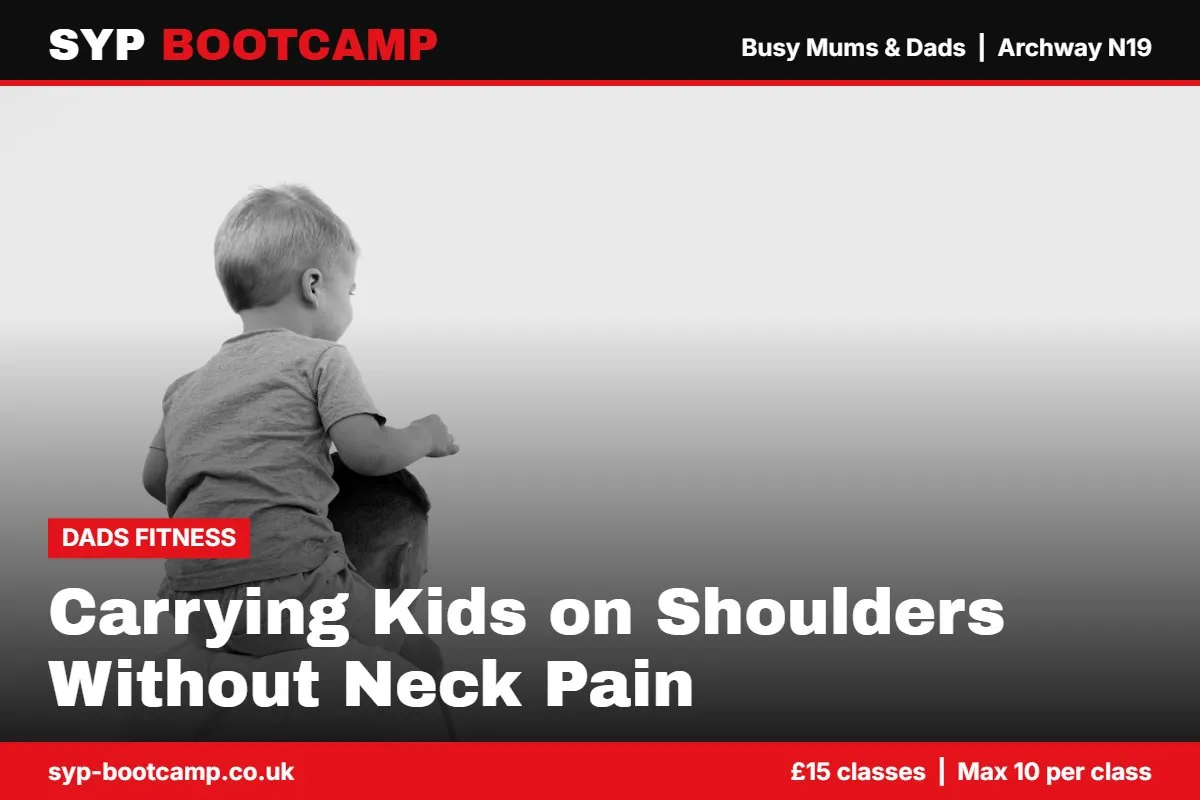
Carrying Kids on Shoulders Without Neck Pain
There is a moment at every school fair, football match and walk on the Heath when a small voice says “Daddy, up!” and you hoist them onto your shoulders. They love the view. Your neck, twenty minutes later, does not. Carrying kids on shoulders is one of the best bits of being a dad, and I do not want you to stop. I just want your neck, upper back and shoulders to handle it better. As a coach in Archway, I see a lot of dads with stiff necks and sore traps from exactly this. Here is how to lift, carry and set them down more safely, plus a short strength routine that makes the whole thing easier.
Why carrying kids on shoulders strains your neck
A toddler or young child sits right on top of your spine, but they rarely sit still. They lean, grab your hair, bounce and twist to look at things. That shifting weight means the muscles of your neck and upper back are working constantly to keep you, and them, upright.
Three things usually make it worse:
- Poking your chin forward. With a child gripping your head, it is natural to push your head forward to balance. That loads the back of the neck.
- Holding their ankles with your arms up. Long periods with your hands up by your ears tire the upper traps and shoulders.
- The lift and drop. Swinging a child up from the ground, often with a twist, is where many dads tweak their lower back or shoulder.
How to lift a child onto your shoulders
- Use a step. Ask your child to stand on a bench, wall or step so you only need to crouch slightly. This is the easiest win.
- If lifting from the ground, squat, do not stoop. Feet wide, hold them close under the armpits, stand up through your legs.
- Bring them up close to your body. Lift them past your chest, not out at arm’s length.
- Avoid twisting while lifting. Turn your feet, not your spine.
- Getting them down is the reverse. Bend your knees, lower them in front of you, then let them step off onto a bench if you can.
How to carry them for longer without pain
- Chin gently tucked. Imagine making a small double chin. Your head should sit over your shoulders, not in front of them.
- Hold hands or shins, not hands overhead. Hold their shins at chest height so your arms can relax down.
- Set a time limit. Ten minutes up, then a walking break. Use landmarks: “Up until the big tree, then you walk to the gate.”
- Breathe and relax your shoulders. Every minute or so, drop your shoulders away from your ears.
- Think about a carrier. For long days out with younger children, a toddler carrier puts the weight on your hips rather than your neck.
- Stop if it hurts. Tingling in the arms, a sharp neck pain or a headache are signs to put them down.
If you already have a sore neck, read my guide to neck and shoulder tension. The NHS page on shoulder pain advises seeing a GP if pain gets worse or has not improved after 2 weeks, or if it is very hard to move your arm. If you have numbness, weakness or pain spreading into your arms, please see your GP or a physio before doing any of the exercises below.
A 12-minute routine to make shoulder carries easier
Do this 2 to 3 times a week. You need a resistance band and something to hold, like a kettlebell, a full shopping bag or a backpack with books in it.
1. Chin tucks (2 sets of 10)
Sit or stand tall. Glide your head straight back, as if making a double chin, and hold for 3 seconds. No nodding. This trains the deep neck muscles that keep your head stacked when a child is pulling on it.
2. Band rows (3 sets of 12)
Loop a band round a door handle or post. Pull your elbows back past your ribs, squeeze your shoulder blades, then return slowly. Strong upper back muscles share the load with your neck.
3. Overhead hold march (3 x 30 seconds)
Hold a light weight overhead with both hands, arms straight, ribs down. March slowly on the spot. This mimics the balancing job your trunk does when a child sits on top of you. Keep it light. If your shoulders do not like overhead positions, do it with the weight held at chest height instead.
4. Suitcase carry (3 x 30 metres each side)
Hold a weight in one hand and walk tall, without leaning. Your core and the side of your trunk have to fight to keep you straight. Swap hands each length.
5. Shrug and drop (2 sets of 10)
Shrug your shoulders up towards your ears, hold 2 seconds, then let them drop and lengthen down. This teaches you what “relaxed” feels like.
6. Doorway chest stretch (2 x 30 seconds)
Forearm on a door frame, step gently through until you feel the front of your chest open. Tight chest muscles pull your shoulders forward, which makes head-forward posture worse.
Practise with the real thing
Once your upper back feels stronger, try short, planned carries: 2 minutes with your child on your shoulders, 2 minutes walking, and repeat 3 times on your next park trip. Practise the chin tuck and relaxed arms each time. My posture tips for busy parents post has more on everyday habits, and for lifting kids off the floor and into car seats, see my guide to back pain from lifting kids.
Where a bootcamp class fits
Being a dad is a strength sport. You lift, carry, crouch and twist all day, often with no warm-up. That is why carries, rows and loaded holds are a regular part of my SYP Built To Last functional strength class. Every move has an easier and harder version, and if your neck is sore, I will give you an alternative on the spot.
FAQs
What age can you carry a child on your shoulders?
Most parents wait until a child has good head and trunk control and can hold on, typically from toddler age. Always hold them securely and avoid it in crowds, near low branches or doorways, and on slippery ground.
Is carrying kids on shoulders bad for your back?
Not for most people if it is done in short bursts with good posture. Problems usually come from long carries, twisting lifts and a head-forward position. Strengthening your upper back and core helps a lot.
Why does my neck hurt after carrying my child?
Usually because the neck and upper trap muscles have been working hard to balance a moving weight. Gentle movement and the routine above can help. If pain lasts or comes with arm symptoms, see your GP or a physio.
Book your first class
Want to feel strong enough for every “Daddy, up!”? SYP Bootcamp runs 45-minute small-group classes in a church hall in Archway N19, max 10 people, £15 a class, with every exercise scaled to you. Book your £15 class here or call or WhatsApp me on 07301 512215. If you would rather work one-to-one on a stiff neck or shoulder, take a look at my private personal training in Archway.
About the author
Artem Olekhnovych is a personal trainer in Archway and the founder of SYP Fitness and SYP Bootcamp. He has coached clients in Archway, Highgate and across North London for over 10 years, and runs small-group bootcamp classes for busy mums and dads. Read reviews from his 1-1 clients.
