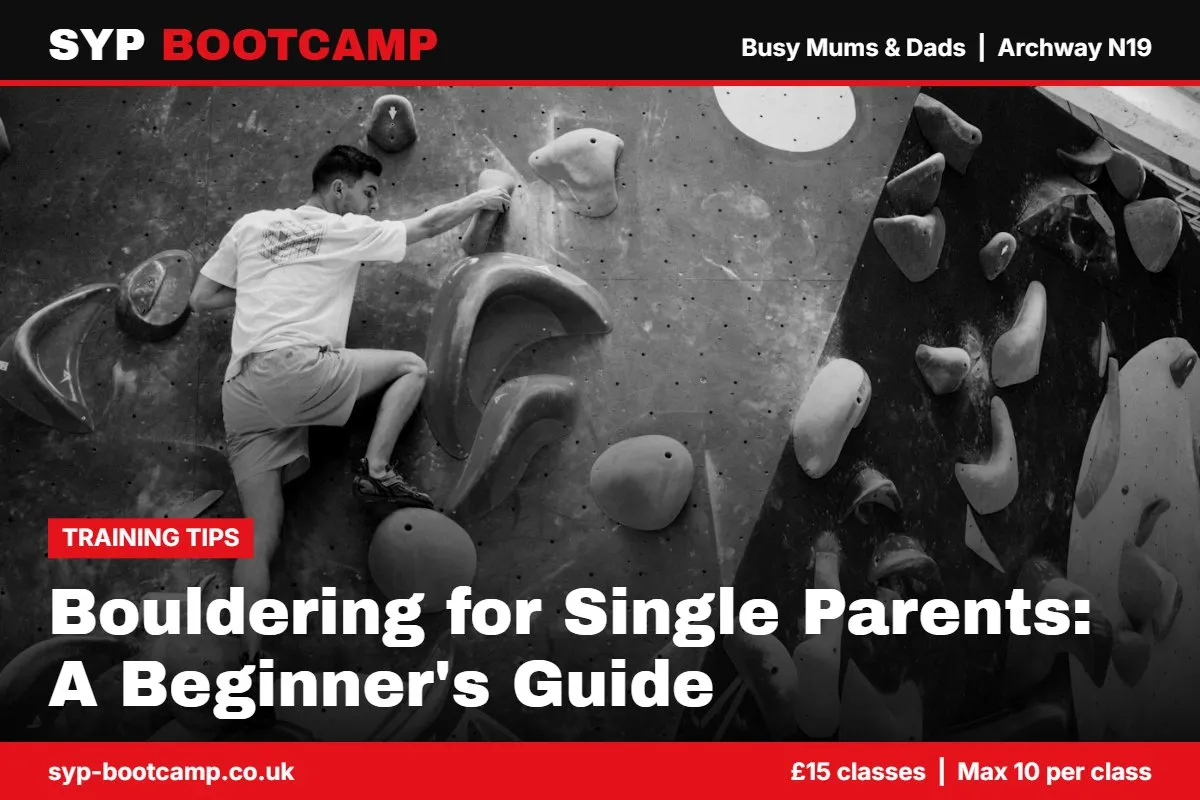
Bouldering for Single Parents: A Beginner's Guide
Picture the only hour you get to yourself each week being spent on a bench at a climbing wall, watching your child at their kids' club. Plenty of parents in that spot end up borrowing a pair of rental shoes and having a go themselves. That is why I like bouldering for single parents so much. It is short, social, needs no partner or ropes, and it is one of the few sports where you and your kids can be beginners side by side.
Bouldering is climbing on short walls, usually no higher than about four or five metres, with thick crash mats underneath instead of ropes. Routes are called “problems” and are colour coded by difficulty. You can turn up alone, climb for 40 minutes and go home. For a solo parent with no one to belay you and no spare evenings, that matters.
Why bouldering for single parents works so well
No partner needed. Rope climbing needs someone holding the other end. Bouldering does not. You can go on your own the moment you have a free slot.
It fits in short windows. Most beginners’ forearms are done within an hour.
Kids love it. Most centres run children’s sessions and family slots, so on weekends with the kids you can go together.
It builds the strength you use every day. Grip, upper back, shoulders, core and hips. The same muscles that carry a sleeping five-year-old up the stairs.
The strength bouldering builds (and what it does not)
Climbing is mostly about grip and pulling. Your fingers and forearms work hard to hold on, your upper back and lats pull you in to the wall, and your core keeps your hips close so your feet do not slip. Your legs push you up far more than beginners expect. Climb with your legs, not your arms.
What bouldering does not do well on its own is build cardio fitness or leg strength under load. See it as an add-on to a simple strength routine. The NHS physical activity guidelines ask for strength work on at least two days a week plus regular moderate activity. A bouldering session counts towards the strength side.
Your first session: a step-by-step plan
Book an induction. Every wall gives newcomers a short safety briefing on falling, where not to stand and grading.
Rent shoes, not a harness. Climbing shoes should be snug but not painful. Chalk is optional on day one.
Warm up for 5 minutes on the floor. Arm circles, 10 slow squats, 10 wall push-ups, then wrist circles and gentle finger opening and closing. The NHS has a simple guide to warming up before exercise.
Climb the easiest colour first. Do 4 or 5 of the easiest problems, climbing up and then down-climbing where you can. Down-climbing teaches control and saves your knees.
Rest as long as you climb. If a problem took 30 seconds, rest at least 30 to 60 seconds. Watching others teaches you a lot.
Stop while you still have grip left. If you cannot close your hand properly, you are done. Pushing past that is how finger and elbow niggles start.
How to fall safely
Falling is part of bouldering, so practise it before you need it. Climb a metre up, then drop on purpose. Land on both feet with soft knees, then roll back onto your bottom and back, keeping your arms tucked in. Never put an arm straight out to catch yourself. That is the classic wrist and shoulder injury. If you are near the top of a problem and feel tired, climb down or jump down in control rather than waiting until you slip.
A 15-minute home routine to make climbing easier
You do not need a hangboard. Twice a week after bedtime, try this circuit. Do 3 rounds, resting 60 seconds between rounds.
Towel hang or doorframe grip holds: 3 x 10-second holds gripping a towel over a sturdy bar, or squeezing a rolled towel hard in each hand if you have no bar.
Table rows (lie under a sturdy table and pull your chest towards it, knees bent): 6 to 10 reps.
Dead bugs: 8 slow reps each side. This is the core control that keeps your feet on the wall.
Reverse lunges: 8 each leg for the high step-ups climbing loves.
If you want more on the grip side, I wrote a full guide to grip strength exercises. Pull-up fans will also like my post on pull-ups for single parents, which builds the same pulling muscles.
Family bouldering session ideas
On weekends with the kids, check the centre’s age rules and family slots first. Then try:
Colour hunt: each person picks a colour and tries to finish three problems of that colour. Younger kids get the easiest colour, you take one up.
Traverse races: climb sideways along the bottom of the wall without going higher than your knees off the mat. Low, safe and tiring.
Keep sessions to an hour with little ones. Bring snacks and water. If you are supervising a toddler, you are not really training, and that is fine.
Where a bootcamp class fits
Bouldering for single parents works best alongside some floor training. Many parents who start climbing find their grip and shoulders are fine but their hips are stiff and their legs are weak. That is exactly what my small-group classes help with. My SYP Unlock hip and back mobility class will make those high foot placements easier, and general strength sessions build the legs and core that take load off your arms. If you are a solo parent, I have put lots more ideas in my main guide to single parent fitness.
FAQs
Is bouldering good exercise for beginners?
Yes. It builds grip, upper body and core strength, and you can start on the easiest grades with no experience. Go slowly with your fingers and shoulders for the first month, and mix it with some basic strength and cardio.
Do I need to be strong or slim to start?
No. The easiest problems are basically ladders. Technique, footwork and patience matter more than strength at first. Most beginners are surprised how quickly they progress in the first few weeks.
Is bouldering safe for children?
It is generally a safe, well-supervised activity at a proper centre with mats and an induction. Follow the centre’s age rules, keep little ones off the mats under people who are climbing, and stay close. If you or your child have a joint or shoulder problem, check with a GP or physio first.
Book your first class
If you want stronger legs, a steadier core and better hips to help your climbing, come and try a class. SYP Bootcamp runs 45-minute small-group classes indoors in a church hall in Archway N19, with a maximum of 10 people at £15 a class, and every exercise has an easier and a harder option. Book your £15 class here or call or WhatsApp me on 07301 512215 and I will send you the timetable. If you would rather start with a plan built just for you, you can also see how my private personal training in Archway works.
About the author
Artem Olekhnovych is a personal trainer in Archway and the founder of SYP Fitness and SYP Bootcamp. He has coached clients in Archway, Highgate and across North London for over 10 years, and runs small-group bootcamp classes for busy mums and dads. Read reviews from his 1-1 clients.
