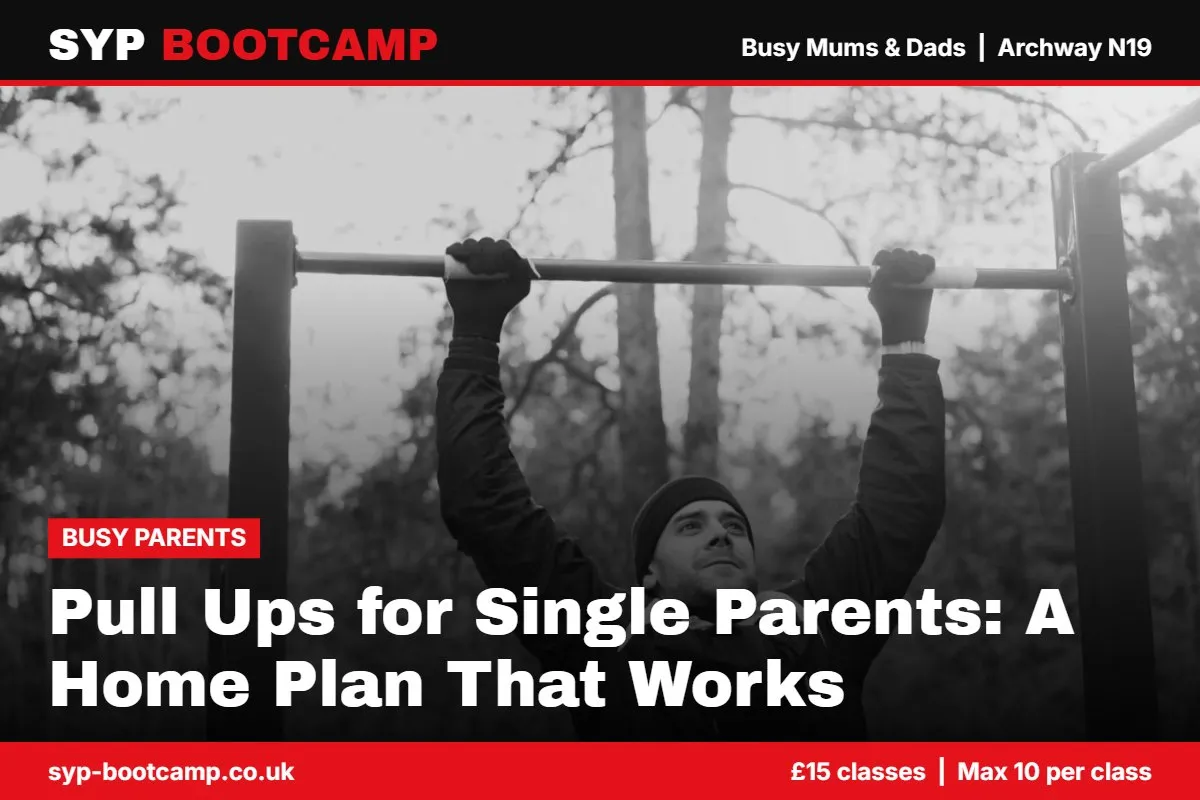
Pull Ups for Single Parents: A Home Plan That Works
A single mum I coach told me the moment she knew she was getting stronger was not on the scales. It was the day she lifted her sleeping six-year-old out of the car and up two flights of stairs without stopping. The work behind that? A lot of pulling exercises, done in ten-minute chunks at home. If you are bringing up kids on your own, pull ups for single parents are less about showing off on a bar and more about building a strong back for the lifting your life demands. Here is how to get there safely, starting from wherever you are today.
Pull-ups vs chin-ups: what is the difference?
A pull-up uses an overhand grip, palms facing away from you, usually a bit wider than shoulder width. A chin-up uses an underhand grip, palms facing you. Pull-ups lean more on the big back muscles and less on the biceps, so most people find them harder. If you are completely new, you may find it easier to start with my chin ups for single parents plan and work on both.
Let me be straight with you: very few beginners can do a full pull-up on day one. That is not a failure, it is the starting line. The progressions below are where the real strength gets built.
What you need
- Something to pull on. A doorway pull-up bar (check your door frame is solid, and remove the bar when little ones are about), the monkey bars at your local playground, or an outdoor gym in the park.
- A low bar or sturdy table for rows.
- Optional: a long resistance band for assistance. It is a cheap, useful bit of kit.
Pull ups for single parents: the 4-level plan
Each level has a test. Pass it on two different days and move up. Train pulling 2 or 3 times a week with at least a day off between sessions.
Level 1: Rows and hangs
- Incline rows: grip a low bar or the edge of a sturdy table, body at an angle, and pull your chest towards it. The more upright you are, the easier. 3 sets of 8 to 12.
- Active hang: hang from the bar with an overhand grip, shoulders pulled down away from your ears, feet lightly touching a step if you need support. 3 holds of 10 to 20 seconds.
- Test to move up: 3 sets of 12 rows with your body nearly horizontal, and a 30-second hang.
Level 2: Top holds and slow lowers
- Flexed-arm hang: step up on a chair so your chin is over the bar, take your feet off and hold. 3 holds of 5 to 15 seconds.
- Negatives: from the top, lower yourself as slowly as you can, counting to 5. 3 sets of 3.
- Test: a 5-second lower, 3 sets of 3, all controlled.
Level 3: Assisted pull-ups
- Loop a band over the bar and put a foot or knee in it, or keep one foot on a chair and push as little as possible. 3 sets of 5 to 8.
- Test: 3 sets of 8 with your lightest band or very little foot help.
Level 4: Full pull-ups
- Do singles. One rep, rest a minute, repeat, up to 5 times. Over the weeks, turn singles into doubles and triples.
The “doorway snack” trick for busy parents
This is my favourite tip for solo parents. If you have a doorway bar, do one easy set every time you walk under it, well short of your limit. Three slow negatives. A 15-second hang. Two assisted reps. Spread through an evening, that is a lot of practice without ever finding a workout slot. It is the same idea as the exercise snacks I recommend to all busy parents. Keep the sets easy, and take the bar down before the kids decide it is a swing.
Good form in four cues
- Shoulders down first. Pull them away from your ears before your elbows bend.
- Squeeze your bum and brace your stomach so your body stays still, no swinging.
- Drive elbows down towards your hips and bring your chest to the bar.
- Lower all the way with control, to straight arms.
Stop if it hurts. Pain in the shoulder joint, elbow or wrist is a signal to drop back a level, not push through. If you have had shoulder or neck problems in the past, ask a GP or physio before you start hanging and pulling.
A sample week with the kids
- Tuesday, after bedtime (15 minutes): rows, hangs and negatives for your level.
- Thursday, playground (10 minutes): rows on the low bar and active hangs on the monkey bars while the kids play. If they want to try, let them hang too. Kids are often surprisingly good at it.
- Weekend: a family walk or bike ride, plus a few doorway snacks.
Do this for a couple of months and you will notice it in your posture and every heavy lift. For more ideas on building a routine that survives solo parenting, read my guide to single parent fitness.
Where a bootcamp class fits
Pulling is only one part of a strong body. You also need legs, hips and a solid core, plus a bit of cardio. In SYP Built To Last, my functional strength class for people over 35, we cover the whole lot in 45 minutes with an easier and harder version of each move, so your home pull-up practice slots straight in alongside it.
FAQs
How can I do a pull-up if I can’t do one?
Start with rows, hangs and slow lowers, then use a band or a chair for assistance. Practise 2 or 3 times a week and move up a level when the current one feels solid.
Are pull-ups harder than chin-ups?
For most people, yes, because the overhand grip uses less bicep. Practising both is a good idea.
Are doorway pull-up bars safe?
They are safe for most people if your door frame is solid and you follow the instructions. Test it carefully before each use and remove it when children are around.
How many pull-ups should a beginner do?
Quality over quantity. A few sets of 1 to 3 good reps is a great start. Build up slowly rather than grinding out messy reps.
Book your first class
When you get a free slot, come and train with a small group of parents who get it. SYP Bootcamp runs 45-minute classes indoors in a church hall in Archway N19, a maximum of 10 people, £15 a class and no contract. Book your £15 class here or call or WhatsApp me on 07301 512215. If you live up the hill, I also offer 1-1 sessions as a personal trainer in Highgate through SYP Fitness.
About the author
Artem Olekhnovych is a personal trainer in Archway and the founder of SYP Fitness and SYP Bootcamp. He has coached clients in Archway, Highgate and across North London for over 10 years, and runs small-group bootcamp classes for busy mums and dads. Read reviews from his 1-1 clients.
