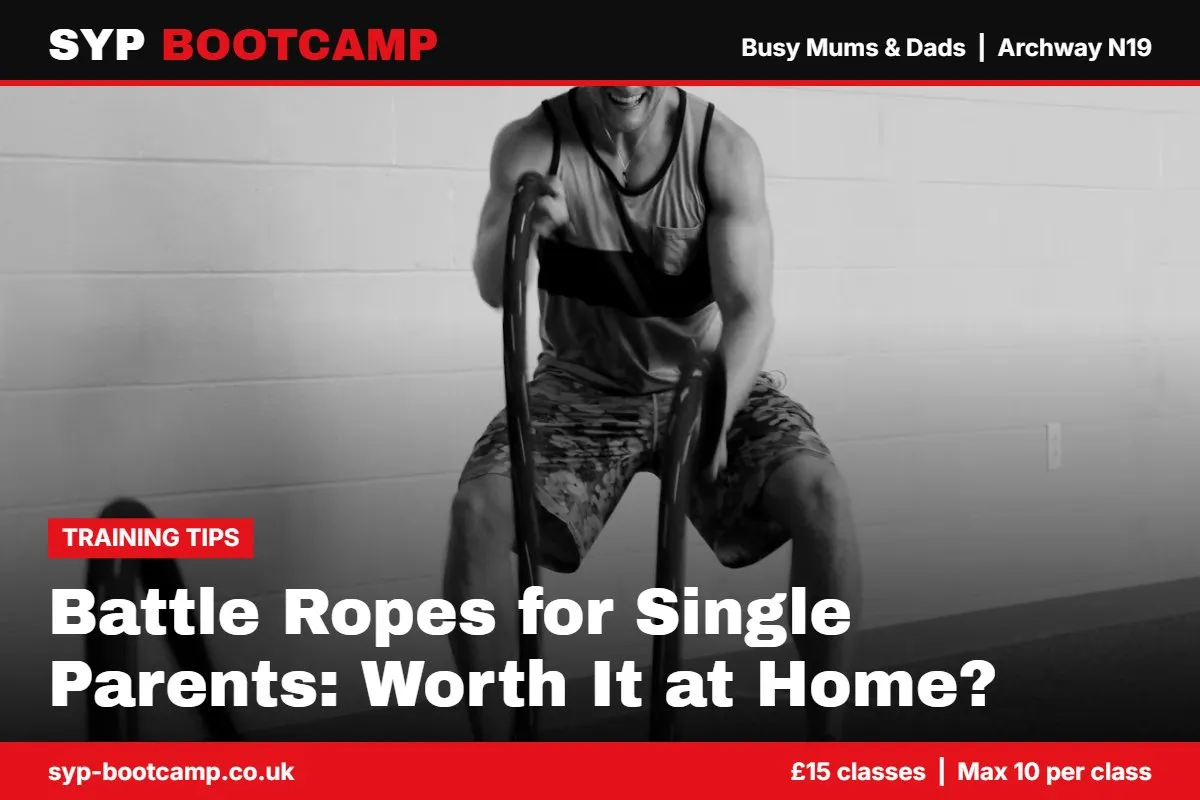
Battle Ropes for Single Parents: Worth It at Home?
Battle ropes look brilliant on social media. Someone in a big warehouse gym whipping two thick ropes into waves, sweat flying, music pumping. If you are a single parent watching that on your phone at 10pm, you might wonder whether you should buy a set. So let me give you an honest answer about battle ropes for single parents: what they are good for, whether they are worth it at home, and the cheap alternatives that get you most of the benefit for almost no money.
What battle ropes actually do
A battle rope is a heavy rope, usually around 9 to 15 metres long and a few centimetres thick, looped around an anchor point. You hold one end in each hand and move your arms to make waves, slams or circles travel down the rope.
They are excellent for:
- Raising your heart rate fast without any impact on your knees or ankles.
- Shoulder and arm endurance. Your shoulders will burn within 20 seconds.
- Grip and core. Your trunk has to brace to stay steady while your arms work.
- Getting stress out. There is something very satisfying about slamming a heavy rope after a long day.
What they are not great for is building serious strength in your legs, or anything that needs a slow, heavy movement. They are a conditioning tool, not a full workout.
Battle ropes for single parents at home: are they worth it?
Here is my honest take, after years of coaching parents in North London homes and flats.
The problems at home
- Space. A standard rope needs a clear run of at least half its length, often 5 to 7 metres. Most London hallways and living rooms are not that long.
- Anchor. You need something very solid to loop it around. A sofa leg is not it. A wall anchor needs drilling, which renters often cannot do.
- Noise. Rope slams on a floor are loud. In a flat, the neighbours will hear every rep.
- Kids. A heavy rope moving fast and a curious toddler walking into it is a real risk. You cannot use it while little ones are around.
- Storage. A coiled rope is big and heavy, and ends up living in the hallway being tripped over.
When they can work
If you have a garden with a solid post, tree or fence footing, and you can train while the kids are at school or with family, a shorter rope can be a fun addition. Otherwise, for most single parents I coach, the money is better spent elsewhere, such as a kettlebell or a few classes.
Cheap alternatives that do a similar job
The towel rope
Take a large bath towel and roll it lengthways into a thick tube. Hold one end in each hand and do the same arm patterns you would do with ropes: fast alternating waves, double-arm slams and circles. There is no rope to move, so the resistance comes from your own speed and from squeezing the towel tight.
- Work 20 seconds, rest 40 seconds, for 6 rounds.
- Stand in a half squat to bring in your legs.
- Silent, takes no space and the kids can join in with a tea towel each.
The towel tug
Loop a towel round a closed door handle (on the side that closes towards you) and pull back hard, holding for 10 seconds. Or play tug of war with an older child, with you on one knee to make it fair. This gives you the grip and shoulder work ropes are known for.
The skipping rope
A cheap skipping rope is the best value cardio kit you can buy. It raises your heart rate as fast as battle ropes, works your calves and shoulders, and folds into a drawer. You need a bit of headroom and it is noisy indoors, so use it in the garden, a car park outside a quiet building or the local park. My jump rope workout for beginners has a full plan, including a version without jumping if you are not ready for impact.
A 12-minute “no rope” rope workout
Use a rolled towel. Do each move for 30 seconds, rest 30 seconds, and go round twice.
- Alternating waves: arms move up and down in turn, quickly, from a half squat.
- Double slams: both arms overhead, then whip the towel down towards the floor, bending your knees.
- Outside circles: draw big circles outwards with both hands.
- Squat and wave: 3 slow squats, then 5 seconds of fast waves. Repeat.
- Towel tug hold: pull against a door handle or partner, 10 seconds on, 5 off.
- Shadow jacks: step jacks with the towel held overhead.
Finish with a minute of shoulder stretches.
Technique if you do use real ropes
- Stand in a quarter squat, feet shoulder-width apart, chest up.
- Move from the shoulders, not just the wrists.
- Keep your back flat. Do not round over the ropes.
- Short bursts. 20 to 30 seconds is plenty. After that, form falls apart.
- Breathe. People hold their breath on ropes more than almost any other exercise.
Stop if you feel pain in your shoulders, elbows or lower back. If you have high blood pressure, a heart condition or a shoulder injury, check with your GP or a physio before doing high-intensity work like this. The NHS page on high blood pressure is a good place to start if you are unsure.
Where to try battle ropes in a class
This is the honest best of both worlds: try ropes somewhere that has the space, the anchors and the floor, without buying a set. If ropes are what you are after, ask me when you book and I will tell you which sessions that week include rope-style conditioning.
If what you really want is that stress-busting, slam-it-out feeling, my SYP Release stress relief class gives you exactly that with pads and slam balls. You might also like my punch bag workout for stress. And for the bigger picture of fitting exercise into solo parenting, have a read of my single parent fitness guide.
FAQs
Are battle ropes good for beginners?
Yes, in short bursts. They are low impact and easy to learn. Start with 15 to 20 seconds of work and plenty of rest.
What length battle rope is best for home?
Shorter ropes, around 9 metres, suit smaller spaces, but you still need a solid anchor and roughly half that length of clear floor. Many homes simply do not have it.
Do battle ropes burn belly fat?
No exercise burns fat from one spot. Ropes raise your heart rate and are a good conditioning tool, but body shape changes come from your overall activity, food and sleep.
What can I use instead of battle ropes?
A rolled-up towel for wave and slam patterns, a skipping rope for cardio, or a slam ball if you have outdoor space.
Book your first class
Save the money on kit and spend it on a session with a coach instead. SYP Bootcamp runs 45-minute small-group classes in Archway N19, max 10 people, £15 a class, indoors in a church hall, with easier and harder options for everything. Book your £15 class here or call or WhatsApp me on 07301 512215. If you would like to train with a friend and split the cost, take a look at partner personal training in Archway.
About the author
Artem Olekhnovych is a personal trainer in Archway and the founder of SYP Fitness and SYP Bootcamp. He has coached clients in Archway, Highgate and across North London for over 10 years, and runs small-group bootcamp classes for busy mums and dads. Read reviews from his 1-1 clients.
