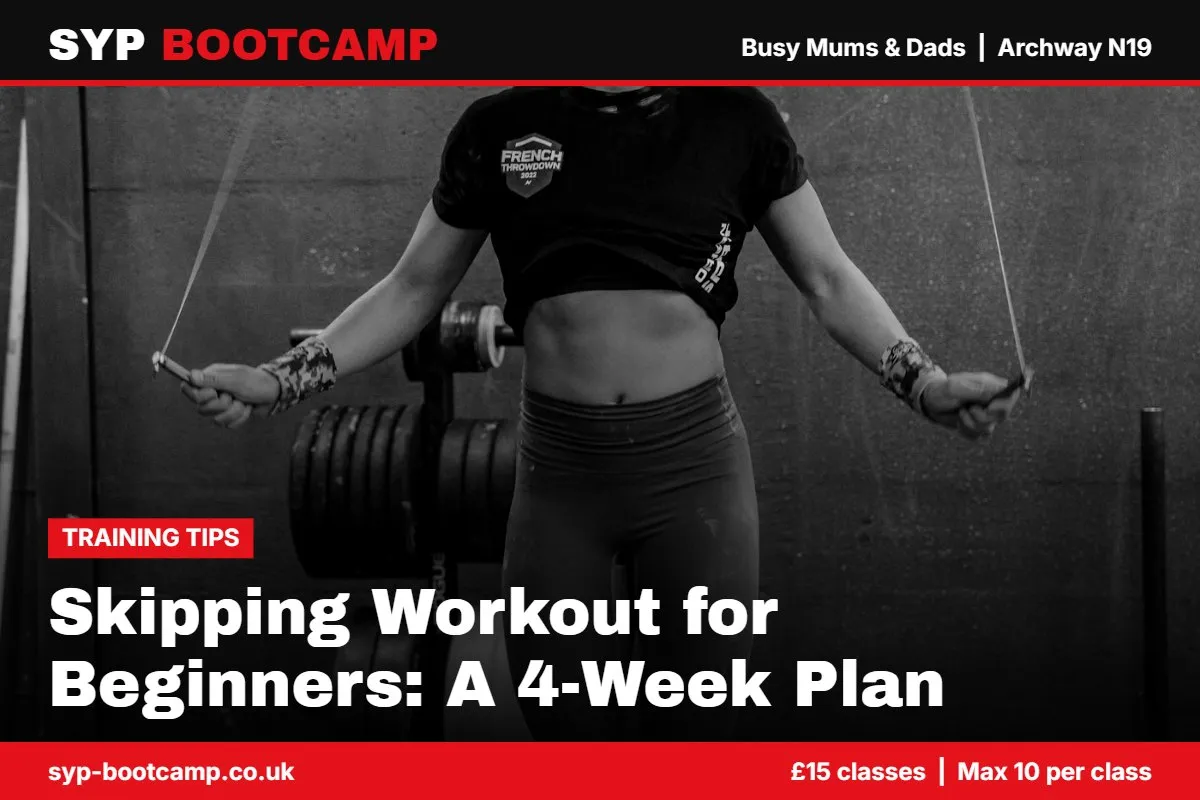
Skipping Workout for Beginners: A 4-Week Plan
A skipping rope costs less than a takeaway, fits in a kitchen drawer and gets your heart going faster than almost anything else you can do in a small space. For a parent who has 15 minutes between bedtime and collapsing on the sofa, that is a very good deal. The catch is that most adults pick one up, trip over it ten times, feel daft and put it away. This skipping workout for beginners fixes that, with a simple way to learn the rhythm and a 4-week plan that builds from 20 seconds at a time.
Before you pick up the rope
Skipping is a jumping exercise, so it puts load through your ankles, knees and pelvic floor. A few honest checks first:
- If you have had a baby, wait until you have had your postnatal check, usually around 6 to 8 weeks after the birth, and get the go-ahead from your GP. Most women need longer than that before jumping feels right, especially after a C-section.
- If you leak when you jump, cough or sneeze, that is common but not something to push through. Speak to your GP. The NHS explains that pelvic floor muscle training is a first treatment, and a specialist can help. My post on pelvic floor and exercise classes has more on this.
- If you have knee, ankle or heart problems, check with your GP or physio before you start.
Getting the right rope and setup
- Length: stand on the middle of the rope with one foot. The handles should reach roughly to your armpits. Too long and it drags, too short and it catches your feet.
- Surface: a wooden floor, a rubber mat or a flat bit of pavement. Avoid concrete if you can, and never skip on a slippery rug.
- Shoes: trainers with some cushioning, not bare feet.
- Ceiling: check it before you start. Plenty of North London flats have low light fittings. The hallway, the garden or the park might be better.
- Kids: keep them well out of range. A rope at speed stings.
How to skip: learn it in three steps
- Bounce without a rope. Small jumps on the balls of your feet, knees soft, landing quietly. Aim for 30 seconds of relaxed, low bounces. You only need to clear the floor by a couple of centimetres.
- Swing the rope without jumping. Hold both handles in one hand and swing the rope at your side, turning from the wrists, elbows tucked in. Bounce in time with the slap of the rope on the floor.
- Put it together. Rope behind you, swing it over, and hop over it as it comes past your toes. One jump per turn. When you trip, and you will, just reset and go again.
Form cues I use in class: tall chest, eyes forward, elbows by your ribs, turn the rope with your wrists not your shoulders, and land softly like you are trying not to wake the baby.
Skipping workout for beginners: a 4-week plan
Do this 2 or 3 times a week, on non-consecutive days. Warm up first with 3 to 5 minutes of marching, arm circles and ankle rolls (the NHS has a simple warm-up routine you can follow).
Week 1: learn the rhythm
8 rounds of 20 seconds skipping, 40 seconds rest. If you trip, keep the clock running and restart. That is about 8 minutes in total.
Week 2: a bit longer
8 rounds of 30 seconds skipping, 30 seconds rest.
Week 3: add strength
Go round 3 times:
- 40 seconds skipping
- 10 squats
- 40 seconds skipping
- 8 push-ups (on the worktop, a step or the floor)
- 60 seconds rest
Week 4: a 15-minute session
Go round 4 times:
- 45 seconds skipping
- 10 reverse lunges each leg
- 45 seconds skipping
- 20-second plank
- 45 seconds rest
No rope yet, or not enough ceiling height? Do “ghost skipping”: the same small bounce while turning your wrists as if you were holding a rope. Most of the benefit, none of the tripping.
Common beginner mistakes
- Jumping too high. Big jumps tire you out and pound your knees. Low and quick wins.
- Double bouncing. A little extra bounce between turns is fine at first, but aim for one jump per turn as you improve.
- Flapping arms. Big arm circles slow the rope and wear out your shoulders. Small wrist turns only.
- Doing it every day from day one. Your calves and Achilles need time to adapt. Two or three sessions a week is plenty to start.
If you get pain in your shins, knees or feet that does not settle after a day or two, stop skipping and swap to a lower-impact option like marching or a bike for a week. If it keeps coming back, see a physio.
Where a bootcamp class fits
Skipping is brilliant cardio, but it is only one tool. In my classes we mix short cardio bursts like skipping with strength, mobility and core work, so you get a full session in 45 minutes. The SYP Recharge energy and focus class uses this style of interval training, and there is always a low-impact option if jumping is not for you yet. If you are new to this kind of training, my guide to HIIT for beginners explains how to pace yourself.
FAQs
How long should a beginner skip for?
Start with short bursts of 20 to 30 seconds, with rest in between, for a total of around 5 to 10 minutes. Build up over a few weeks to 45 to 60 second rounds as your calves, coordination and fitness improve.
Is skipping every day good for you?
Once you are used to it, short daily sessions can be fine for many people. As a beginner, 2 to 3 sessions a week gives your calves, shins and Achilles time to adapt and lowers the risk of niggles.
Is skipping bad for your knees?
Not for most people, as long as you jump low, land softly on the balls of your feet and build up gradually. If you have existing knee problems or pain while skipping, check with a GP or physio and use a low-impact option instead.
Can I do a skipping workout without a rope?
Yes. Ghost skipping, where you bounce and turn your wrists as if holding a rope, gives you much of the same cardio work and is handy in rooms with low ceilings.
Book your first class
If you would like to learn skipping and interval training with a coach watching your form, come along to SYP Bootcamp. Classes are 45 minutes, indoors in a church hall in Archway N19, with no more than 10 people and options for every level, for £15 a class. Book your £15 class here or call or WhatsApp me on 07301 512215. If you would prefer one-to-one attention away from a group, have a look at private personal training in Archway.
About the author
Artem Olekhnovych is a personal trainer in Archway and the founder of SYP Fitness and SYP Bootcamp. He has coached clients in Archway, Highgate and across North London for over 10 years, and runs small-group bootcamp classes for busy mums and dads. Read reviews from his 1-1 clients.
