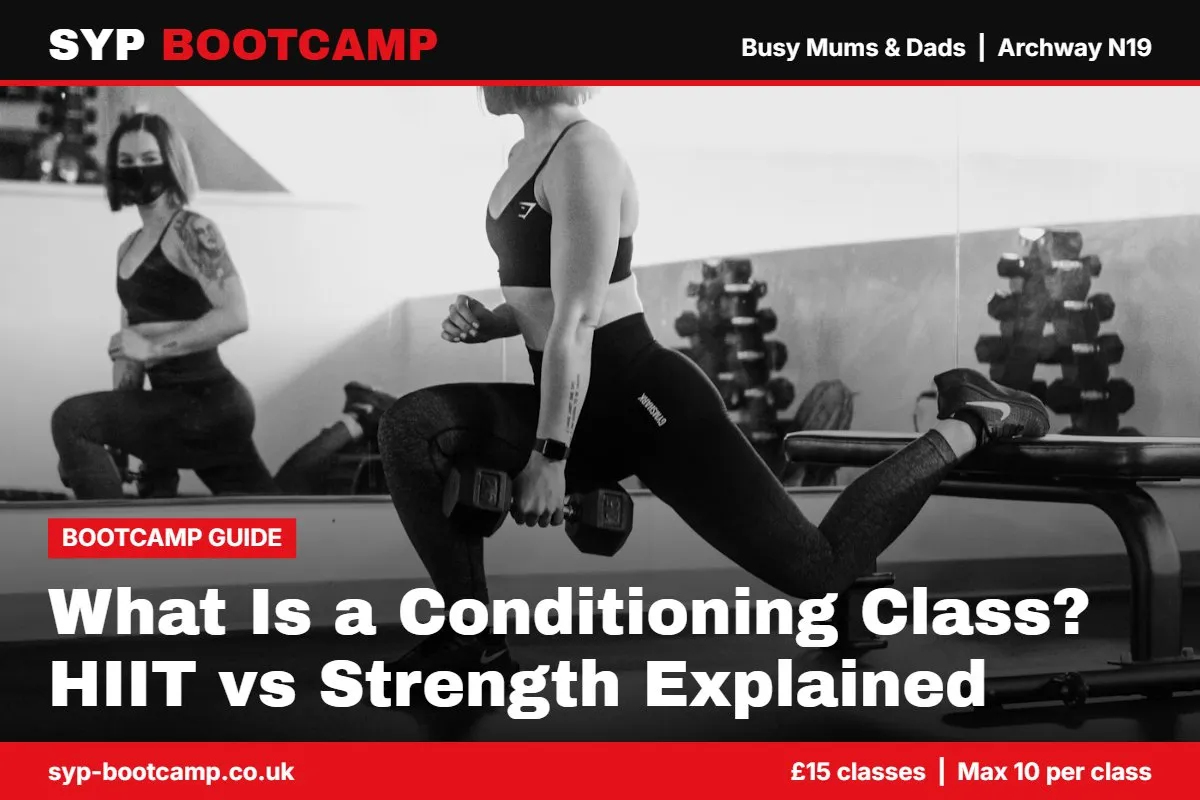
What Is a Conditioning Class? HIIT vs Strength Explained
You run for the bus and you are wheezing by the time you sit down. You play tag with the kids for five minutes and need a lie down. Your legs are strong enough, but your engine is not. That is what conditioning is about. If you have seen a timetable and wondered what is a conditioning class, here is the short answer: it is a session designed to build your stamina, so you can work harder for longer and recover faster between efforts. Below I explain how it differs from HIIT and strength classes, who it suits and what a session actually looks like.
What is a conditioning class, exactly?
“Conditioning” is a broad gym word for improving your work capacity: how much effort your heart, lungs and muscles can keep up before you have to stop. A conditioning class usually mixes:
- Cardio pieces such as rowing, bike intervals, skipping or shuttle runs.
- Light to moderate weights moved for higher reps, such as kettlebell swings or slam balls.
- Bodyweight moves such as step-ups, mountain climbers and squats.
- Timed formats such as intervals, circuits, EMOMs (every minute on the minute) or AMRAPs (as many rounds as possible).
The aim is not to lift your heaviest weight or to go flat out for 20 seconds. It is to keep a strong, steady effort going for longer, with short rests. If those workout terms are new to you, my post explaining EMOM and AMRAP workouts breaks them down.
Conditioning vs HIIT vs strength classes
These labels overlap, and every gym uses them slightly differently. Here is how I would explain the difference to a client.
| Conditioning class | HIIT class | Strength class | |
|---|---|---|---|
| Main goal | Stamina and recovery between efforts | Very hard, short bursts | Getting stronger |
| Effort | Hard but sustainable | Close to maximum in each burst | Heavy, controlled, plenty of rest |
| Work and rest | Longer work, shorter rests, for example 40 seconds on, 20 off | Short work, often equal or longer rest | Sets of reps, 1 to 2 minutes rest |
| Weights | Light to moderate | Mostly bodyweight | Moderate to heavy |
| Feels like | A steady burn | Short, sharp and very sweaty | Focused and technical |
For a closer look at two of these, read HIIT vs strength training. In my own bootcamp classes, I combine all three: a strength block first, then a conditioning finisher. For most busy parents, getting both in one 45-minute session is the best use of their time.
A sample 20-minute conditioning block
Here is a conditioning block you might see at the end of an SYP Bootcamp class. You can also try it at home with a little space.
Format: 4 rounds. Work 40 seconds, rest 20 seconds on each exercise. Rest 1 minute between rounds.
- Step-ups onto a low, sturdy step. Easier: lower step and slower pace. Harder: higher step, or hold a light weight.
- Kettlebell or backpack deadlift. Easier: lighter load. Harder: heavier load and steady pace.
- Mountain climbers. Easier: hands on a bench, slow steps. Harder: on the floor, faster.
- Squat to press with light dumbbells or water bottles. Easier: no weight. Harder: heavier.
Always warm up for a few minutes first. Aim for an effort where you could say a few words but not hold a conversation. If you feel dizzy, sick or have chest pain, stop straight away and seek medical advice. If you have a heart condition, high blood pressure or another health issue, check with your GP before starting conditioning work. The NHS page on high blood pressure is a good starting point if that applies to you.
Who is a conditioning class for?
Conditioning suits:
- Parents who want to stop feeling puffed out on stairs, hills and in the playground.
- Runners and footballers who want better stamina for their sport.
- People who find pure strength training a bit slow and want to sweat.
- Anyone looking to meet the NHS aim of 75 minutes of vigorous activity or 150 minutes of moderate activity a week, set out in the physical activity guidelines for adults.
It is less ideal if you are completely new to exercise and going straight into a full-on session, or if you are managing an injury. In those cases, start with the easier options, keep the pace gentle and build up over a few weeks.
How to get better at conditioning
- Start slower than you think. Most people go too hard in round one and fade badly. Hold back so the last round is your best.
- Breathe out on the effort. It sounds basic, but holding your breath makes everything harder.
- Repeat the same block. Do the same session a few weeks running and note your reps. Progress becomes obvious.
- Do two a week. Consistency builds stamina more than the occasional hard session.
If your energy is the big issue right now, SYP Recharge, my energy and focus class, is a gentler entry into conditioning.
FAQs
Is a conditioning class good for beginners?
Yes, as long as the coach offers easier options and you pace yourself. In my classes every exercise has a scaled version.
Is conditioning cardio or strength?
Mostly cardio, but often using weights or bodyweight exercises. That is why it also builds some muscular endurance.
How often should I do conditioning?
One or two sessions a week, alongside some strength work and daily walking, suits most busy parents.
Can conditioning help with weight loss?
It can be a useful part of an active lifestyle, but no single type of class guarantees a result. What you eat, how you sleep and how consistent you are all matter. My post on cardio or weights for fat loss explains more.
Book your first class
If you want to build stamina that shows up on the school run and the stairs, come and try a session. SYP Bootcamp runs 45-minute small-group classes in Archway N19, indoors, max 10 people, with easier and harder options for everything, at £15 a class. Book your £15 class here, or call or WhatsApp me on 07301 512215 if you have questions. If you want a longer, fully guided plan, you can read about my 12-week transformation programme.
About the author
Artem Olekhnovych is a personal trainer in Archway and the founder of SYP Fitness and SYP Bootcamp. He has coached clients in Archway, Highgate and across North London for over 10 years, and runs small-group bootcamp classes for busy mums and dads. Read reviews from his 1-1 clients.
