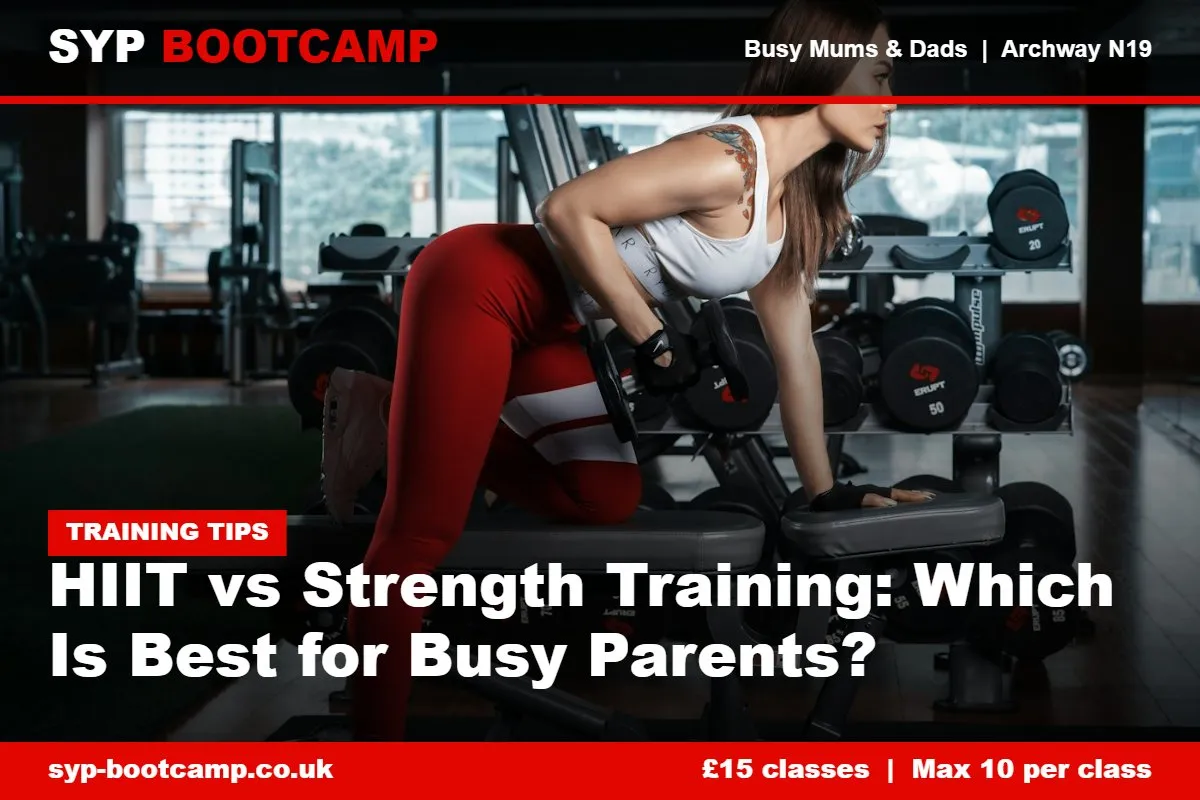
HIIT vs Strength Training: Which Is Best for Busy Parents?
You have maybe two or three free hours a week, if the kids sleep and nothing goes wrong at work. So when you finally get a slot to exercise, you want it to count. That is usually when the big question comes up: HIIT vs strength training, which one should a busy parent actually do? I get asked this every week in Archway. The short answer is that you do not have to pick one forever, but you do need to know what each one does, so you can use your limited time well.
HIIT vs strength training: what is the difference?
HIIT stands for high intensity interval training. You work very hard for a short burst (say 20 to 40 seconds), rest briefly, and repeat. Think fast step-ups, burpees, skipping or sprinting on a bike. It mostly trains your heart and lungs, and it gets you out of breath quickly.
Strength training means making your muscles work against resistance: dumbbells, kettlebells, resistance bands or your own bodyweight. Think squats, lunges, rows and push-ups. You rest long enough between sets to do the next set well. It mostly builds and keeps muscle, and makes everyday lifting (car seats, shopping, a sleepy five-year-old) easier.
The NHS counts both. Its physical activity guidelines for adults recommend 150 minutes of moderate activity or 75 minutes of vigorous activity a week, plus strengthening activities that work all the major muscle groups (legs, hips, back, abdomen, chest, shoulders and arms) on at least 2 days a week. HIIT sits in the vigorous bucket. Strength work is its own separate box to tick. So the guidelines are already telling you something useful: most adults need some of both.
When HIIT makes sense for a parent
- You have 15 to 20 minutes, not 45. A short HIIT session can help you towards the weekly vigorous target in very little time.
- You enjoy feeling out of breath. Some people love the “done and dusted” feeling.
- You already have a decent base. HIIT is hard on tired legs and joints if you are coming back from years off.
Where HIIT goes wrong: people do it every day, on four hours of sleep, with sloppy form because they are rushing. Fast reps with poor technique are how knees and lower backs get grumpy.
When strength training makes sense
- You want to feel stronger carrying kids, bags and buggies. This is the most direct way to get there.
- You are starting again after a long break. You can control the pace and learn the movements properly.
- You are over 40. Keeping muscle becomes more of a priority as we age, and you can scale strength work to any level.
- You are exhausted. A steady strength session often feels more manageable on a bad night’s sleep than all-out intervals.
How to try both this week (step by step)
Here is a simple way to test both without overthinking it. Check with your GP first if you have a heart condition, blood pressure issues, are pregnant or recently postnatal, or have joint pain.
- Day 1, strength (25 minutes). Warm up for 5 minutes. Then do 3 rounds of: 10 squats to a chair, 10 incline push-ups against a kitchen worktop, 10 bent-over rows with two full water bottles, and a 20-second plank on your knees. Rest about a minute between rounds.
- Day 2, rest or walk. A brisk school run counts as moderate activity.
- Day 3, short HIIT (15 minutes). Warm up for 5 minutes. Then do 6 rounds of 30 seconds fast marching or step-ups, 60 seconds easy walking on the spot. Cool down with 2 to 3 minutes of slow walking.
- Day 4 or 5, repeat whichever felt best, or another strength session.
- Write down how you felt afterwards and the next morning. Energy, sleep, aches. That tells you more than any article.
Easier and harder options
- Easier HIIT: drop the work interval to 20 seconds and keep it low impact (no jumping). Fast marching instead of jumping jacks.
- Harder HIIT: 40 seconds on, 40 seconds off, with step-ups or squat to calf raise.
- Easier strength: fewer reps (6 to 8), higher worktop for push-ups, sit fully onto the chair in squats.
- Harder strength: hold a backpack with books for squats, move push-ups to a lower surface, slow the lowering phase to a count of 3.
So which one wins?
For most tired parents I coach, strength training is the foundation and HIIT is the topping. Get stronger first, learn to move well, and then add short bursts of harder effort once your body can handle them. If you are trying to decide based on fat loss, I have written a separate piece on cardio or weights for fat loss, and if you are worried about time, read is two classes a week enough.
Where a small-group bootcamp fits
This is exactly why my SYP Bootcamp classes in Archway mix both. A 45-minute session usually blends strength stations with short intervals, and with a maximum of 10 people I can actually watch your form and give you the easier or harder version. You get both boxes ticked in one go, and you do not have to plan anything. See this week’s class times on the SYP Bootcamp booking page.
FAQs
Is HIIT or strength training better for weight loss?
Both can help as part of an overall routine, alongside how you eat, sleep and move day to day. Results vary a lot from person to person. The best option is the one you will keep doing week after week, and for most people that means a mix.
Can I do HIIT and strength training on the same day?
Yes. Many people do strength first, while they are fresh, then finish with a few minutes of intervals. Keep the HIIT short so your technique does not fall apart.
How many times a week should a beginner do HIIT?
Start with once or twice a week at most, with at least a day in between. The NHS recommends strength activities on at least 2 days a week, so build those in first.
If you want a session that does both for you, with a coach checking every rep, book a class. It is £15, 45 minutes, all levels welcome. Book my £15 class or message me on WhatsApp on 07301 512215. And if you would prefer a fully personal plan built around a set goal, have a look at my 12-week body transformation programme.
About the author
Artem Olekhnovych is a personal trainer in Archway and the founder of SYP Fitness and SYP Bootcamp. He has coached clients in Archway, Highgate and across North London for over 10 years, and runs small-group bootcamp classes for busy mums and dads. Read reviews from his 1-1 clients.
