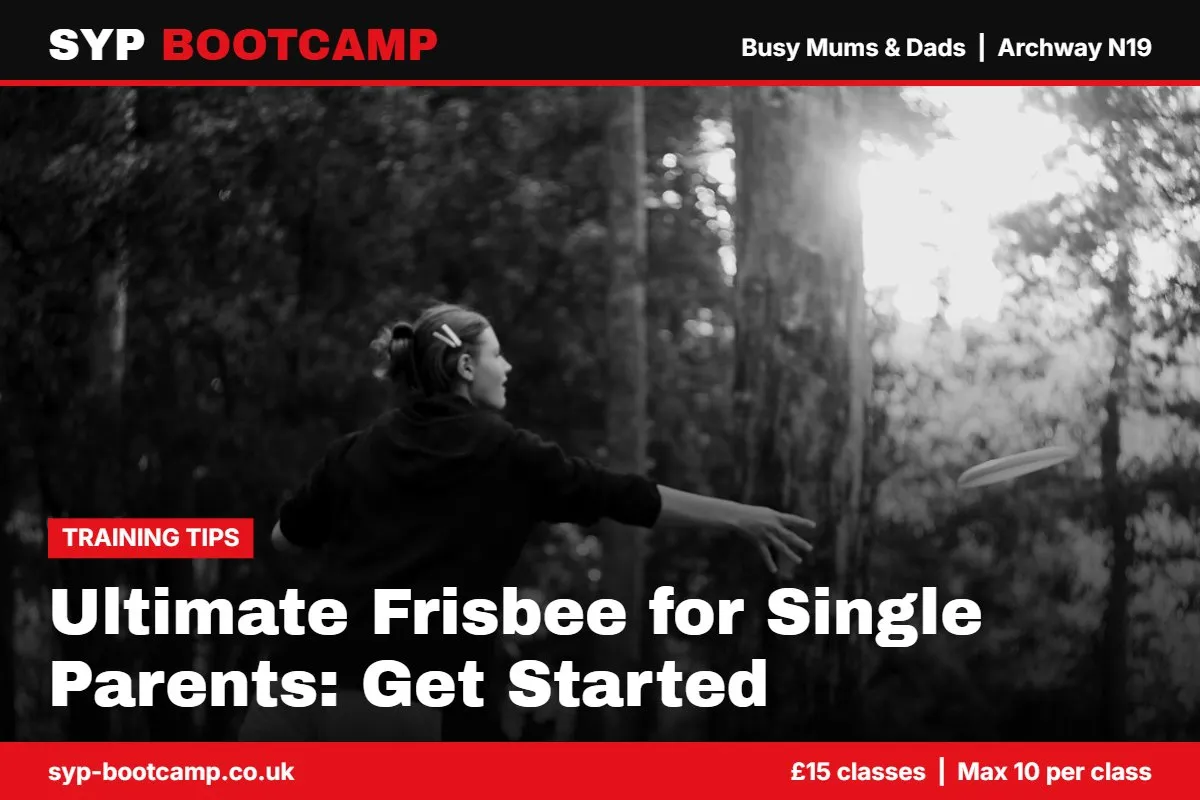
Ultimate Frisbee for Single Parents: Get Started
If team sports at school left you scarred, ultimate frisbee might change your mind. There is no tackling, no referee shouting at you, and the culture is famously friendly. Players even call their own fouls. For a solo parent who misses being part of a team, ultimate frisbee for single parents is a lovely way back into sport, and the basics of throwing and catching a disc are something you can practise in the park with your kids on a Saturday morning.
It does ask a lot of your running fitness, though. Ultimate is basically repeated short sprints with quick stops and turns. So this post covers what the game is like, the running fitness it needs, and a simple park session you can do with one disc and whoever you have with you.
What ultimate frisbee is like
- Two teams try to catch the disc in the opposite end zone, a bit like American football without the contact.
- You cannot run while holding the disc. You stop, pivot and pass within a few seconds.
- If the disc hits the ground or is intercepted, the other team takes over.
- It is non-contact and usually mixed gender, with a strong “spirit of the game” culture of fair play.
- Most cities have social leagues and beginner sessions, often in parks in summer and on astro pitches in winter.
Why ultimate frisbee for single parents works
- Instant team. You turn up alone and leave with a group of people who know your name.
- Cheap. A decent disc costs less than a takeaway. Social leagues are usually affordable compared with gyms.
- Kids can learn the skills. Throwing and catching a disc is a great game for children from around six or seven, and older children can join family-friendly pick-up games.
- It is fun cardio. You will run a lot without noticing, because you are chasing a disc rather than a lap time.
The running fitness ultimate needs
Many adult beginners are surprised how tiring their first game is. That is because ultimate is not steady jogging. It is:
- Short sprints of 5 to 30 metres to get free from a defender.
- Sharp stops and cuts to change direction.
- Walking or jogging recovery while the disc is moving elsewhere.
- Repeated for 60 to 90 minutes, with substitutions.
So the fitness you need is the ability to repeat short efforts and recover quickly. Jogging at one pace helps a bit, but interval work helps much more. And because hamstrings and calves do most of the work in sprinting, they need preparing too.
A 4-week build-up plan
Two sessions a week, ideally on grass. Always warm up first with 5 minutes of brisk walking and easy jogging.
- Week 1: 10 rounds of 20 seconds brisk jog, 40 seconds walk. Plus 3 sets of 10 calf raises and 3 sets of 8 glute bridges.
- Week 2: 10 rounds of 20 seconds faster run (about 70 percent effort), 40 seconds walk. Add 2 sets of 6 slow reverse lunges each side.
- Week 3: 8 rounds of 10-metre run out, stop with control, turn, run back. Walk 45 seconds between rounds.
- Week 4: 8 rounds of a curved run, then a sharp cut the other way, at about 80 percent. Walk back to start.
Do not go flat out in your first month. Most hamstring pulls I see in returning parents happen when someone sprints at full effort on day one. My post on sprints for single parents explains a safe sprint progression in more detail. If you have heart problems, high blood pressure or any injury, check with your GP before starting high-intensity running.
A simple frisbee drill session for the park
Here is a 30-minute session you can do with one disc and one or two other people, including your kids. Plenty of open grass needed. Tufnell Park Playing Fields, Whittington Park and Hampstead Heath all have space within reach of Archway. My guide to parks in Archway has more options.
1. Warm-up (5 minutes)
- Jog a lap of the area, then leg swings, walking lunges and side shuffles.
2. Static throwing (8 minutes)
- Stand 5 metres apart. Practise the backhand throw: side-on, disc flat, flick from the wrist. 20 throws each.
- Step back to 10 metres. Another 20 each.
- Try the forehand (flick) if you feel brave. It feels odd at first. That is normal.
3. Run and catch (8 minutes)
- The thrower stands still. The runner jogs out, then cuts sideways, and the thrower leads them with the disc. Swap after 5 throws.
- Catch with two hands, one above and one below the disc, like a crocodile mouth. Children love this cue.
4. Mini game (6 minutes)
- Two cones (or bags) as end zones 20 metres apart. Play “keep away” or 2 versus 1 with simple rules: no running with the disc, 10 passes scores a point.
5. Cool down (3 minutes)
- Walk, then gently stretch calves, hamstrings and hips.
For younger children, simplify: just throwing and catching, or aim for a target like a tree. My post on frisbee games for families has more ideas for little ones.
Where a bootcamp class fits
Ultimate is the reward. The work behind it is strong legs, springy calves and a body that can stop and turn without straining. In my SYP Bootcamp classes we do exactly that kind of conditioning, with intervals, lunges and lateral movement, all with easier and harder options. Our SYP Recharge energy and focus class is a good fit if you want to build that stop-start fitness. For more ideas on making time to train as a solo parent, see my guide to single parent fitness.
FAQs
Is ultimate frisbee good for beginners?
Yes. Many clubs welcome complete beginners and teach throwing and the basic rules. The non-contact, self-refereed culture makes it less intimidating than many team sports.
How fit do you need to be for ultimate frisbee?
You do not need to be very fit to start, as substitutions are frequent. But it involves lots of short sprints, so building interval fitness and leg strength makes it more enjoyable and lowers your injury risk.
What age can kids start playing frisbee?
Children can start throwing and catching a soft disc from around six or seven. Simple games and short distances work best.
What shoes do I need for ultimate frisbee?
Many players use football boots with moulded studs on grass. Trainers with good grip are fine for your first sessions or on astro.
Book your first class
Get your legs and lungs ready for team sport with us. SYP Bootcamp runs 45-minute small-group classes in Archway N19, maximum 10 people, at £15 a class. We train indoors in a church hall, so the weather never stops us, and all levels are welcome. Book your £15 class here or call or WhatsApp me on 07301 512215. If you would like to train with a friend, I also run partner personal training in Archway at SYP Fitness.
About the author
Artem Olekhnovych is a personal trainer in Archway and the founder of SYP Fitness and SYP Bootcamp. He has coached clients in Archway, Highgate and across North London for over 10 years, and runs small-group bootcamp classes for busy mums and dads. Read reviews from his 1-1 clients.
