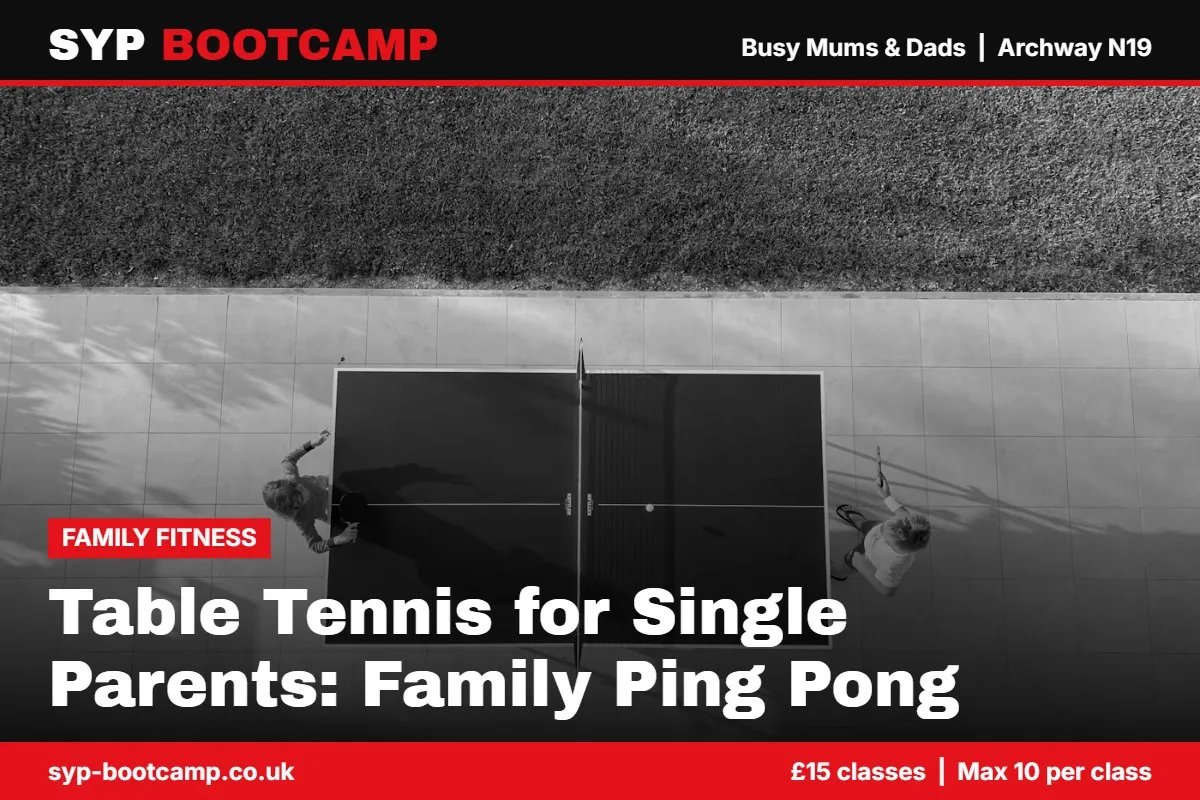
Table Tennis for Single Parents: Family Ping Pong
It is a wet Sunday, the kids are bouncing off the walls, and you have about £3 left in the fun budget for the week. A ping pong ball, two cheap bats and the kitchen table can rescue the afternoon. Table tennis for single parents is one of the most underrated family activities I know: cheap, quick to learn, playable by a six-year-old and a 46-year-old together, and surprisingly good for your reactions, balance and mood.
It will not replace strength training. I will be honest about that. But as a gentle workout that gets you moving with your children instead of watching them, it is hard to beat. Here is how I would use it.
Why table tennis for single parents is such a good fit
- Tiny cost. A basic bat-and-ball set costs very little, and a clip-on net turns almost any table into a court.
- Tiny space. You need a table and a bit of room to step around it. Perfect for a flat.
- Everyone can play. Children as young as five or six can rally if you stand close and hit softly. Teenagers will happily try to beat you.
- It trains things adults lose. Hand-eye coordination, quick decisions and light footwork tend to fade in our 40s if we never use them.
- It is free outdoors too. Lots of London parks have outdoor tables. Near us, Whittington Park in Archway has two outdoor table tennis tables next to the playground and a free outdoor gym. Bring your own bats and balls.
Setting up at home safely
A few minutes of setup avoids tears and broken glasses:
- Clear the table and move anything breakable off nearby shelves.
- Use a clip-on net, or a row of books on their spines as a net.
- Push chairs away so nobody trips stepping back.
- Smaller children can stand on a sturdy step so the table is at waist height. Supervise closely.
- Agree the “ball under the sofa” rule before you start. Whoever hit it out fetches it.
Five drills that build reactions (and make you move)
Rallying alone is lovely, but these drills add a training effect. Do each for 3 to 5 minutes.
1. Ten in a row
Count how many hits you can make together without missing. The goal is cooperation, not winning. Great for younger kids and for calming down a squabbly house.
2. Corner calls
One player calls “left” or “right” just before hitting, and the other must move their feet to that side rather than reaching. This is the one that gets your legs working and your heart rate up.
3. Ready position reset
After every shot, both players must return to a small athletic stance: feet hip-width, knees soft, bat in front. Holding this for a whole game is more work for the thighs than you would expect.
4. Wrong hand round
Play a full game with your non-dominant hand. Kids find this hilarious, and it is a real coordination challenge for adults.
5. Reaction drops
Without a table: drop a ball from shoulder height without warning. Your child catches it before the second bounce. Swap.
The family ladder league
This is how I suggest keeping table tennis going for more than one weekend. It works brilliantly with siblings and even with neighbours.
- Write everyone’s name on a sheet of paper in a column. That is the ladder. Stick it on the fridge.
- Anyone can challenge the person one or two places above them.
- Games are first to 7 points (shorter for the smallest players).
- If the challenger wins, they swap places.
- Handicaps keep it fair. Adults must play with their weaker hand against children under 8, or give them a 4-point head start. Teenagers might start 2 points behind you. Adjust until games are close.
- Add an exercise forfeit. The loser of each game does 5 squats or 5 wall push-ups. Fun, not punishment, and it adds a little strength work.
- Reset monthly. The winner picks the Friday film.
If you like this kind of thing, my post on family sports day games at home has more ideas for rainy weekends, and hand-eye coordination games has extra drills for younger children.
A 10-minute “ping pong plus” workout for you
Want a bit more from the session? While the kids play each other, do this beside the table, or do it after they go to bed:
- Side shuffles along the length of the table: 30 seconds
- Squats to a chair: 10 reps
- Wall push-ups: 10 reps (harder: hands on the table edge)
- Lateral lunges: 6 each side
- Standing trunk rotations, arms loose like a forehand: 20 total
Go round 3 times, resting a minute between rounds. Easy to scale, quiet, and needs no kit.
Looking after your back and neck
Table tennis has you leaning forward a lot, which can stiffen the lower back and neck, especially if you sit at a desk. Bend your knees rather than your back to get low. Take breaks every 15 to 20 minutes to stand tall and roll your shoulders. If you have ongoing back pain, the NHS page on back pain says staying active usually helps, but check with your GP or a physio if pain is severe, persistent or comes with other symptoms.
Where a bootcamp class fits
Ping pong gives you fun, movement and time with the kids. What it does not give you is the strength to carry shopping up the stairs and a back that copes with bending over a table for an hour. That is what my classes are for. At SYP Bootcamp we work on legs, trunk and posture in 45 minutes, with music and a small, friendly group. Our SYP Unlock hip and back mobility class is a good match if you feel stiff after leaning over a table or a laptop all day. For more ideas on fitting exercise around solo parenting, read my guide to single parent fitness.
FAQs
Is table tennis a good workout?
It is a gentle to moderate workout depending on how hard you play. Fast rallies with lots of footwork raise your heart rate, and it is excellent for reactions and coordination. For strength, you still need some resistance training each week.
What age can children start playing table tennis?
Many children can start rallying from around five or six with patient, slow hits. Younger children can enjoy catching and bouncing games with the ball first.
Can I play table tennis on a dining table?
Yes. A clip-on net works on most tables. It will be shorter than a regulation table, which actually makes it easier for children and beginners.
Where can I play table tennis for free in London?
Many parks have outdoor concrete tables. Check your council’s park pages. You usually need to bring your own bats and balls.
Book your first class
Ready for something that builds the strength ping pong cannot? SYP Bootcamp runs 45-minute small-group classes in Archway N19, maximum 10 people, at £15 a class. We are indoors in a church hall, and every exercise has an easier and harder option, so you can start wherever you are. Book your £15 class here or call or WhatsApp me on 07301 512215. If you live up the hill, I also offer 1-1 personal training in Highgate through SYP Fitness.
About the author
Artem Olekhnovych is a personal trainer in Archway and the founder of SYP Fitness and SYP Bootcamp. He has coached clients in Archway, Highgate and across North London for over 10 years, and runs small-group bootcamp classes for busy mums and dads. Read reviews from his 1-1 clients.
