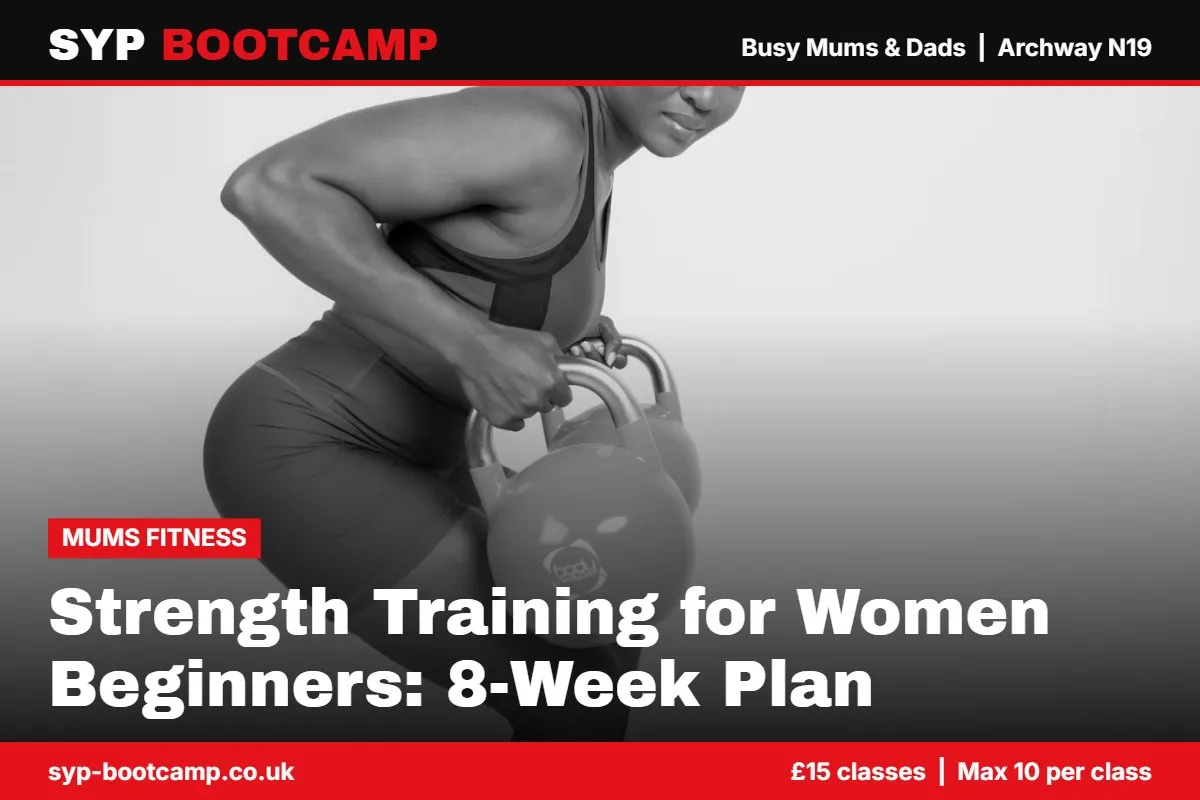
Strength Training for Women Beginners: 8-Week Plan
You have probably heard that you “should” be lifting weights. Your friend swears by it, the NHS recommends it, and every podcast seems to mention it. But walking into the weights area for the first time, or even buying a kettlebell for the living room, can feel daunting when nobody has shown you where to start. This guide to strength training for women beginners gives you a clear 8-week plan, explains the kit you need and how heavy to go, and shows you how to track progress so you can see yourself getting stronger week by week.
Why strength training is worth your time
The NHS physical activity guidelines recommend that adults do strengthening activities that work all the major muscle groups on at least two days a week. For women, especially busy mums, the benefits are very practical:
- Carrying children, shopping and car seats gets easier.
- Strong legs and hips can help protect your knees and back.
- Weight-bearing and resistance exercise helps keep bones strong, which matters more as you approach menopause. The NHS mentions this on its osteoporosis prevention page.
- Many women find it boosts mood and confidence.
And no, it will not make you bulky. My post on whether lifting weights makes you bulky explains why.
The kit you need
You can do this plan at home or in a gym. At home, start with:
- One kettlebell: 8 kg suits most beginners for squats and deadlifts. My guide on what weight kettlebell to start with goes into detail.
- A pair of light dumbbells: 3 to 5 kg for rows and presses.
- A resistance band: for warm-ups and glute work.
- A sturdy chair or step.
- A notebook or phone note to log your sessions.
How heavy should you lift?
Pick a weight you can lift for the target reps with good form, finishing with about 2 or 3 reps “left in the tank”. If you could easily do 5 more, go heavier. If your form breaks down before the end of the set, go lighter. When you hit the top of the rep range on every set for two sessions in a row, increase the weight slightly or add a rep. That steady increase is called progressive overload and it is the key to getting stronger.
Strength training for women beginners: your 8-week plan
Train 2 or 3 times a week, with at least one rest day between sessions. Each session takes 30 to 40 minutes. Warm up for 5 minutes first with marching, arm circles, bodyweight squats and glute bridges.
Weeks 1 and 2: learn the movements
2 sets of 10 reps, 60 seconds rest. Focus on technique, not weight.
- Goblet squat to a chair: hold the kettlebell at your chest, sit back to touch the chair, stand up. See my goblet squat guide.
- Kettlebell deadlift: push your hips back with a flat back, grab the bell between your feet, stand tall.
- Incline push-up: hands on a counter or bench.
- One-arm dumbbell row: hand on a chair, pull the weight to your hip.
- Glute bridge: on the floor, squeeze at the top.
- Dead bug: 6 each side, slow.
Weeks 3 and 4: build volume
3 sets of 10 reps. Same exercises. Try to add a little weight to squats and deadlifts if they felt comfortable.
Weeks 5 and 6: add load and new moves
3 sets of 8 to 10 reps, 90 seconds rest. Swap in:
- Reverse lunge instead of glute bridge (8 each leg)
- Dumbbell overhead press, 3 sets of 8
- Farmer’s carry: walk 20 metres holding a heavy weight in each hand, 3 times
Weeks 7 and 8: get stronger
3 to 4 sets of 6 to 8 reps on squats and deadlifts with a heavier weight, 2 minutes rest. Keep 3 sets of 8 to 10 on the other exercises. End each session with a 30 to 45 second plank.
How to track your progress
Write down for each session: the exercise, the weight, the sets and reps, and a note on how it felt (easy, good, hard). Every four weeks, test yourself:
- How many goblet squats can you do with good form in 60 seconds?
- How many incline push-ups can you do before your form breaks?
- How long can you hold a plank?
Seeing those numbers go up is very motivating, far more than the scales. My post on tracking fitness progress without scales has more ideas.
Form cues to remember
- Brace: take a breath in, gently tighten your middle, then lift.
- Breathe out on the effort. Do not hold your breath, especially if you have pelvic floor symptoms.
- Feet flat, knees track over toes.
- Flat back on deadlifts and rows. Hinge from the hips.
- Stop if it hurts. Muscle effort is fine, sharp or joint pain is not.
If you are pregnant, postnatal (your GP check is usually around 6 to 8 weeks after birth), have high blood pressure, osteoporosis, an injury or another health condition, check with your GP or physio before starting.
Where a bootcamp class fits
Learning to lift is much easier when someone can watch your technique. In my SYP Built To Last strength class we use kettlebells, dumbbells and bodyweight for exactly these movements, with easier and harder options so you always work at the right level. A lot of women use classes alongside a home plan like this one: one or two classes a week plus one session at home.
FAQs
How often should a beginner woman do strength training?
Two or three sessions a week is a great start, with a rest day between each. The NHS recommends strength activities on at least two days a week.
How long does it take to see results from strength training?
Most beginners feel stronger within 3 to 4 weeks as their body learns the movements. Visible changes vary and take longer, often a few months.
Should I do cardio or weights first?
If getting stronger is your main goal, do weights first while you are fresh. A short warm-up of light cardio before lifting is a good idea.
Is it OK to do strength training during your period?
Yes, if you feel up to it. Some women feel stronger at certain points in their cycle and more tired at others. Adjust the weight to how you feel on the day.
Book your first class
If you want coaching on your squats, deadlifts and presses from someone who works with beginners every week, come and train with me. SYP Bootcamp runs 45-minute small-group classes indoors in a church hall in Archway N19, max 10 people, £15 a class. Book your £15 class here or call or WhatsApp me on 07301 512215. If you want a fully personalised plan with one-to-one support, have a look at my 12-week transformation programme.
About the author
Artem Olekhnovych is a personal trainer in Archway and the founder of SYP Fitness and SYP Bootcamp. He has coached clients in Archway, Highgate and across North London for over 10 years, and runs small-group bootcamp classes for busy mums and dads. Read reviews from his 1-1 clients.
