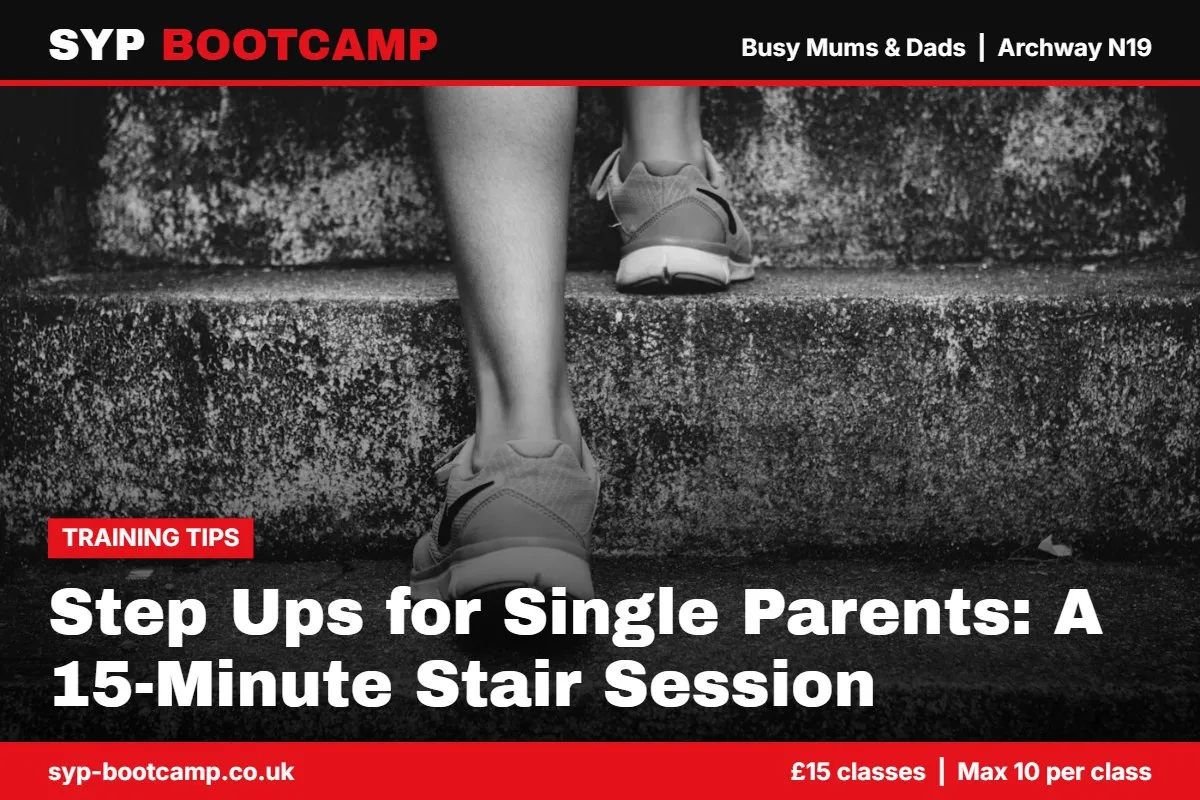
Step Ups for Single Parents: A 15-Minute Stair Session
Here is a confession from a personal trainer: some of the best leg workouts I have ever given clients happened on a staircase. If you have a bottom stair at home, or a sturdy bench in the garden or the local park, you have everything you need for step ups for single parents. They are simple, they build strong legs and a fitter heart, and you can stop mid-set to wipe a nose or find a missing shoe, then carry straight on.
That last part matters. When you are the only grown-up in the house, workouts get interrupted. A plan that falls apart the moment someone shouts “Mum!” or “Dad!” is no good. This one is built for interruptions.
Why step ups for single parents work so well
Step ups train one leg at a time. That means they fix imbalances between your sides, improve balance and copy real life: climbing stairs with a toddler on your hip, getting up a steep kerb with a buggy, carrying shopping up to a flat. They are also quiet. Unlike jumping exercises, they will not shake the ceiling of the neighbour downstairs.
Best of all, there is no setup. You do not unroll a mat or move furniture. You walk to the stairs and start. If you live in a flat with a communal stairwell, my stairs workout post has more ideas for using whole flights.
How to do a step up properly
- Stand facing the bottom stair. Place your whole right foot on the step, heel included. Not just your toes.
- Lean your chest forward slightly so your nose is roughly over your front knee.
- Push down through the heel of the front foot and stand up onto the step. Try not to push off with your back foot. Imagine it is made of paper.
- Stand tall at the top, then lower yourself back down slowly with the same leg in control.
- Do all your reps on one side, then switch.
Key cue: “Front leg does the work.” If you bounce off your back toes, you are cheating yourself out of the strength part. Slow it down.
Hold the banister or a wall if you need it for balance. That is not cheating, it is sensible, especially when you are tired.
Picking the right step height
A standard UK stair is a nice beginner height for most adults. If it feels too hard, start with step ups onto a thick book or a low doorstep. Once the bottom stair feels easy, use the second stair, or a park bench. Keep this rule in mind: at the bottom of the movement, your front knee should not go higher than your hip. Higher steps add strain without adding much benefit.
If you are using a bench, check it is solid and does not wobble, and that the surface is dry. Wet wood in a British park is slippery.
The 15-minute stop-and-start leg session
This session is split into five 3-minute blocks. Each block stands on its own. If you get interrupted, finish the block you are on later, or just pick up with the next one. You do not need to restart anything.
Block 1: warm up (3 minutes)
- March on the spot for 1 minute.
- Slow step ups with no pause, alternating legs, for 2 minutes.
Block 2: strength (3 minutes)
- Step ups, 10 on the right leg, 10 on the left. Lower over 3 seconds.
- Rest for whatever time is left in the 3 minutes.
Block 3: balance (3 minutes)
- Step up and lift the back knee to hip height at the top. Hold 2 seconds. 8 each leg.
Block 4: heart rate (3 minutes)
- Alternating step ups at a brisk pace for 40 seconds, rest 20 seconds, 3 rounds.
- Keep the whole foot on the step even when going faster.
Block 5: finisher and stretch (3 minutes)
- Calf raises on the edge of the step, holding the banister: 2 sets of 15.
- Stretch your thighs and calves for the remaining time.
Two or three times a week is enough. If you only manage two blocks on a chaotic day, that is still a win.
Making it harder over time
- Go slower. A 4-second lowering phase is tougher than you think.
- Hold weight. A water bottle in each hand, a filled backpack, or a kettlebell held at your chest.
- Go higher. Second stair or a bench, as long as your knee stays below hip height.
- Add a reverse lunge. Step up, step down, then go straight into a reverse lunge with the same leg.
Doing it with kids around
Little ones love copying you on the stairs, but they should only do it while you are right there, and toddlers should be at the bottom step only with a hand to hold. A stairgate on the second step can be a handy boundary. Older kids can count your reps or time the blocks on your phone. If the stairs are a no-go zone in your home, the park bench option works brilliantly during a playground trip.
If your knees complain
Step ups are usually knee-friendly when the step is low and the knee tracks in line with your toes. If you feel sharp pain at the front of the knee, use a lower step, slow down and check your knee is not caving inwards. If pain continues, or you have a knee injury, check with your GP or a physio. The NHS page on knee pain explains when to get help, and my post on knee-friendly workouts has more options.
Where a class fits in
Home step ups are a brilliant base. In class we add things that are harder to do alone: proper step platforms at the right height, kettlebells and the buzz of a small group doing intervals together. Our SYP Recharge energy and focus class uses step-based intervals that leave you feeling more awake rather than wiped out. And if you want the wider picture of exercising as a solo parent, my single parent fitness guide pulls it all together.
FAQs
Are step ups good for your bum?
Yes. Leaning slightly forward and pushing through the heel of your front foot puts a lot of work into your glutes, as well as your thighs.
How many step ups should I do?
For strength, 2 to 3 sets of 8 to 12 on each leg. For fitness, go for timed blocks like 40 seconds on, 20 seconds off.
Is the bottom stair high enough?
For most beginners, yes. It is a good height to start building strength. Move to a higher step only when your knee stays below hip height and the bottom stair feels easy.
Do step ups count as cardio?
Done at a brisk pace for a few minutes, they raise your heart rate nicely. Slow, controlled step ups are more of a strength exercise.
Book your first class
If you get an evening or morning with cover, use it for something that is all yours. SYP Bootcamp runs 45-minute small-group classes in Archway N19, max 10 people, £15 a class, indoors and open to all fitness levels. Book your £15 class here or call or WhatsApp me on 07301 512215. If you are curious what one to one coaching would look like, here is how SYP Fitness personal training works.
About the author
Artem Olekhnovych is a personal trainer in Archway and the founder of SYP Fitness and SYP Bootcamp. He has coached clients in Archway, Highgate and across North London for over 10 years, and runs small-group bootcamp classes for busy mums and dads. Read reviews from his 1-1 clients.
