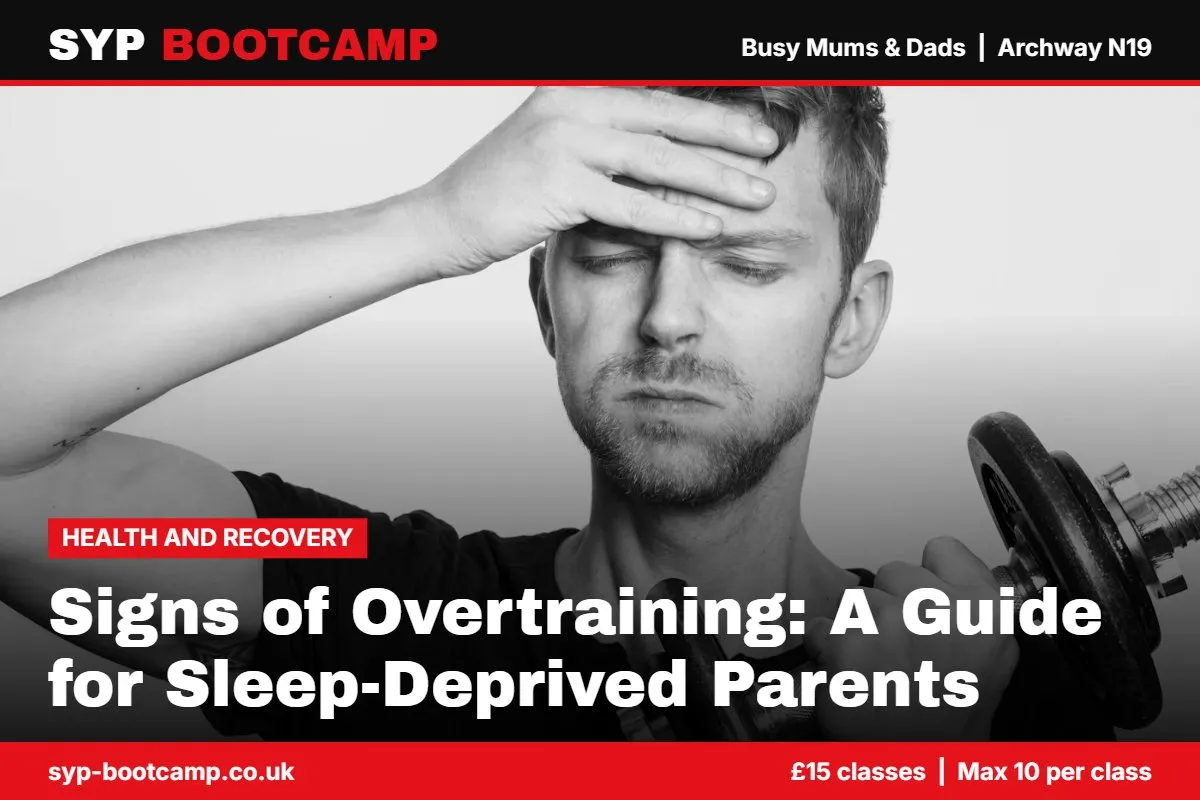
Signs of Overtraining: A Guide for Sleep-Deprived Parents
You started a new routine with real energy. Three weeks in, your legs feel heavy on the stairs, you are snapping at the kids, and the session you used to enjoy now feels like dragging a sofa uphill. Is it laziness? Probably not. For a parent running on broken sleep, the signs of overtraining can show up much sooner than they would for a 22-year-old with nothing to do but train, eat and nap.
In this post I will walk you through the warning signs I look out for in busy mums and dads, why sleep-deprived parents are more at risk, and exactly what to change this week.
Overtraining is really “under-recovering”
Exercise is a stress. The fitness gains happen afterwards, while you recover. Recovery needs sleep, food and some calm. If you are already short on all three because of a teething baby, a stressful job or a toddler who thinks 5am is morning, then your recovery tank is smaller. The same workout that a well-rested person bounces back from can leave you dug into a hole.
So for parents, I rarely see true elite-athlete overtraining. What I see a lot is simple under-recovery: too much intensity stacked on too little rest, for too many weeks in a row.
Signs of overtraining to watch for
None of these on their own proves anything. A cluster of them, lasting more than a week or two, is your cue to back off.
In your body
- Soreness that will not shift. Normal muscle soreness usually eases within a few days. If you are sore all the time, or every session feels like day two of DOMS, recovery is not keeping up.
- Performance going backwards. The weights you managed easily last month feel heavy. Your usual walk up Highgate Hill feels harder.
- Niggles stacking up. A grumbling knee, then a sore shoulder, then an achy Achilles.
- Catching every bug going. More colds than usual, or colds that drag on.
- Resting heart rate creeping up. If you wear a watch, a resting pulse that sits several beats higher than your normal for a week can be a sign of fatigue (or illness).
In your head and your day
- Dreading sessions you used to like.
- Short fuse and low mood. More irritable with your partner or the kids.
- Poor sleep despite being exhausted. Wired at bedtime, then shattered at 3pm.
- Cravings and appetite swings. Living on biscuits by Thursday.
One important note: these signs overlap with plenty of other things, including illness, low iron, thyroid problems, depression and simply being a parent of small children. If you feel tired all the time for weeks with no obvious reason, the NHS page on tiredness and fatigue explains when to see a GP. Do not assume it is “just training”.
Why sleep-deprived parents tip over faster
Most of the repair work your body does happens during sleep. Parents with young kids often get fragmented sleep, which is not the same as a long, unbroken night even if the total hours look fine. Add a high-intensity class five days a week because you want results quickly, plus some strict dieting, and you have a recipe for burnout. I go into the sleep side more in exercising when you are sleep deprived.
What to change: a 7-day reset
If three or more of the signs above ring true, try this for one week:
- Cut your hard sessions in half. If you were doing four intense workouts, do two. Keep them, but drop the volume by about a third (fewer sets, same weights).
- Swap the rest for easy movement. 20 to 30 minute walks, gentle mobility, a slow swim. You should be able to chat comfortably throughout.
- Put two full rest days in the diary. Not “rest” where you do a 5k instead. Actual rest.
- Protect one early night. Agree with your partner, or ask family to take one bedtime, so you get to sleep an hour earlier at least twice this week.
- Eat enough. Get some protein at each meal and do not crash-diet while training hard. Recovery needs fuel.
- Use a simple daily check-in. Score sleep, mood and soreness from 1 to 5 each morning. If two are at 2 or below, make that day an easy one.
Most people feel noticeably fresher within a week. Then build back up slowly: add one harder session at a time, and only if your check-in scores hold.
The long-term fix: plan easy weeks before you need them
Rather than waiting until you crash, build a lighter week into your plan every four to six weeks. Lifters call it a deload week. For parents, it is also handy to line these up with known busy times: school holidays, a work deadline, a week when your partner is away. My guide to rest days and recovery has more on structuring your week.
How a bootcamp class fits without burning you out
A good class should leave you energised, not destroyed. In my sessions every exercise has an easier and a harder option, and I would honestly rather you pick the easier one on a 4-hour-sleep morning than grind through and pay for it for three days. Two or three classes a week, plus walking, is plenty for most busy parents. If you are feeling flat, the SYP Recharge energy and focus class is designed to leave you feeling better than when you walked in.
FAQs
What are the first signs of overtraining?
Usually persistent tiredness, soreness that does not go away between sessions, and workouts feeling harder than they should. Mood changes and poor sleep often follow.
How long does it take to recover from overtraining?
Mild under-recovery often improves within one to two weeks of lighter training and better sleep. If you still feel exhausted after that, see your GP to rule out other causes.
Can you overtrain doing only 3 workouts a week?
Yes, if those sessions are very intense and your sleep, food and stress are poor. Overtraining is about the balance between load and recovery, not a set number of workouts.
Should I stop exercising completely if I am overtrained?
Usually not. Most people do better swapping hard sessions for easy walks and mobility for a week or two, then building back slowly.
Book your first class
If you want structure without overdoing it, come and train with a coach who will tell you when to ease off. SYP Bootcamp runs 45-minute small-group classes in a church hall in Archway N19, max 10 people, £15 a class. Book your £15 class here, or call or WhatsApp me on 07301 512215. If you would like to see how I plan training and recovery for 1-1 clients, here is how personal training at SYP Fitness works.
About the author
Artem Olekhnovych is a personal trainer in Archway and the founder of SYP Fitness and SYP Bootcamp. He has coached clients in Archway, Highgate and across North London for over 10 years, and runs small-group bootcamp classes for busy mums and dads. Read reviews from his 1-1 clients.
