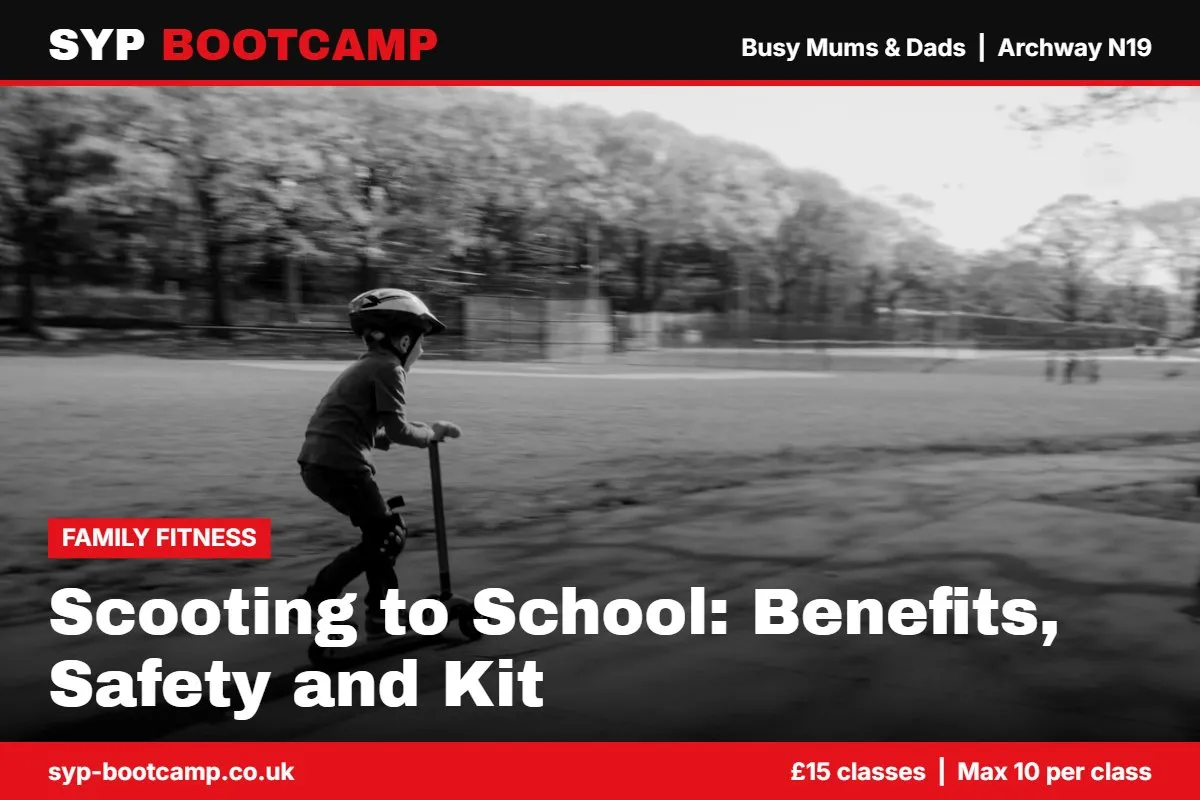
Scooting to School: Benefits, Safety and Kit
Every school morning in Archway, you see the same scene: kids whizzing along the pavement on scooters, a parent half jogging behind with a book bag and a coffee. If that is not you yet, it might be worth a try. Scooting to school turns a dull walk into something children actually look forward to, gets them to the gate awake and alert, and quietly adds activity to your day too. In this guide I cover the real benefits, how to stay safe on busy London pavements, what kit you need and how to make the school run part of your family’s daily movement.
Why scooting to school is worth it
It gets kids moving every day
The NHS physical activity guidelines for children and young people recommend at least 60 minutes of moderate or vigorous activity a day on average for 5 to 18 year olds. A scoot to school and back can cover a good chunk of that before they have even sat down in class.
It builds balance and leg strength
Pushing off with one leg and balancing on the other works the legs, hips and core. Steering and braking build coordination. These are the same skills that later help with cycling and many sports.
It makes the journey faster and happier
A child who drags their feet on a 15-minute walk will often happily scoot the same distance. Less moaning, fewer late marks.
It is cheap
A decent scooter costs far less than a bike, needs almost no maintenance and folds up to fit in a hallway.
It gets you moving too
Keeping up with a scooter means brisk walking at least. That counts towards the 150 minutes of moderate activity a week recommended in the NHS physical activity guidelines for adults. Ten minutes there and ten back, five days a week, adds up to 100 minutes. You have done two thirds of your weekly target on the school run.
Safety: the rules that matter
Pavements in North London are busy, narrow in places and full of driveways, bus stops and side roads. These are the rules I would set with any child:
- Stop at every kerb. Feet down, scooter stopped, wait for the grown-up. Every single time, no exceptions.
- Walk the scooter across roads. Never scoot across a road, even on a zebra crossing.
- Slow down near people. Pedestrians come first. Slow to walking pace near the elderly, prams and crowds at the school gate.
- Watch for driveways. Cars reversing out cannot always see small children.
- Stay within sight. Agree a “stop point” ahead, such as the next lamp post, where they wait for you.
- Scoot on the pavement, not the road. Kick scooters are for pavements and parks. Electric scooters are a different matter: privately owned e-scooters are not legal on public roads or pavements in the UK.
Practise the rules in a quiet park first, then on the actual route at a weekend when there are fewer people around.
Kit checklist
- A scooter that suits their age. Three-wheel scooters (two wheels at the front) are more stable for under 5s. Two-wheel scooters suit most children from about 5 or 6, once their balance is good.
- Adjustable handlebars so the scooter grows with them. Handlebars around waist height are about right.
- A working brake. Check the rear foot brake regularly.
- A helmet. It is not a legal requirement, but I strongly recommend one. Make sure it fits snugly and sits level, two fingers above the eyebrows.
- Something bright. A hi-vis vest, reflective strips or a light clipped to the bag for dark winter mornings.
- Gloves in cold weather. Cold hands are bad at braking.
- A lock or scooter rack. Ask the school where scooters can be left during the day.
Making it part of your family’s daily activity
Scooting to school is a great start. Here is how to build on it:
- Take the long way home. Add a loop through a park on the way back. Five extra minutes, every day.
- Turn the walk home into a workout for you. After drop-off, walk briskly back, or stop at a park bench for 3 rounds of 10 step-ups, 10 incline push-ups and 10 squats. It takes under 10 minutes.
- Weekend scoots. Use the scooter for weekend trips to the park or shops too, so it becomes “how we get around”.
- Swap with walking days. Some days walk, some days scoot. Variety keeps it fresh.
I wrote more about using the morning journey for your own fitness in my post on walking the school run, and if you want to fit in a proper session before the day starts, see my morning workout before the school run.
What about bikes?
Scooters are a great step towards cycling. Many children who scoot confidently find balance bikes and pedal bikes easier to learn. If your child is ready for the next step, Islington runs Bikeability and cycle skills training, and there are tips in my post on how to teach a child to ride a bike.
Common problems and fixes
“My child goes too fast”
Set clear stop points and practise “emergency stops” in the park as a game. Give lots of praise for stopping well.
“I end up carrying the scooter home”
Choose a scooter light enough for your child to carry or pull, and make “you scoot it, you carry it” a rule. A carry strap helps.
“The pavement is too crowded near school”
Agree a point a few minutes before school where everyone gets off and walks. It is safer and kinder to other families.
Where a bootcamp class fits in
The school run gets you moving. But to feel strong, energetic and less achy, most parents also need some proper strength and fitness work. That is what my classes are for. If you spend your mornings jogging behind a scooter and your days at a desk, my SYP Unlock hip and back mobility class is a good place to start.
FAQs
What age can a child scoot to school?
Many children start scooting from around 3 on a three-wheel scooter, with an adult close by. Two-wheel scooters suit most children from about 5 or 6. Children should always be supervised near roads.
Do children have to wear a helmet on a scooter?
It is not a legal requirement in the UK, but a well-fitted helmet is strongly recommended, especially near roads and on hills.
Is scooting good exercise for kids?
Yes. It works the legs, hips and core, builds balance and coordination and gets children’s hearts pumping on the way to school.
Can children ride electric scooters to school?
No. Privately owned e-scooters are not legal to ride on public roads or pavements in the UK. Stick to kick scooters.
Book your first class
Once the kids are at school, it is your turn. SYP Bootcamp runs 45-minute small-group classes in a church hall in Archway N19, indoors whatever the weather, with a maximum of 10 people. Every exercise has an easier and harder option and each class costs £15. Book your £15 class here or call or WhatsApp me on 07301 512215 and I will send the timetable. If you live one stop down the Northern line, read about my personal training in Tufnell Park.
About the author
Artem Olekhnovych is a personal trainer in Archway and the founder of SYP Fitness and SYP Bootcamp. He has coached clients in Archway, Highgate and across North London for over 10 years, and runs small-group bootcamp classes for busy mums and dads. Read reviews from his 1-1 clients.
