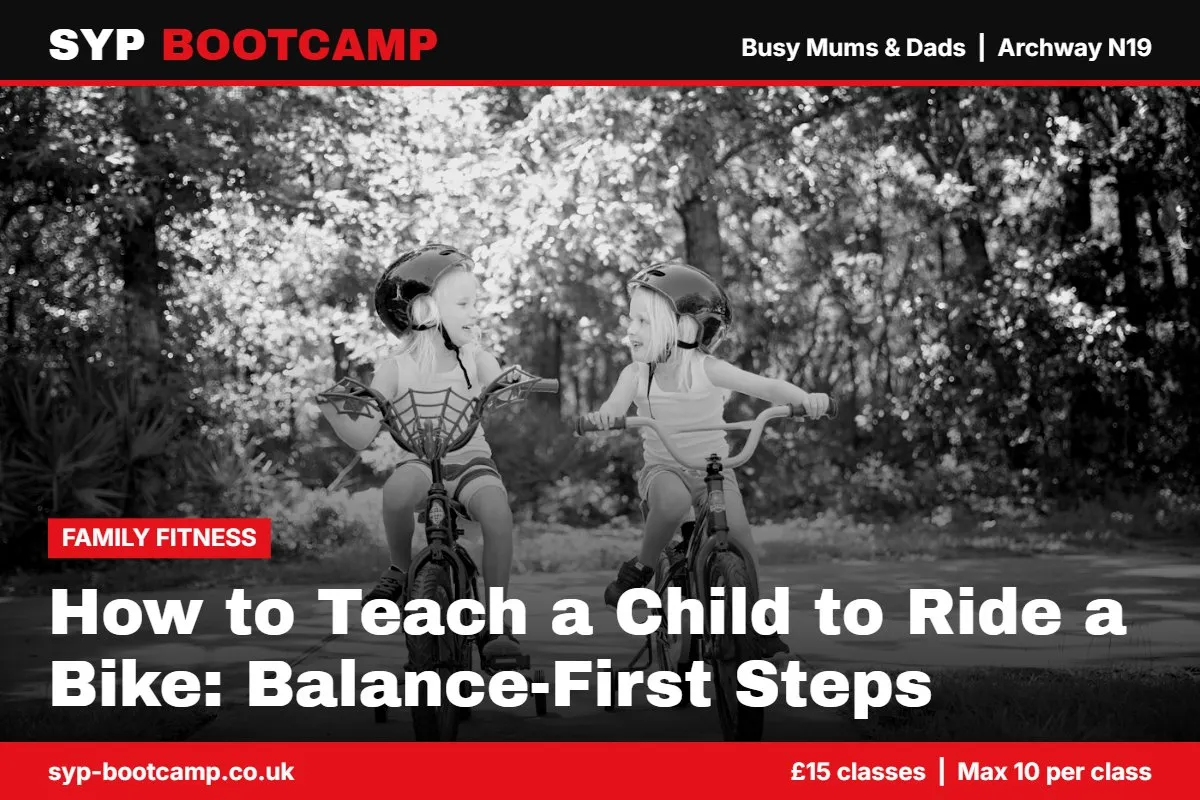
How to Teach a Child to Ride a Bike: Balance-First Steps
Most of us remember learning to ride with a parent running behind, bent double, holding the back of the saddle and shouting “keep pedalling!” It works eventually, but it is hard on your back and scary for the child. There is an easier way. If you are wondering how to teach a child to ride a bike without tears (theirs or yours), the answer is to teach balance first and pedalling second. Kids who learn this way often go from wobbly to riding in a few short sessions.
I coach busy parents in Archway, and getting kids cycling comes up all the time, because it opens up so much: rides on the Parkland Walk, trips to the Heath, and eventually riding to school. Here is the step-by-step method I share.
Why balance first works
Riding a bike combines three skills: balancing, steering and pedalling. Stabilisers let a child practise pedalling, but they take away the balancing, which is the hardest part. That is why children often struggle when the stabilisers come off.
A balance bike (or a normal bike with the pedals removed) flips this. The child scoots along with their feet, learns to lean, steer and glide, and pedalling is added once balance is automatic. Many kids who start on balance bikes never need stabilisers at all.
What you need
- A bike that fits. Your child should be able to sit on the saddle with both feet flat on the ground. If they are on tiptoes, lower the saddle.
- A helmet that fits snugly, sitting level just above the eyebrows, with the strap done up.
- Closed shoes, not sandals or wellies.
- Long trousers or knee pads if your child is nervous about falling.
- A safe, flat, traffic-free space with a smooth surface. A very gentle slope helps later.
How to teach a child to ride a bike: 7 steps
Step 1: Remove the pedals (or use a balance bike)
If you only have a pedal bike, take the pedals off with a spanner (the left pedal usually unscrews clockwise, the right one anti-clockwise) and lower the saddle. Now it is a balance bike.
Step 2: Walk with the bike
Your child sits on the saddle and walks the bike forwards, feet on the ground. Ask them to look ahead, not down at their feet. Five minutes of this builds confidence.
Step 3: Scoot and glide
Now they take bigger, faster pushes with both feet and lift their feet off the ground for a second. Make it a game: “How many lamp posts can you glide past?” or “Can you glide for a count of 3?” This is the heart of the method. Spend as long as needed here, often a couple of sessions.
Step 4: Practise steering and braking
Set up a few markers (shoes or water bottles) and let them weave around them while gliding. Teach braking early: squeeze both brakes gently to stop. Practise “stop on my signal” until it is automatic. Stopping safely matters as much as going.
Step 5: Put the pedals back on
Once they can glide for several seconds and steer around obstacles, refit the pedals. Keep the saddle low enough that they can put their feet down easily.
Step 6: The power pedal start
Ask your child to put one pedal at about “2 o’clock” (forward and up). Pushing down on that pedal gives them a strong start. Hold their shoulders lightly (not the saddle), let them push off, and let go as soon as they are moving. Holding the shoulders keeps your back straighter and helps them balance through their own body.
Step 7: Short rides, lots of praise
Keep each session to 15 to 20 minutes. Finish on a good ride. Gradually raise the saddle as they get confident, and add gentle turns, slopes and stopping drills.
Common problems and quick fixes
- They look down at the pedals: give them something to look at ahead, like you standing at the end of the path.
- They wobble at low speed: a bit more speed makes balance easier. A very gentle downhill slope helps.
- They panic and stop pedalling: go back to gliding for a few minutes, then try again.
- They are scared of falling: lower the saddle so feet reach the floor easily, add knee pads, and remind them they can always put their feet down.
Where to practise near Archway
Look for wide, flat, traffic-free paths in parks or quiet playgrounds where cycling is allowed. Check signs before you start, as some parks restrict cycling on certain paths. The City of London’s page on cycling at Hampstead Heath explains where you can ride there.
For extra help, Islington Council runs Bikeability and cycle skills training. I have written more about it in free cycle training in Islington. Once your child is riding, my guide to cycling with kids in London covers family routes and staying safe on the road.
Look after your back
Even with the balance-first method, you will be bending, jogging alongside and lifting bikes in and out of the car or up the stairs. If that leaves your lower back aching, you are not alone. My SYP Built To Last functional strength class is built around these real-life movements: lifting, carrying, hinging and getting up and down without strain.
FAQs
What is the best age to learn to ride a bike?
Many children start on a balance bike from around 2 or 3 and move to a pedal bike between 3 and 6. There is no fixed age. Kids who learn later often pick it up very quickly, especially with the balance-first method.
Are stabilisers bad?
They are not dangerous, but they can slow down learning balance, and some children find it hard to ride once they come off. Many parents now skip them and go straight from balance bike to pedal bike.
How long does it take to teach a child to ride a bike?
It varies a lot. Some children who have used a balance bike ride a pedal bike within one session. Others need several short sessions over a few weeks. Short, frequent practice beats one long, tiring afternoon.
Should my child wear a helmet?
Yes. A well-fitted helmet is sensible every time your child rides, and it is a good habit to start from the very first session.
Book your first class
Running behind a bike is a workout, and it is easier when you are fit for it. SYP Bootcamp runs 45-minute small-group classes for busy parents in an indoor church hall in Archway N19, with a maximum of 10 people and an easier or harder option for every exercise. Classes are £15 each, and the timetable is sent when you book. Book my £15 class, or call or WhatsApp me on 07301 512215. If a sore back or old injury is holding you back, I also offer injury-safe personal training in Archway.
About the author
Artem Olekhnovych is a personal trainer in Archway and the founder of SYP Fitness and SYP Bootcamp. He has coached clients in Archway, Highgate and across North London for over 10 years, and runs small-group bootcamp classes for busy mums and dads. Read reviews from his 1-1 clients.
