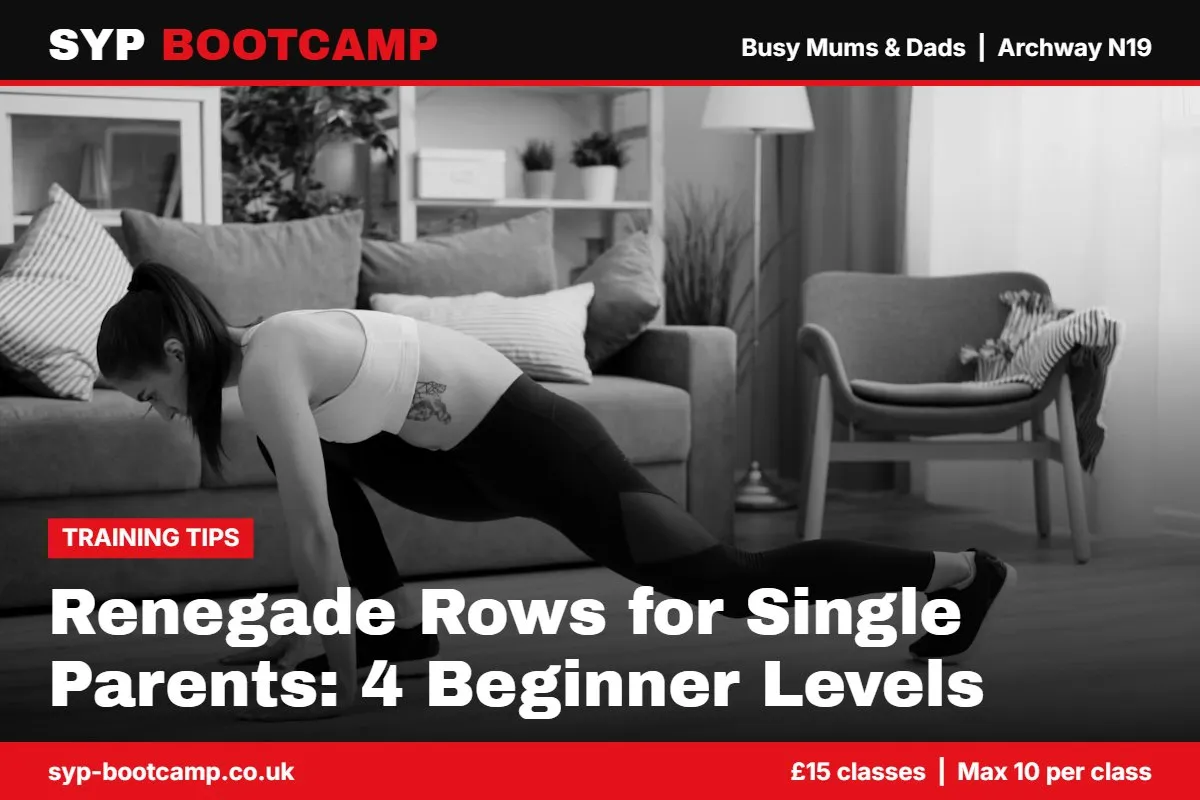
Renegade Rows for Single Parents: 4 Beginner Levels
You see renegade rows on Instagram: someone in a perfect plank, rowing heavy dumbbells one arm at a time without a wobble. It looks like a move for people with a home gym and a free morning. But the skill behind it, holding your body steady while one arm does something else, is exactly what you need when you are carrying a wriggling toddler on one hip and a bag of shopping in the other hand. This guide to renegade rows for single parents breaks an advanced move down into versions any beginner can do on a living-room floor, then puts them into a short circuit you can fit in before the kids wake up or after they go down.
What a renegade row actually trains
A renegade row is a high plank on two dumbbells. You row one weight up to your ribs while the other hand and both feet hold you still, then swap sides. It is two exercises at once:
- An anti-rotation core exercise. Your tummy and hips have to stop your body twisting when one hand leaves the floor.
- A one-arm back row. The muscles round your shoulder blade pull the weight up.
The core part is the real prize. Most daily injuries I see in parents come from twisting under load: lifting a car seat out at an angle, hauling a buggy up the stairs to a flat, scooping a child off the floor with a rounded back. Training your trunk to resist twisting makes those moments safer.
Be honest: is the full version right for you yet?
Probably not on day one, and that is fine. The full renegade row needs a strong plank, steady shoulders and decent wrists. If you rush it, your hips swing side to side, your lower back sags, and the move turns into a wobbly mess that trains nothing much.
A good test: can you hold a straight-arm plank on your hands for 30 seconds with your hips level? If not, build that first using my plank progression for beginners, and start with Level 1 below.
A note on health: if you have had a baby in the last year, have a tummy gap (diastasis), wrist problems or back pain, check with your GP or a physio before plank-based moves. Most people are checked by their GP around 6 to 8 weeks after giving birth, and the NHS explains this in its guide to your 6-week postnatal check.
Renegade rows for single parents: the 4 levels
Stay on each level until you can do 3 sets of 6 slow reps per side with your hips not moving. Then move up.
Level 1: kneeling shoulder taps
Plank on your hands and knees, knees behind your hips so your body is in a straight line from head to knee. Lift one hand and tap the opposite shoulder, then swap. The goal is zero hip sway. Put a plastic cup of water or a soft toy on your lower back. If it falls, slow down.
Level 2: kneeling renegade row, no weight
Same kneeling plank, hands on two sturdy books or yoga blocks. Slide one hand up towards your ribs as if rowing, pause, put it down. This teaches the path of the arm without adding weight.
Level 3: kneeling renegade row with light weight
Use two hexagonal dumbbells (round ones roll and can hurt your wrist) or two filled 1-litre water bottles laid on their side so they will not tip. Row one up to your hip, lower it slowly, then the other. Widen your knees a little for more balance.
Level 4: full renegade row
Move onto your toes, feet wider than hip width. The wider your feet, the easier it is to stay still. Row, pause, lower, swap. Start light; most of my class members use 4 to 6 kg dumbbells for months before going heavier.
Form cues: push the floor away with the hand that is down, squeeze your bum, breathe out as you row, and keep your eyes just in front of your hands. Stop if your wrists or lower back hurt rather than just your muscles working hard.
A 12-minute living-room circuit
This works on a mat between the sofa and the coffee table. It is quiet enough for flats and short enough for nap time. Do each exercise for 40 seconds, rest 20 seconds, and go round 3 times.
- Renegade row (your level from above)
- Squat to the sofa, sitting down lightly and standing up
- Dead bug, lying on your back, lowering opposite arm and leg slowly
- Reverse lunge, holding the back of a chair if needed
- Glute bridge with a 2-second squeeze at the top
For more trunk work you can rotate in, my guide to core exercises for beginners has plenty of floor-friendly options.
Kids in the room? Make it a game
Renegade rows are oddly good with children around, because you are low to the ground and they love “obstacles”. A few ideas parents in my classes use:
- Tunnel time: a small child crawls under you between reps (not during them), which keeps your plank honest.
- Counting coach: an older child counts your reps out loud and tells you if your hips move.
- Copycat: they do kneeling shoulder taps next to you. Kids are usually better at it than adults.
Keep dumbbells on the floor and out of reach when you are not using them, and never let a child stand on or lean on you while you hold weights.
Where a bootcamp class fits
Renegade rows are a move where a second pair of eyes helps. In my small-group classes I can see in a second whether you need wider feet, lighter weights or another week on your knees. We use plank variations in almost every session, with easier and harder options so a complete beginner and a regular can work side by side. My SYP Built To Last strength class uses this kind of anti-rotation work to keep backs healthy for lifting kids and shopping. And if you are working out how to fit any of this round solo parenting, start with my single parent fitness hub.
FAQs
Are renegade rows good for beginners?
The full version is not ideal for most beginners. Kneeling versions with no weight or light weight are a great place to start, and you can build up to the full move over a few months.
What weight should I use for renegade rows?
Lighter than you think. Use a weight you could row 15 times standing up, then use that for 6 to 8 reps in plank. Hexagonal dumbbells are safer than round ones because they do not roll.
Why do my hips sway during renegade rows?
Your core cannot yet resist the twist. Widen your feet, drop to your knees or lighten the weight. Slow reps with still hips are worth far more than fast ones.
Book your first class
If you want someone to check your plank and rows rather than guessing in your living room, come and train with us. SYP Bootcamp runs 45-minute small-group classes in Archway N19, max 10 people, £15 a class, indoors and weatherproof. Book your £15 class here or call or WhatsApp me on 07301 512215 and I will send you the timetable. Curious how one-to-one coaching would work around your week? Read how SYP Fitness personal training works.
About the author
Artem Olekhnovych is a personal trainer in Archway and the founder of SYP Fitness and SYP Bootcamp. He has coached clients in Archway, Highgate and across North London for over 10 years, and runs small-group bootcamp classes for busy mums and dads. Read reviews from his 1-1 clients.
