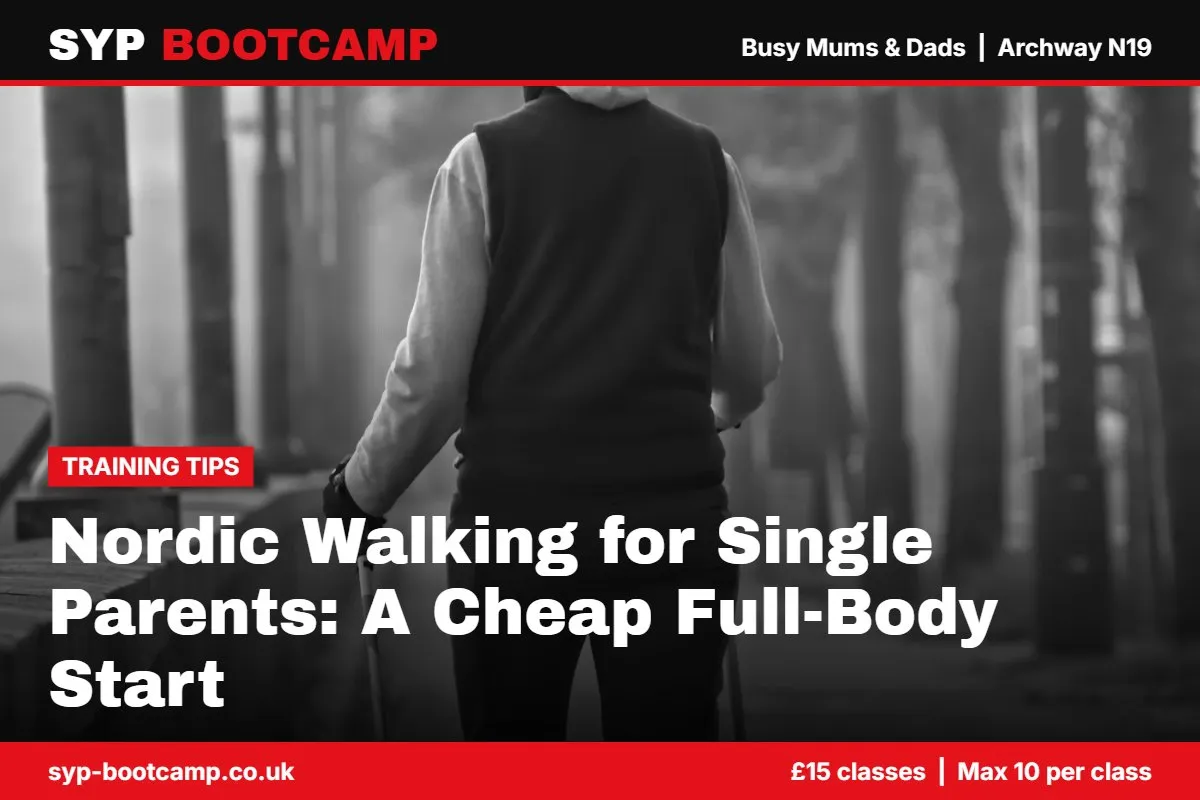
Nordic Walking for Single Parents: A Cheap Full-Body Start
If you are raising kids on your own, a walk is often the only exercise that fits. You are already walking to school, to the shops, to the park. The problem is that a normal stroll rarely feels like a workout. That is where nordic walking for single parents earns its place. Add two poles and the same walk starts working your arms, shoulders, back and core, not just your legs. It costs very little and you can start on paths you already know.
I coach a lot of solo mums and dads in Archway, and the ones who stick with exercise are the ones who pick something that fits the life they actually have. Nordic walking fits surprisingly well.
Why poles turn a walk into a full-body workout
In ordinary walking your arms swing loosely and do almost nothing. With nordic poles, every step includes a push. You plant the pole behind you and drive back through it, which brings in the muscles across your upper back, the backs of your arms and your trunk. Your legs still do the walking, but now the top half of your body is pulling its weight too.
What I like most for tired parents:
- It feels easier than it is. Because the effort is spread across more muscles, your heart rate goes up but your legs do not feel as battered.
- It is kind to joints. No jumping, no pounding. The poles take a little of the load off knees and hips on hills.
- It fixes “school run posture”. Pushing back through the poles opens your chest and pulls your shoulders out of that hunched, carrying-a-bag-and-a-toddler shape.
- It counts. The NHS says brisk walking is moderate activity that counts towards your 150 minutes a week, and its walking for health page is a good place to start.
Starting nordic walking for single parents on a budget
You do not need much. Here is the honest kit list:
- A pair of nordic walking poles. These are different from hiking poles. Nordic poles have a glove or strap that lets you open your hand on the back swing, and a rubber “paw” for pavements. Basic aluminium ones are fine. You do not need carbon fibre.
- The right length. Stand tall, hold the grip with the tip by your foot, and your elbow should be bent at roughly 90 degrees.
- Comfortable trainers. The ones you already own will do for paths and parks.
The technique in four steps
- Walk normally first, poles dragging. Hold the grips loosely and let the poles trail behind you for a minute. Your arms will start swinging in the natural opposite pattern (left arm with right leg).
- Start planting. Let each pole touch down roughly level with your opposite heel, angled backwards, never out in front.
- Push back. Press down and back through the strap as you step past the pole. Your arm should finish behind your hip.
- Open the hand. At the end of the push, relax your fingers and let the strap hold the pole. Close the hand again as the arm swings forward.
If your shoulders are creeping up to your ears, you are gripping too hard. Loose hands, long arms, tall chest.
Where to go near Archway
The Parkland Walk is my favourite local option. It is an old railway line, so it is long and mostly gentle, which is perfect for finding your rhythm. They list access points so you can pick a short stretch. Highgate Wood has good paths for a loop, and Hampstead Heath gives you hills when you are ready. My guide to the Parkland Walk has more on entrances and what to expect.
How to fit it in when you are the only adult
Here is the catch: poles need both hands. You cannot push a buggy and nordic walk at the same time, and you cannot hold a small child’s hand either. So be realistic about when it works.
- With older kids on scooters or bikes. If your children are 6 or over and can ride ahead on a traffic-free path, a park loop works well. You walk, they lap you.
- On contact weekends. If the kids are with their other parent or grandparents, this is your slot. Even 40 minutes on a Saturday morning adds up.
- After drop-off. Keep the poles folded in a bag, drop the kids at school, then walk the long way home. Three mornings a week is a solid habit.
- With a baby in a carrier. Some parents do it once confident, but start without the baby until your technique is automatic, and stay on flat, even ground.
A simple 4-week plan
- Week 1: 2 walks of 20 minutes, flat route, focus only on technique.
- Week 2: 2 walks of 25 minutes, add 3 x 1-minute “push harder” bursts.
- Week 3: 3 walks of 25 to 30 minutes, include one gentle hill.
- Week 4: 3 walks of 30 minutes, with 5 x 2-minute brisk bursts. You should be able to talk but not sing.
Where a bootcamp class fits
Nordic walking is brilliant for your heart and posture, but it will not build much leg or hip strength on its own. That is the missing piece. Two short strength sessions a week, plus your walks, is a great combination. In my classes we do squats, lunges, carries and rows, all with an easier and harder option, so you get stronger legs and a stronger back to make every walk feel easier. If stiff hips are slowing you down, my SYP Unlock hip and back mobility class pairs really well with walking. For more ways to fit training in around solo parenting, read my hub post on single parent fitness.
FAQs
Is nordic walking better than normal walking?
For most people it is a bit harder and works more muscles at the same speed, because your arms and upper back join in. Normal brisk walking is still great. Nordic walking just gives you more for your time, which matters when time is short.
Can I use hiking poles for nordic walking?
You can try, but they are designed to be planted in front of you for support, not pushed behind you. Without the proper strap you will grip hard and tire your hands. Proper nordic poles make the technique much easier.
Is nordic walking good if I have bad knees?
Many people with sore knees find it comfortable because it is low impact and the poles share some of the load on slopes. If you have a diagnosed knee problem or pain that is not settling, check with your GP or a physio first. The NHS knee pain page explains when to get help.
How often should I do it?
Two or three times a week is a good start. Combine that with two short strength sessions and you are well on your way to the NHS weekly guidelines.
Book your first class
Want the strength to go with your walks? SYP Bootcamp runs 45-minute small-group classes indoors in a church hall in Archway N19, with a maximum of 10 people and £15 a class. All fitness levels are welcome and the timetable is sent when you book. Book your £15 class here or call or WhatsApp me on 07301 512215. If you would rather start with someone guiding every session around your schedule, see how private personal training in Archway works.
About the author
Artem Olekhnovych is a personal trainer in Archway and the founder of SYP Fitness and SYP Bootcamp. He has coached clients in Archway, Highgate and across North London for over 10 years, and runs small-group bootcamp classes for busy mums and dads. Read reviews from his 1-1 clients.
