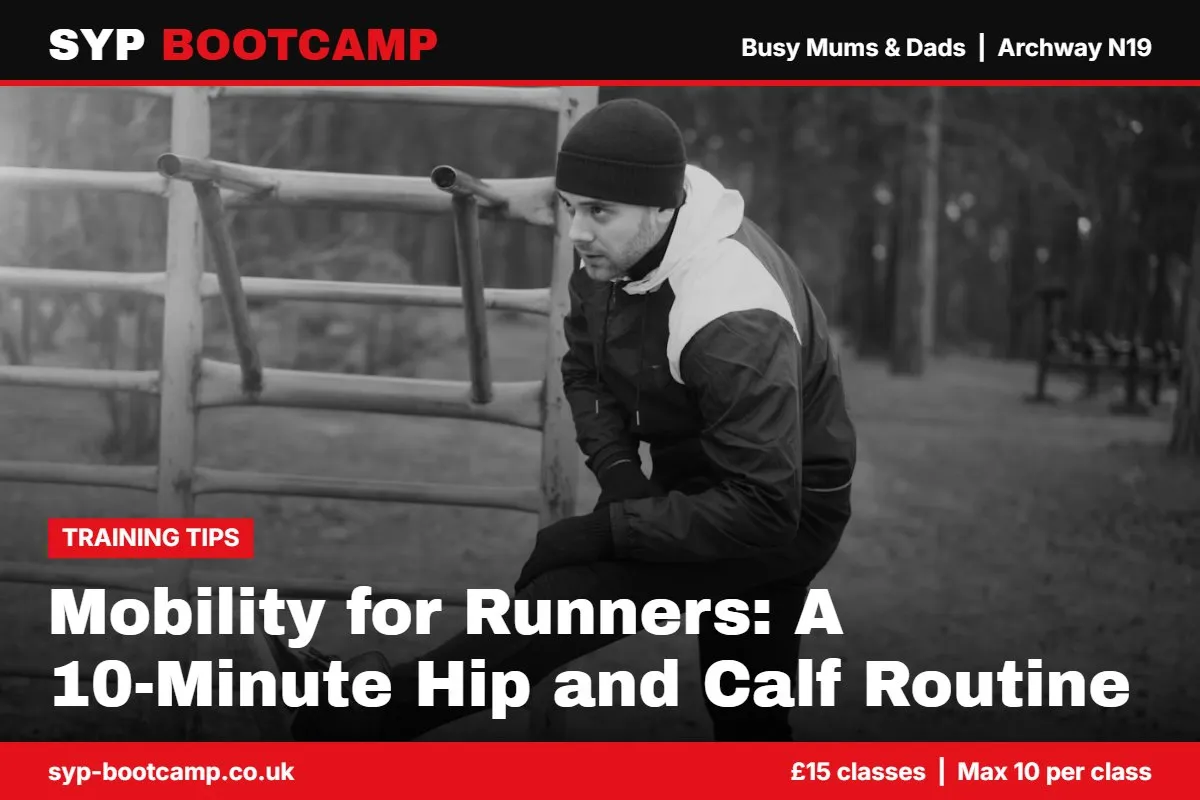
Mobility for Runners: A 10-Minute Hip and Calf Routine
Most parents I know who run do it in the gaps. A loop of the Parkland Walk before the school run. A quick 5k while the kids are at a party. When time is that tight, the warm-up and cool-down are the first things to go, and then the tight calves, stiff hips and grumbly Achilles start to show up. Good mobility for runners does not need a 45-minute yoga session. Ten minutes, split between before and after your run, is enough to make a real difference to how your body feels.
Below is the routine I give to runners in my Archway classes: 5 minutes before you head out, 5 minutes when you get back. No kit needed, just a wall and a bit of floor.
Why mobility for runners matters
Running is a repetitive movement. You do the same small range of motion thousands of times, often after a day sitting at a desk or in the car. Over time, the hips lose some of their ability to extend behind you, the ankles stiffen and the calves take more than their fair share of the load.
Mobility work helps by moving your joints through a fuller range than running alone does. It is not about becoming super flexible. It is about having enough movement in your hips, ankles and calves that each stride does not feel like it is fighting you.
Mobility is not a cure for injury. If you have pain that lasts more than a few days, pain that changes the way you run, or swelling, stop running and see your GP or a physio. The NHS page on sprains and strains is a good starting point for what to do in the first few days.
Before your run: 5-minute dynamic warm-up
Before a run, keep everything moving. Avoid long static stretches; you want to feel warm and loose, not floppy. The NHS has a helpful guide on how to warm up before exercising if you want the basics.
- Brisk walk or march, 60 seconds. Just get the blood moving. Arms swinging.
- Leg swings, 10 each leg forward and back, 10 side to side. Hold a wall or lamppost. Let the swing get gradually bigger. This wakes up the hips.
- Ankle rocks, 10 each side. Stand facing a wall in a split stance, front foot about a hand’s length away. Keep the heel down and push the knee forward towards the wall, then back. You should feel the ankle bend, not the knee hurt.
- Walking lunge with reach, 5 each side. Step into a lunge, then reach both arms overhead and slightly to the side of the front leg. This opens up the hip flexor on the back leg.
- Calf pulses, 15 reps. Rise up onto your toes and lower slowly. Then 10 quick little bounces on the balls of your feet.
- Easy jog, 60 seconds. Start your run slower than you think. The first kilometre is still part of the warm-up.
After your run: 5-minute cool-down mobility
After the run is when slower, longer holds make sense, because your muscles are warm. Breathe slowly through each one. The NHS guide on how to stretch after exercising covers the same principle.
- Calf stretch on a wall, 30 seconds each side. Back leg straight, heel pressed down. Then bend the back knee slightly to target the lower calf and Achilles area for another 20 seconds.
- Half-kneeling hip flexor stretch, 30 seconds each side. Kneel on one knee (use a folded jumper for comfort), squeeze the glute on that side and shift your weight gently forward. Tall chest. You should feel a stretch at the front of the hip.
- 90/90 hip switches, 8 each side. Sit on the floor with both knees bent at 90 degrees, one in front, one to the side. Rotate your knees over to the other side slowly. Use your hands behind you for support.
- Figure-four glute stretch, 30 seconds each side. Lie on your back, cross one ankle over the opposite knee and gently pull the bottom leg towards you.
- Toe and foot release, 30 seconds. Kneel with toes tucked under and sit back gently, or simply roll each foot over a tennis ball while standing.
If your hips feel tight after long days sitting too, my hip flexor stretches for desk workers go well alongside this. For more ankle-specific work, see ankle mobility for squats, which helps runners just as much as lifters.
Building it into a busy week
The routine only works if you actually do it. Some ideas that have worked for parents I coach:
- Do the warm-up at the front door. Leg swings holding the door frame, calf pulses on the doorstep. No extra time needed.
- Do the cool-down while the kettle boils or while the kids are in the bath.
- Add two short strength sessions a week. Mobility helps range, but strength in your calves, glutes and hips is what helps them cope with mileage. Calf raises, split squats and glute bridges are a great start.
- Use the hills wisely. North London is not flat. If you are running up towards Highgate, give yourself a gentler first few minutes before tackling the climb.
If you are looking for routes, my guide to running routes in Archway has some options close to home.
Where a bootcamp class fits
Lots of runners come to bootcamp for the strength work they know they should be doing but never do. In class, we train single-leg strength, hip stability and core, which are the bits that help running feel smoother. The SYP Unlock hip and back mobility class is built for exactly this: freeing up stiff hips and lower backs with guided, controlled movement.
FAQs
Should runners stretch before or after running?
Both, but differently. Before a run, use dynamic movements like leg swings and lunges. After a run, use slower, held stretches while your muscles are warm.
How often should runners do mobility work?
A short routine around every run is ideal. If you only manage one longer session, do 10 to 15 minutes on a rest day focusing on hips, ankles and calves.
Can mobility exercises prevent running injuries?
Mobility can help you move better, but injury risk depends on lots of things, including how quickly you increase your mileage, strength, sleep and footwear. Build up gradually and see a GP or physio if pain persists.
What is the best mobility exercise for tight calves?
The wall calf stretch with a straight and then bent back knee, plus ankle rocks before your run. Slow calf raises also strengthen the area.
Book your first class
If you want strength and mobility work that actually supports your running, come and try a class. SYP Bootcamp is 45 minutes of small-group training in an indoor church hall in Archway N19, max 10 people, £15 a class, with options for every level. Book your £15 class here or call or WhatsApp me on 07301 512215. If you are working around a niggle, my injury-safe personal training in Archway takes a more careful, 1-1 approach.
About the author
Artem Olekhnovych is a personal trainer in Archway and the founder of SYP Fitness and SYP Bootcamp. He has coached clients in Archway, Highgate and across North London for over 10 years, and runs small-group bootcamp classes for busy mums and dads. Read reviews from his 1-1 clients.
