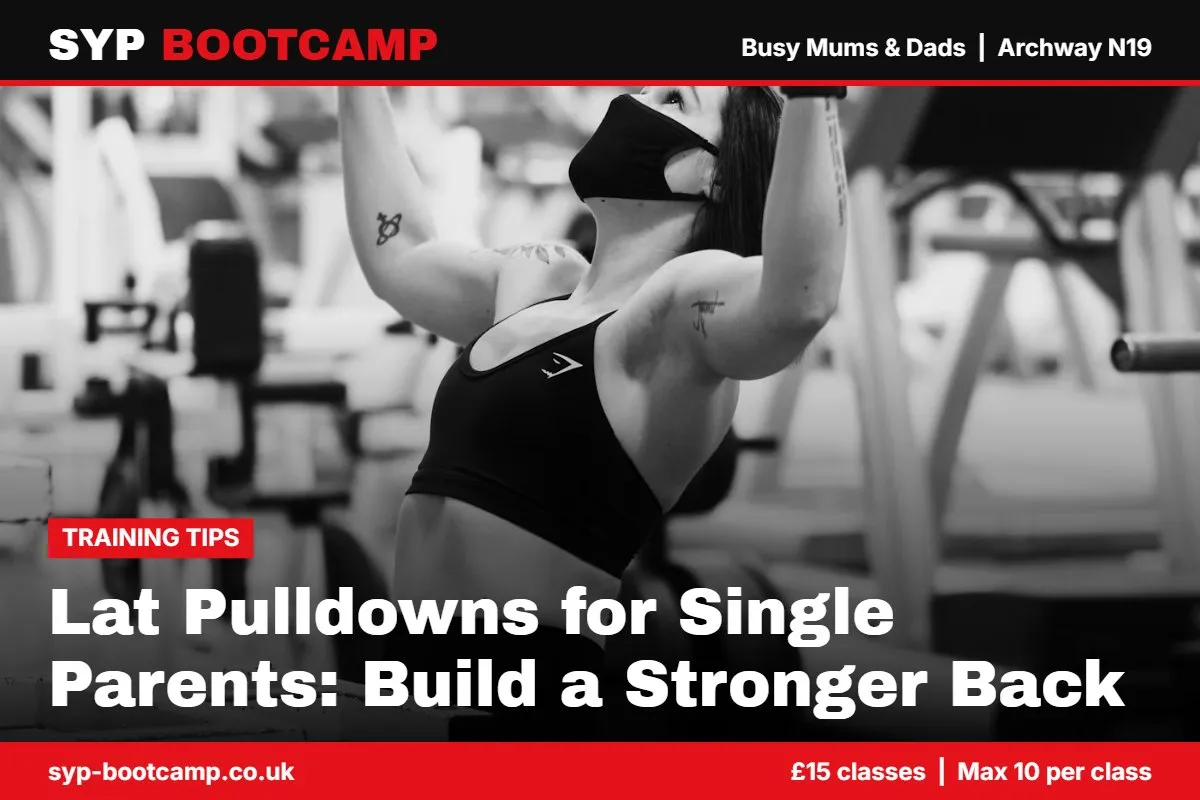
Lat Pulldowns for Single Parents: Build a Stronger Back
If you are raising kids on your own, your back does a lot of unpaid overtime. You lift a sleepy child out of the car seat, haul the shopping up the stairs, and bend over the bath every night. Then you wonder why your shoulders feel rounded and your upper back aches by Thursday. In this guide to lat pulldowns for single parents, I will show you how to use the gym machine properly, how to copy it at home with a cheap resistance band, and how to use it as a stepping stone to your first ever pull-up.
Why lat pulldowns for single parents make sense
Most of what a parent does all day is pushing and bending forwards: pushing a buggy, leaning over a cot, hunching over a phone at 11pm doing admin. The muscles on the back of your body, especially your lats (the big muscles down the sides of your back), rarely get a proper workout. The pulldown trains exactly those muscles, plus the muscles between your shoulder blades and your grip.
The NHS physical activity guidelines for adults recommend strengthening activities that work all the major muscle groups on at least 2 days a week. Your back is one of those groups, and a pulldown is one of the most beginner-friendly ways to tick it off.
How to do a lat pulldown on the gym machine
If you get a short gym window while the kids are at school or with family, this is how I set people up:
- Set the thigh pad so your legs are snug under it. This stops you lifting off the seat.
- Grip the bar a little wider than shoulder width, palms facing away.
- Sit tall with a slight lean back, chest up. Think “proud chest”, not “lying down”.
- Pull your shoulders down first, away from your ears, then bend your elbows and bring the bar to the top of your chest.
- Squeeze for a second, as if you were tucking your elbows into your back pockets.
- Let the bar rise slowly over about 2 to 3 seconds until your arms are straight.
Common mistakes I see every week: pulling the bar behind your head (please do not, it strains the shoulders), swinging your whole body backwards to move the weight, and shrugging your shoulders up to your ears. If you have to rock to move it, the weight is too heavy.
Choosing a starting weight
Pick a weight you can pull for 12 clean reps with 2 or 3 reps left in the tank. For many beginners that is a lot lighter than they expect, and that is fine.
The band pulldown: your home version
No gym membership, no childcare, no problem. A long loop resistance band costs less than a takeaway and does a good job. Here are two ways to set it up:
- Door anchor: loop the band over a door anchor at the top of a closed, solid door (the side it closes towards, so it cannot swing open on you). Kneel facing the door and pull the band down to your chest, elbows driving down and back.
- No anchor: hold a band overhead with both hands, arms straight and wide. Pull your hands apart and down until the band touches the back of your neck area or upper chest. This is a “band pulldown apart” and it hits the same muscles.
Kneeling is a good trick if you have a toddler wandering about, because you are lower down, more stable and can stop instantly. My resistance band workout at home has more ideas for the same band.
A 20-minute back plan you can actually fit in
Do this twice a week, either at the gym or at home with a band. Rest about 60 to 90 seconds between sets.
| Exercise | Sets x reps |
|---|---|
| Lat pulldown (machine or band) | 3 x 10 to 12 |
| Single-arm row (dumbbell, or band around a table leg) | 3 x 10 each side |
| Band pull-aparts | 2 x 15 |
| Dead hang from a bar or slow negative pulldown | 2 x 15 to 20 seconds |
When you can do all 3 sets of 12 pulldowns with clean form, nudge the weight up one notch or use a thicker band. Small jumps, every week or two, is the whole secret.
From pulldown to your first pull-up
A lot of parents tell me a pull-up is on their bucket list, often because their kid can do one on the monkey bars and they cannot. The pulldown is a great way to get there, but it is not the whole answer, because hanging your full bodyweight from a bar is a different skill. Here is the progression I use:
- Weeks 1 to 4: pulldowns twice a week, building to roughly a third to half of your bodyweight for 8 to 10 reps.
- Weeks 4 to 8: add dead hangs (build to 30 seconds) and scapular pulls (hang, then pull your shoulders down without bending your elbows).
- Weeks 8 onwards: add slow negatives. Step up so your chin is over the bar, then lower yourself as slowly as you can, aiming for 3 to 5 seconds.
- Then: band-assisted pull-ups, with a band looped over the bar and under one knee or foot.
If you feel sharp pain in your shoulder, elbow or neck, stop and get it checked. Mild muscle soreness the next day is normal; pain while pulling is not. For the full pull-up journey, read my guide to pull-ups for single parents, and for the palms-facing version, chin-ups for single parents.
Where a bootcamp class fits
Doing this alone can feel like one more job on the list. In my small-group classes I coach the pulling pattern with bands, rows and carries so you get feedback on your form without paying for 1-1 sessions. The SYP Built To Last strength class in particular spends a lot of time on back strength, because that is what keeps you lifting kids and shopping without twinges. If you want the wider picture of training as a solo parent, my single parent fitness guide is a good place to start.
FAQs
Are lat pulldowns good for beginners?
Yes. They are one of the easiest back exercises to learn because the machine controls the path and you can choose a very light weight. Focus on pulling your shoulders down first and keeping your body still.
Should I pull the bar in front or behind my head?
In front, to the top of your chest. Pulling behind the neck forces your shoulders into an awkward position and gives you no extra benefit.
Can I do lat pulldowns at home without a machine?
Yes. A long resistance band anchored over a door, or held overhead and pulled apart, trains the same muscles. Check the door is solid and closes towards you, and keep little ones away from the band.
Book your first class
If you would rather learn this with a coach watching your form, come along to a class. SYP Bootcamp runs 45-minute small-group classes in a weatherproof church hall in Archway N19, with a maximum of 10 people at £15 a class, and every exercise has an easier and harder option. Book your £15 class here or call or WhatsApp me on 07301 512215 and I will send you the timetable. If you later want a plan built entirely around your schedule, have a look at private personal training in Archway.
About the author
Artem Olekhnovych is a personal trainer in Archway and the founder of SYP Fitness and SYP Bootcamp. He has coached clients in Archway, Highgate and across North London for over 10 years, and runs small-group bootcamp classes for busy mums and dads. Read reviews from his 1-1 clients.
