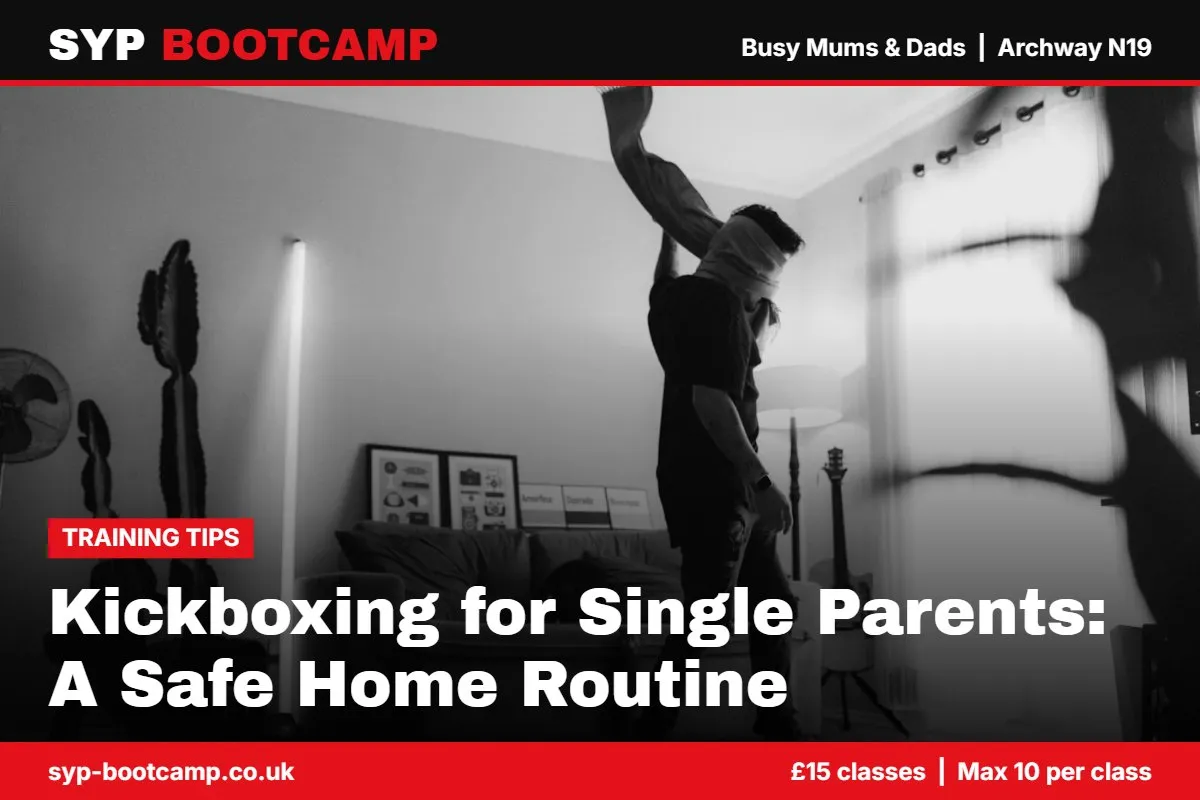
Kickboxing for Single Parents: A Safe Home Routine
Some days as a solo parent you need to hit something. Not someone, something. Kickboxing gives that frustration somewhere to go, and it is one of the best full-body workouts you can do in a small space. The catch is that most kickboxing advice assumes you have a partner holding pads, a gym bag and two free hours. This guide to kickboxing for single parents is built for the living room after bedtime: no partner, no bag, no equipment, and a strong focus on kicking safely so you do not tweak your hips or knees on day one.
Kickboxing vs boxing fitness: what is the difference?
People often ask me if my Box Fit class is kickboxing. It is not, and the difference matters for beginners.
- Boxing fitness uses punches only. Your feet stay grounded, so it is easier to learn, easier on your balance and kinder to tight hips.
- Kickboxing adds kicks and knees. That means standing on one leg, rotating on the supporting foot and moving your hips through a bigger range. It burns a lot of energy and builds balance, but it asks more of your hips, knees and lower back.
If you have not trained in years, have a stiff back or have had a knee problem, I usually suggest starting with punches only, then adding kicks once you feel steady. My post on boxing workouts at home for beginners is a good place to start. If you have any injury or joint condition, please check with your GP or a physio before adding kicks.
Kick safety: the five rules I teach first
- Kick low. Aim at knee to hip height. High kicks look great online and pull hamstrings in real life.
- Pivot the standing foot. On a roundhouse kick, let your supporting heel turn towards the target. Kicking with a planted foot twists the knee.
- Control the return. Bring the leg back the way it went out. Do not let it drop and slap down.
- Hands up. Even with no opponent, keeping your guard up trains your core to stay braced while you kick.
- Clear the space. Move the coffee table, check where small feet and toys are, and never kick near a sleeping baby’s cot or a child who might run in.
Learn three kicks before you string them together
Front kick (teep)
Lift the knee up in front of you, then push the ball of the foot forward like you are shoving a door shut. Return the knee, then the foot. Hold the back of a chair for the first week.
Low roundhouse kick
Step slightly out with your front foot, pivot it, and swing the back leg round so your shin lands at thigh height on an imaginary target. Start at half speed. Think “turn the hip over”, not “swing hard”.
Knee strike
Grab an imaginary head at chest height, pull it down and drive your knee up. Brilliant for your core and very low risk. This is the kick I give nervous beginners first.
A 20-minute routine: kickboxing for single parents at home
Start with a 5-minute warm-up: march on the spot, arm circles, gentle leg swings holding the wall and some easy squats. The NHS has more on how to warm up before exercising.
Then do each round for 1 minute, with 30 seconds rest between rounds. Go through the list twice.
- Jab, cross (punches only), light on your feet
- Knee strikes, alternating legs
- Jab, cross, then a front kick with the back leg
- Low roundhouse kicks, right leg only, half speed
- Low roundhouse kicks, left leg only, half speed
- Free round: mix punches, knees and front kicks
- Squat hold with fast punches
Finish with 3 minutes of stretching: hip flexors, hamstrings and calves. If it is late and the flat walls are thin, swap any bouncing for steady stepping. Nobody needs to hear you.
Making it work with kids around
- Toddlers: do punches and knees only. Kicks and small children who appear from nowhere do not mix.
- Primary-age kids: let them call out the combos. “1, 2, knee!” keeps them busy and keeps you going.
- Teenagers: they might fancy joining in. Keep it no contact unless you are both in a proper class with pads and a coach.
Where a class fits
Hitting pads with a coach correcting your stance is a big step up from shadowboxing at home. My SYP Box Fit class is beginner boxing with no sparring and no kicks, which makes it a safe base before you try a kickboxing gym. If you are thinking about other combat sports, I also wrote about martial arts for single parents, and the single parent fitness hub covers how to fit it all in.
FAQs
Is kickboxing good for beginners?
Yes, if you start with low kicks, slow speed and good technique. Absolute beginners or anyone with stiff hips may find punches-only boxing fitness easier for the first few weeks.
Can I do kickboxing at home without a bag?
Yes. Shadow kickboxing builds fitness, coordination and balance with no kit at all. A bag is nice later, but technique matters more early on.
Is kickboxing good for stress?
Many parents find it a great release. It is focused, physical and leaves little room to think about anything else. If stress is getting on top of you, also speak to your GP.
Will kickboxing hurt my knees?
It should not if you pivot the standing foot, kick low and warm up. Stop if you feel pain in the knee or hip and get it checked by a physio.
Book your first class
Want to hit pads instead of thin air? SYP Bootcamp runs 45-minute small-group classes indoors in a church hall in Archway N19, max 10 people, £15 a class, with easier and harder options for everything. Book your £15 class here or call or WhatsApp me on 07301 512215. If an old knee or back injury is holding you back, my injury-safe personal training is designed for exactly that.
About the author
Artem Olekhnovych is a personal trainer in Archway and the founder of SYP Fitness and SYP Bootcamp. He has coached clients in Archway, Highgate and across North London for over 10 years, and runs small-group bootcamp classes for busy mums and dads. Read reviews from his 1-1 clients.
