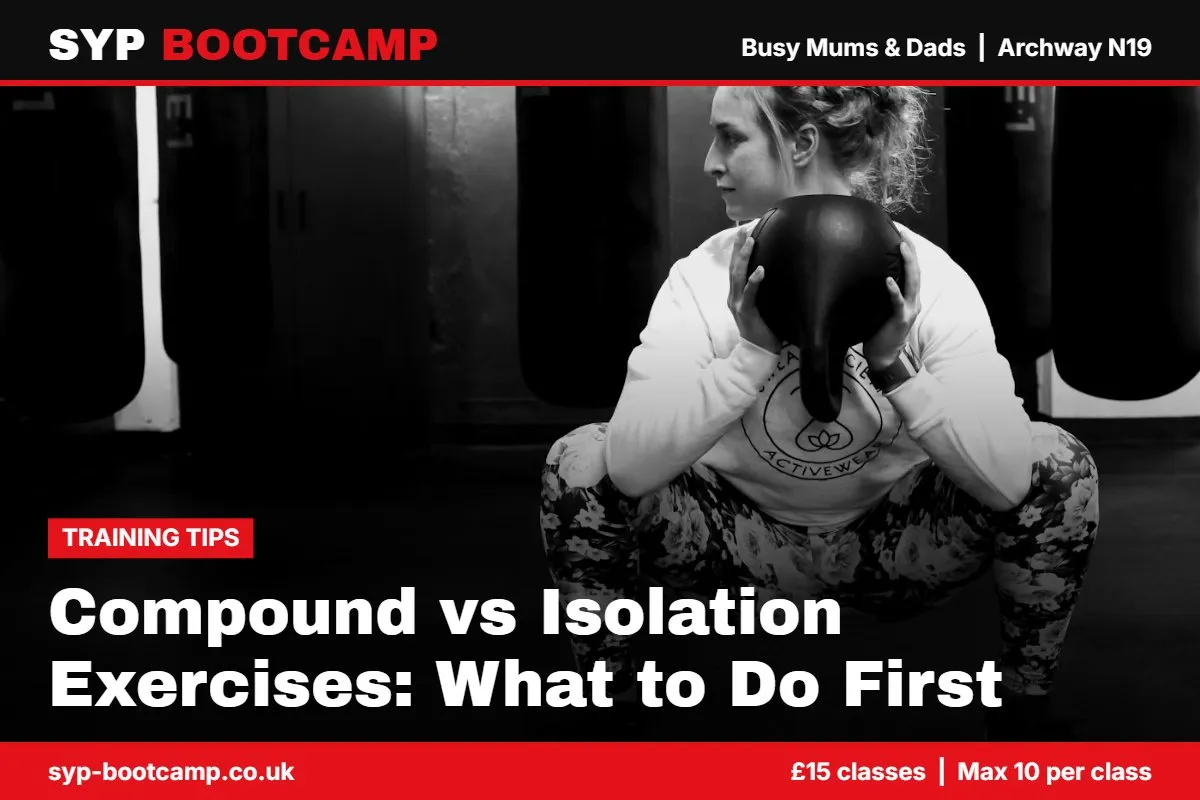
Compound vs Isolation Exercises: What to Do First
If you have ever stood in a gym looking at the machines, wondering whether to do bicep curls or squats, you have bumped into the compound vs isolation exercises question. It sounds technical, but it matters a lot when you only get 30 minutes, three times a week. Pick the right exercises and that half hour does a huge amount. Pick the wrong ones and you can train for months and feel very little different.
Here is a plain-English explanation, with examples, and a simple rule for what to prioritise when time is short.
What is a compound exercise?
A compound exercise moves more than one joint and works several muscles at once. A squat bends your hips, knees and ankles, and uses your thighs, glutes, back and core together. A push-up uses your chest, shoulders, triceps and core.
Common compound exercises:
- Squats and goblet squats
- Deadlifts and Romanian deadlifts
- Lunges and step-ups
- Push-ups and presses
- Rows and pull-ups
- Carries, like the farmer’s walk
What is an isolation exercise?
An isolation exercise moves one joint and focuses on one main muscle. A bicep curl bends only the elbow. A leg extension straightens only the knee.
Common isolation exercises:
- Bicep curls and tricep extensions
- Lateral raises
- Leg extensions and hamstring curls
- Calf raises
- Clamshells and glute kickbacks
Compound vs isolation exercises: which matters more?
For busy parents, compound exercises should make up most of your training. Here is why:
- More muscle per minute. One set of squats trains more muscle than a set of leg extensions, a set of glute kickbacks and a set of calf raises combined. When time is your main problem, that is a big deal.
- They match real life. Lifting a car seat, carrying shopping up the stairs, picking a sleeping toddler off the back seat. Those are all compound movements. Training them makes daily life easier.
- Your heart works harder. Big moves use more muscle, so your breathing and heart rate go up more. You get a bit of fitness alongside strength.
- Your core gets trained for free. Holding your trunk steady during a squat, carry or push-up is real core work.
The NHS guidance on strength exercises focuses on movements like squats, lunges, push-ups and step-ups for exactly this reason. They cover the whole body efficiently.
So are isolation exercises a waste of time?
No. They have a place. I use them for:
- Weak links. If your glutes switch off and your knees cave in, clamshells or banded side steps can help you feel those muscles before squatting.
- Rehab and prehab. After an injury, a physio will often give you isolation work first because it is easier to control. Always follow their advice.
- Shoulder health. Small moves like band pull-aparts help balance out a lot of sitting and phone time.
- Specific goals. If you want bigger arms or more shape in a certain area, some extra isolation work helps once the basics are covered.
The point is order of priority. Isolation exercises are the seasoning, not the meal.
A simple rule when time is short
Here is how I build sessions for parents with 20 to 40 minutes:
- 20 minutes: compound only. One squat or lunge, one hinge, one push, one pull.
- 30 minutes: the four compound moves plus one carry or core exercise.
- 40 minutes or more: the above, plus one or two isolation moves at the end for whatever needs extra attention.
A 25-minute compound-first session
- Warm up for 4 minutes: marching, arm circles, 10 slow squats, 10 hip hinges.
- Goblet squat: 3 x 10
- Romanian deadlift: 3 x 10
- Push-up (hands on a bench or sofa if needed): 3 x 8 to 12
- One-arm row: 3 x 10 each side
- Farmer’s carry: 2 x 30 steps
- Optional finisher if you have 5 minutes spare: 2 x 15 band pull-aparts and 2 x 12 calf raises.
Rest about 60 seconds between sets. If you want to cut it further, pair the moves into supersets.
Form cues for the big four
- Squat: feet about shoulder width, push knees out over toes, sit between your heels, chest proud.
- Hinge: soft knees, push hips back like closing a car door with your bum, back long and flat.
- Push: body in one straight line, elbows at about 45 degrees, lower with control.
- Row: pull your elbow towards your back pocket, do not shrug.
Stop if anything causes sharp pain. Mild muscle effort is normal, joint pain is not. If you have an existing injury, check with your GP or physio before adding load.
Where bootcamp fits
In my classes nearly everything is compound: squats, hinges, pushes, rows, carries and some boxing. That is how we get a full body session in 45 minutes. Our SYP Built To Last functional strength class is the purest version of this, and there is more on the idea in my post on functional strength exercises over 35. If you are starting from scratch, have a look at my goblet squat guide first, because it is the best first compound lift I know.
FAQs
Can you build muscle with only compound exercises?
Yes. Plenty of people build good strength and muscle with mainly compound lifts. Isolation work is a useful extra, not a requirement.
Are compound exercises safe for beginners?
They are, with sensible weights and good form. Start with bodyweight or a light kettlebell and learn the pattern before going heavier.
Should I do compound or isolation exercises first?
Compound first, while you are fresh. Save isolation moves for the end of the session.
Is a plank a compound exercise?
It is usually classed as a core stability exercise rather than either. It works many muscles together but without moving a joint, so it sits in its own category.
Book your first class
If you want someone to coach your squat, hinge and push form in person, come to SYP Bootcamp. Classes are 45 minutes in a church hall in Archway N19, max 10 people, all fitness levels, £15 a class. Book your £15 class or call or WhatsApp me on 07301 512215. If you have an old injury and want extra care, read about my injury-safe personal training in Archway.
About the author
Artem Olekhnovych is a personal trainer in Archway and the founder of SYP Fitness and SYP Bootcamp. He has coached clients in Archway, Highgate and across North London for over 10 years, and runs small-group bootcamp classes for busy mums and dads. Read reviews from his 1-1 clients.
