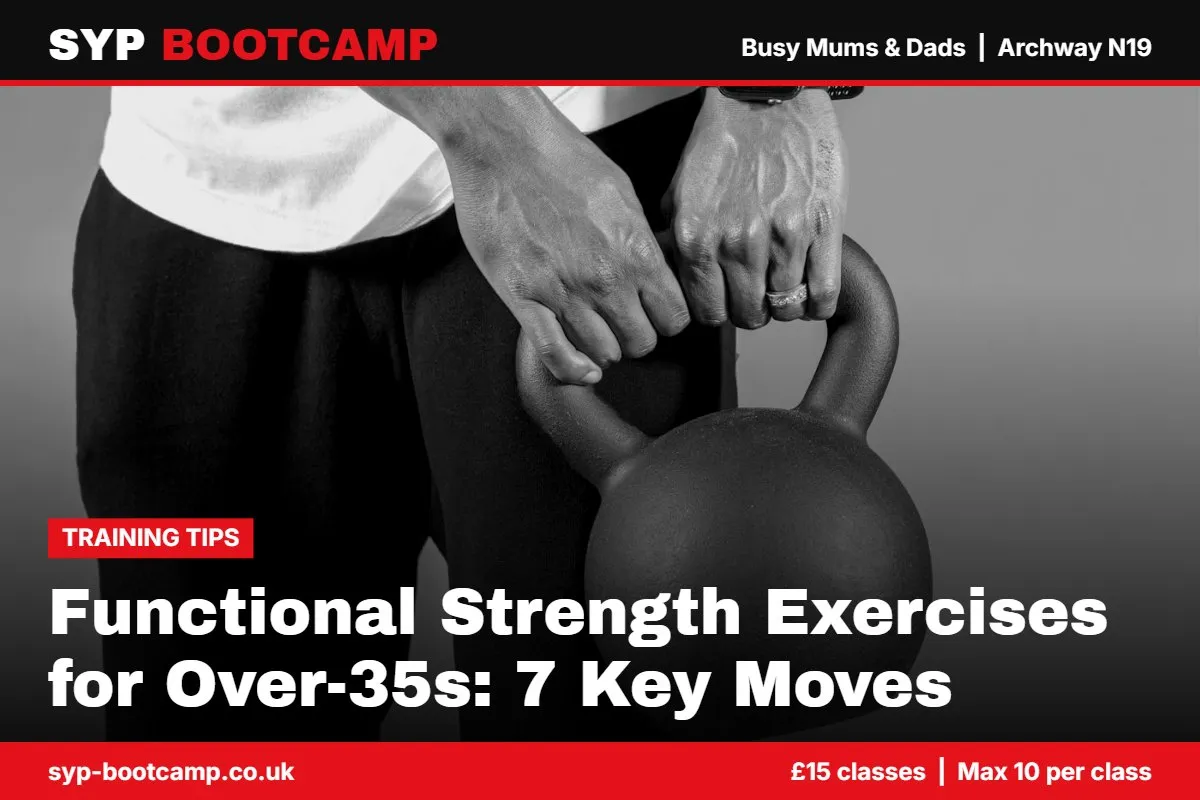
Functional Strength Exercises for Over-35s: 7 Key Moves
Somewhere after 35, many parents notice that everyday life starts to feel heavier. Getting up off the floor after playing with the kids takes a hand on the sofa. Lifting a suitcase into the boot tweaks your back. Carrying a sleeping five-year-old up the stairs leaves you puffing. That is exactly what functional strength exercises are for: training the movements you use every day so they feel easy again. This is the approach I use with the over-35s in my Built To Last classes in Archway.
What does “functional strength” actually mean?
Functional strength is strength that carries over to real life. Instead of isolating one muscle on a machine, you train whole movement patterns that your body uses all day. Most coaches group them into a handful of basic patterns:
- Squat: sitting down and standing up, getting low to pick up toys
- Hinge: bending from the hips to lift something off the floor
- Lunge: climbing stairs, kneeling down and getting back up
- Push: pushing a buggy, getting up off the floor, putting a bag in an overhead locker
- Pull: opening a heavy door, pulling a child up onto a climbing frame
- Carry: shopping bags, car seats, the washing basket
- Rotate and brace: twisting to reach the back seat, staying steady when a toddler barges into you
Train all of these a couple of times a week and you cover the whole body. That also fits neatly with the NHS guidelines, which recommend strengthening activities that work all the major muscle groups on at least 2 days a week (see the NHS physical activity guidelines for adults).
7 functional strength exercises for over-35s
Each one has an easier and harder option, the same way I run my classes.
1. Goblet squat
Hold a kettlebell or dumbbell at your chest. Feet shoulder-width apart, sit down between your heels, chest up, then drive back up. Easier: squat to a chair. Harder: pause for 2 seconds at the bottom. For technique tips, see my guide on how to squat properly.
2. Kettlebell deadlift
Kettlebell between your feet. Push your hips back with a flat back, grip the handle, then stand up tall by driving your hips forward. Easier: raise the kettlebell on a step. Harder: heavier bell or a slow 3-second lowering. My kettlebell deadlift for beginners post breaks it down step by step.
3. Reverse lunge
Step back and lower your back knee towards the floor, then push through your front foot to return. Easier: hold a chair. Harder: hold weights by your sides.
4. Push-up
Easier: hands on a wall or worktop. Standard: knees or toes on the floor. Harder: slow 3-second lowering. Keep your body in one straight line.
5. Bent-over row
One hand on a bench or chair, pull a dumbbell or a heavy bag up towards your hip, squeezing your shoulder blade back. Easier: lighter weight, or a resistance band. Harder: pause at the top.
6. Farmer’s carry
Hold a heavy weight in each hand and walk tall for 30 seconds. This builds grip, core and posture all at once. Start lighter than you think, and keep your shoulders down and away from your ears.
7. Get-up to standing
Lie on your back on the floor, then get up to standing any way you like, and lie back down. Try not to use your hands as you improve. It is a brilliant test of real-life strength and balance. Easier: use a sofa for support.
A simple 30-minute session, twice a week
Warm up for 5 minutes, then do 3 rounds of this circuit. Rest about 60 seconds between rounds.
- Goblet squat: 10 reps
- Push-up (your level): 8 to 10 reps
- Kettlebell deadlift: 10 reps
- Bent-over row: 10 each side
- Reverse lunge: 8 each leg
- Farmer’s carry: 30 seconds
- Get-up to standing: 5 reps
Pick a weight where the last 2 reps feel hard but your form stays clean. When all the reps feel comfortable for two sessions in a row, go a little heavier. That steady progression is what builds strength over months and years.
Train smart after 35
- Warm up properly. Your joints take a bit longer to get going than they did at 25.
- Prioritise form over weight, especially on squats and deadlifts.
- Recover well. Leave at least a day between strength sessions for the same muscles.
- Add balance work, which matters more each decade. See my post on balance exercises for adults.
- Get checked if needed. If you have a back, knee or shoulder injury, joint pain, a heart condition, osteoporosis, are pregnant or recently postnatal, speak to your GP or a physio before starting a new strength programme. Stop any exercise that causes sharp pain.
Built To Last: functional strength in a small group
My SYP Built To Last class is functional strength training designed for people over 35. We work through these patterns every week with kettlebells, dumbbells and bodyweight, and I adjust every move to your level. It is a great place to learn good technique before going it alone.
FAQs
What are the best functional strength exercises?
Squats, deadlifts, lunges, push-ups, rows and loaded carries cover nearly all the movements you use in daily life. Doing these twice a week is a strong foundation.
Is functional training good for over-40s?
Yes. It builds strength in the movements you actually use, and every exercise can be scaled up or down to suit your current fitness and any niggles.
How often should I do strength training after 35?
Twice a week is a good target for most people, in line with NHS guidance. Three sessions can work if you recover well.
Can I build muscle after 35?
Yes. People can build strength and muscle at any age with consistent training, enough protein and good recovery.
Book your first class
SYP Bootcamp runs 45-minute small-group classes indoors in Archway N19, with a maximum of 10 people and an easier and harder option for every exercise. Classes are £15 each, and the timetable is sent when you book. Book my £15 class or call or WhatsApp me on 07301 512215. For a bigger, structured change with 1-1 support, read about the SYP Fitness transformation programme.
About the author
Artem Olekhnovych is a personal trainer in Archway and the founder of SYP Fitness and SYP Bootcamp. He has coached clients in Archway, Highgate and across North London for over 10 years, and runs small-group bootcamp classes for busy mums and dads. Read reviews from his 1-1 clients.
