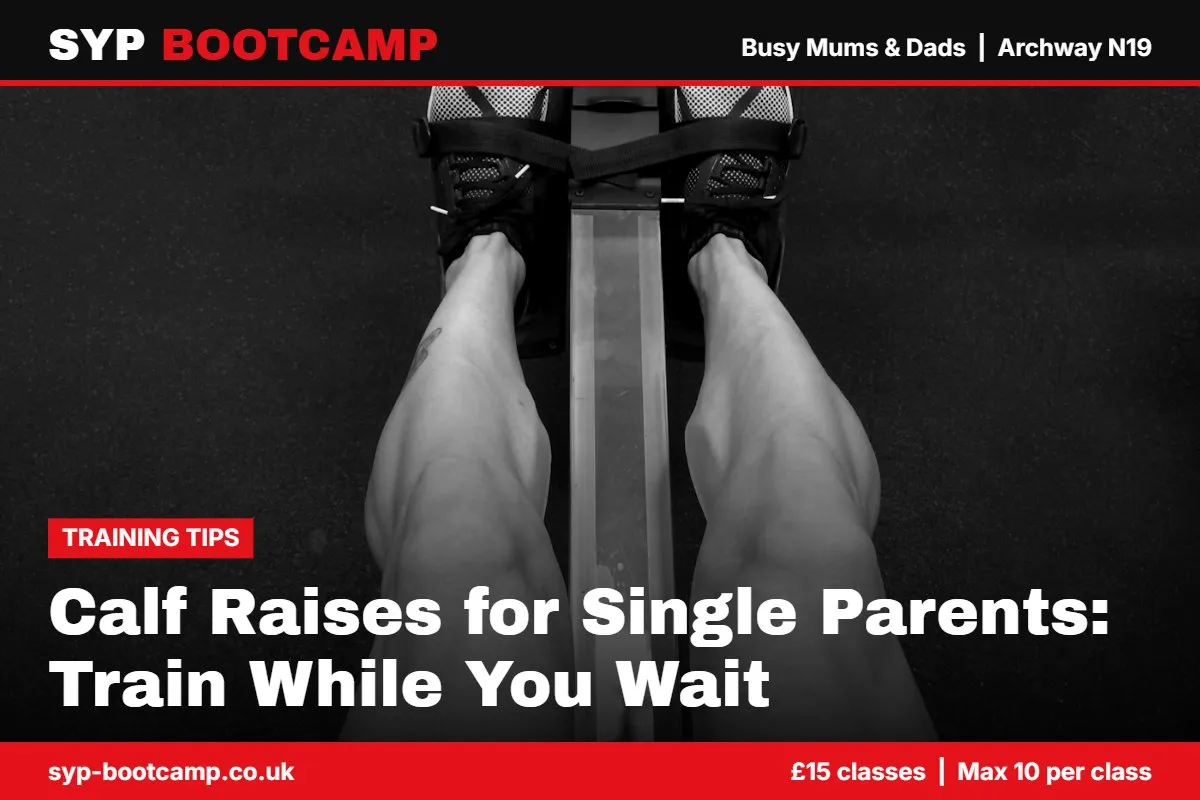
Calf Raises for Single Parents: Train While You Wait
You are standing at the school gate, again. Waiting for the bell, or the queue at the bus stop, or the kettle. These dead minutes add up to hours every week, and a single parent can turn them into training without anyone noticing. Calf raises for single parents are the ultimate hidden exercise: you can do them while brushing your teeth, waiting for the 41 bus or stirring the pasta. This post shows you how to do them properly, how to progress all the way to single-leg raises, and why strong calves matter far more than most people think, especially if you run or want to start.
Why your calves deserve attention
Your calves are two main muscles, the gastrocnemius (the big one you can see) and the soleus (underneath, working hard whenever your knee is bent). Together with the Achilles tendon, they absorb and push off on every step you take.
- Walking and stairs. Every push-off uses your calves. Weak calves tire fast on hills, and North London has plenty.
- Running. When you run, your calves and Achilles handle several times your body weight on each stride. Weak calves are a common reason new runners get sore shins, tight Achilles or calf strains.
- Balance. Strong ankles and calves help you recover from a wobble, like when a small child crashes into your legs.
- Carrying. A toddler on your hip plus a bag means more load through your ankles than you realise.
How to do a calf raise properly
- Stand tall, feet hip-width apart, with a fingertip on a wall, worktop or the sink for balance.
- Press through the ball of your foot, especially the big toe, and rise as high as you can.
- Pause for one second at the top.
- Lower slowly, taking two or three seconds, all the way down.
Common mistakes: bouncing quickly, rolling onto the little toes, and only going halfway up. Slow and full range beats fast and short.
Calf raises for single parents: the hidden-minutes plan
Here is how to sneak them into a normal day without carving out any extra time.
- Brushing teeth (morning and night): 2 minutes of slow calf raises. That is around 30 to 40 reps each time.
- School gate or bus stop: 3 sets of 15 slow raises while you wait. Nobody will notice, I promise.
- Kettle or microwave: one set of 20 every time.
- Bent-knee version while cooking: soften your knees slightly and do raises from that position. This hits the soleus, which is the calf muscle runners need most.
That is easily 100 or more reps a day with zero extra time. Add a couple of focused sessions each week and you will notice stairs feel easier within a few weeks.
The progression: from two legs to one
Do this focused routine two or three times a week, after bedtime or while the kids play. Move on when you can do the top of the range for the stated reps with good control.
| Level | Exercise | Target |
|---|---|---|
| 1 | Two-leg calf raise on the floor | 3 x 20, slow lowering |
| 2 | Two-leg raise on a step, heels dropping below the step | 3 x 15 |
| 3 | Two up, one down: rise on both feet, lower slowly on one | 3 x 10 each leg |
| 4 | Single-leg calf raise on the floor | 3 x 12 each leg |
| 5 | Single-leg raise on a step, full range | 3 x 15 to 20 each leg |
| 6 | Single-leg on a step holding a backpack or a child’s school bag of books | 3 x 12 each leg |
Always add the bent-knee version too: 2 sets of 15 at your current level. Use the bottom stair at home and keep a hand on the bannister.
Calf raises and running
If you are thinking about starting to run, the NHS Couch to 5K plan is a great free option. I would add calf raises from week one. A useful target before you start running regularly is around 20 to 25 slow single-leg raises on each side. That is not an official rule, it is just what I see work well with new runners I coach. If you are a postnatal runner, my post on running after a baby covers the other checks you need first.
Walking more is a great place to start too. My guide to walking the school run pairs nicely with the gate-side calf raises above. And for a full solo-parent plan, read my single parent fitness guide.
Safety
Some calf soreness for a day or two after starting is normal. Pain in the Achilles tendon (the cord at the back of your heel), sudden sharp pain in the calf, or swelling are reasons to stop. The NHS page on sprains and strains explains when to get help. If you have had an Achilles injury, circulation problems or are recovering from surgery, check with your GP or physio before progressing to single-leg work.
Where a bootcamp class fits
Calf raises are perfect for filling the gaps. A class gives you the rest: strength for the big muscles, cardio, and a coach to make it all fit together. If low energy is the real issue, my SYP Recharge energy and focus class is a good place to start, and you will find calf and ankle work built into the warm-ups.
FAQs
How many calf raises should I do a day?
For most beginners, 50 to 100 spread through the day plus two focused sessions a week works well. Quality and slow lowering matter more than the total.
Do calf raises help with running?
Yes. Strong calves and Achilles tendons help absorb the load of each stride, which is why many running coaches include them in training.
Should calf raises be done with bent or straight knees?
Both. Straight knees work the big gastrocnemius more, bent knees target the soleus. Doing both covers the whole calf.
Can calf raises make your calves bigger?
They can help a bit, but calf size is strongly influenced by genetics. The main benefits for parents are strength, balance and fewer niggles when walking or running.
Book your first class
Ready to add more than calf raises to your week? SYP Bootcamp runs 45-minute small-group classes in Archway N19, indoors in a church hall, max 10 people, £15 a class. All levels are welcome, and every exercise has an easier and harder option. Book my £15 class or call or WhatsApp me on 07301 512215. If you live up the hill, I also coach 1-1, see personal training in Highgate with SYP Fitness.
About the author
Artem Olekhnovych is a personal trainer in Archway and the founder of SYP Fitness and SYP Bootcamp. He has coached clients in Archway, Highgate and across North London for over 10 years, and runs small-group bootcamp classes for busy mums and dads. Read reviews from his 1-1 clients.
