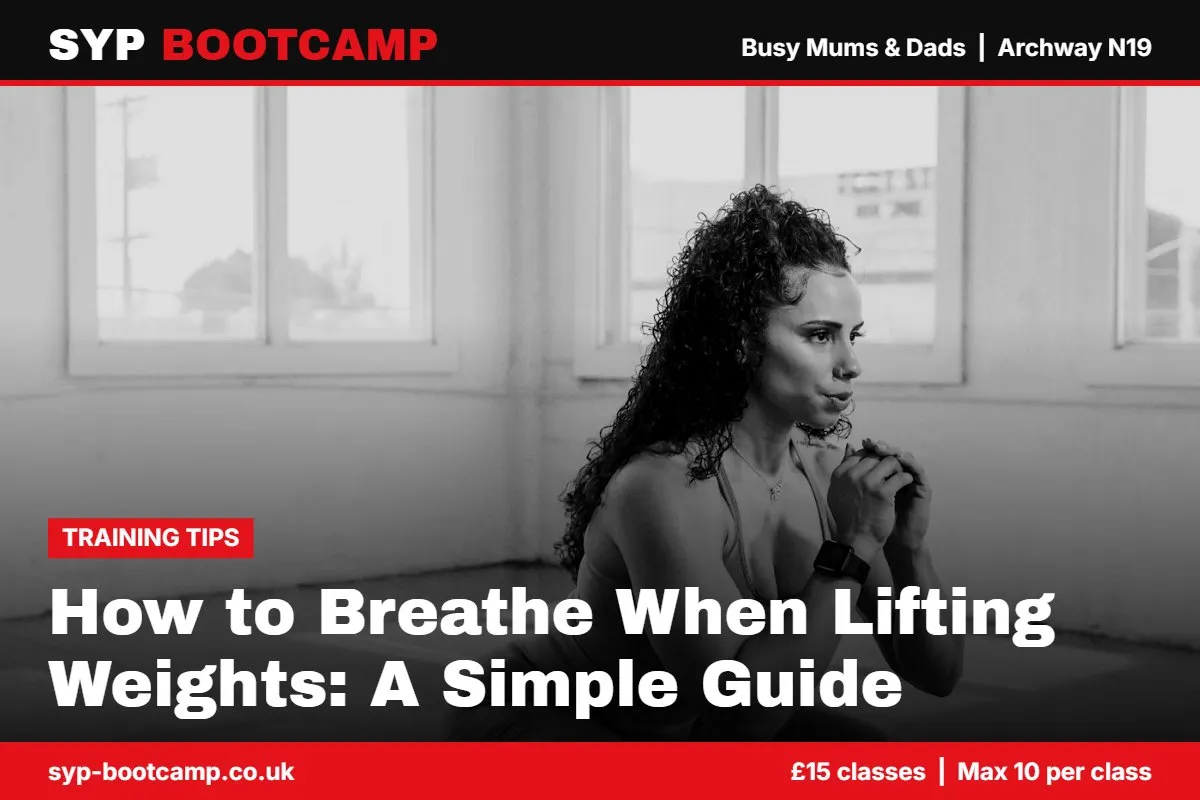
How to Breathe When Lifting Weights: A Simple Guide
You pick up a kettlebell, do a few squats, and halfway through the set you realise you have not breathed since the first rep. Your face is hot, your head feels a bit fuzzy and the last rep is a wobble. It happens to almost every beginner I coach. Knowing how to breathe when lifting weights sounds like a small detail, but it changes how strong, steady and safe you feel. Here is a simple guide, including when holding your breath can help and who should avoid straining altogether.
The basic rule: out on the effort
For most exercises, the simple version is:
- Breathe in during the easier part, usually when you lower the weight or yourself.
- Breathe out during the harder part, when you push, pull or stand up.
So in a squat, breathe in on the way down and out on the way up. In a push-up, in as you lower, out as you press. In a row, out as you pull, in as you let the weight back down.
That rule alone fixes most breath-holding. It also keeps your heart rate and blood pressure steadier than straining through every rep.
How to breathe when lifting weights: exercise by exercise
| Exercise | Breathe in | Breathe out |
|---|---|---|
| Goblet squat | At the top, then lowering | Driving up, near the top |
| Deadlift or RDL | Standing tall before you hinge | As you stand up and squeeze your glutes |
| Push-up or chest press | Lowering | Pressing away |
| Row | Lowering the weight | Pulling towards you |
| Overhead press | Weight at shoulders | Pressing up |
| Kettlebell swing | As the bell swings back | A short sharp “tss” as the hips snap forward |
| Plank | Slow, steady breaths the whole time. No holding. |
What about holding your breath?
You may have heard of the “Valsalva manoeuvre”. That is when you take a big breath, brace your core hard and hold the breath for a moment during the toughest part of a heavy lift. Experienced lifters use it because the pressure inside the trunk makes the spine more stable under very heavy loads.
For the kind of training most busy parents do, light to moderate weights for 8 to 15 reps, you do not need it. A short, gentle hold for a second at the hardest point is fine for most healthy people. Long holds, straining and going red in the face are not needed and are not a good idea.
If you want to learn the bracing part properly, read my guide on how to brace your core. Breathing and bracing work together.
Who should avoid straining and breath-holding
Holding your breath and straining makes blood pressure rise sharply for a moment. That matters for some people. Please speak to your GP before lifting weights, and avoid breath-holding and very heavy straining, if you:
- have high blood pressure, or are not sure what your blood pressure is
- have a heart condition, or have had a stroke
- are pregnant or recently postnatal
- have glaucoma or certain eye conditions, or a hernia
Blood Pressure UK has helpful guidance on exercise and physical activity with high blood pressure. In practice, people in these groups can often still strength train, using lighter weights, more reps and steady breathing, once their GP is happy. If you feel dizzy, get chest pain, a bad headache or unusual breathlessness, stop and seek medical advice.
A 5-minute breathing practice before you lift
Try this before your next workout. It teaches the rhythm without any weight.
- Box breathing, 1 minute. In for 4, hold for 2, out for 4, hold for 2. Gentle, not forced.
- Bodyweight squats, 10 reps. In on the way down, out on the way up. Say “up” quietly as you stand if it helps.
- Wall push-ups, 10 reps. In as you lean in, out as you push away.
- Glute bridges, 10 reps. Out as you lift your hips, in as you lower.
- Plank, 3 x 20 seconds. Count your breaths. Aim for 4 or 5 calm breaths in each hold.
Once the pattern feels automatic with no weight, add a light kettlebell or dumbbells. A good next step is my goblet squat guide.
Signs your breathing needs work
- You finish a set gasping, even when the weight was light.
- You get light-headed or see stars after a rep.
- Your neck and face go tense and red.
- Your form falls apart halfway through the set.
If that sounds like you, slow the reps down, use a lighter weight and count your breaths out loud for a session or two.
How I coach breathing in class
In my bootcamp classes I cue breathing out loud: “breathe in, down, and out, up”. It sounds simple, but with 10 people or fewer in the room, I can spot breath-holders quickly. In the SYP Built To Last functional strength class we spend time on this because good breathing is what lets you lift safely as you get older. For more on that, see my post on functional strength exercises over 35.
FAQs
Should you breathe through your nose or mouth when lifting?
Many people breathe in through the nose and out through the mouth, which feels natural and controlled. During harder sets it is fine to breathe through your mouth. The main thing is not to hold your breath for long.
Is it bad to hold your breath when lifting?
A brief hold during the hardest part of a heavy lift is used by experienced lifters. Long holds and straining are not needed for most people and should be avoided if you have high blood pressure or a heart condition.
Why do I feel dizzy after lifting weights?
Common reasons include holding your breath, standing up quickly, not eating or drinking enough beforehand, or working too hard. Stop, sit down and rest. If it keeps happening, speak to your GP.
Do I breathe out on the way up or down in a squat?
Usually breathe in on the way down and out on the way up, as you push through the hardest part.
Book your first class
Learn to breathe and lift with a coach watching. SYP Bootcamp runs 45-minute small-group classes indoors in Archway N19, max 10 people, £15 a class, with an easier and harder option for every exercise. Book your £15 class here or call or WhatsApp me on 07301 512215. If you live up the hill and would prefer one-to-one sessions, I also work as a personal trainer in Highgate.
About the author
Artem Olekhnovych is a personal trainer in Archway and the founder of SYP Fitness and SYP Bootcamp. He has coached clients in Archway, Highgate and across North London for over 10 years, and runs small-group bootcamp classes for busy mums and dads. Read reviews from his 1-1 clients.
