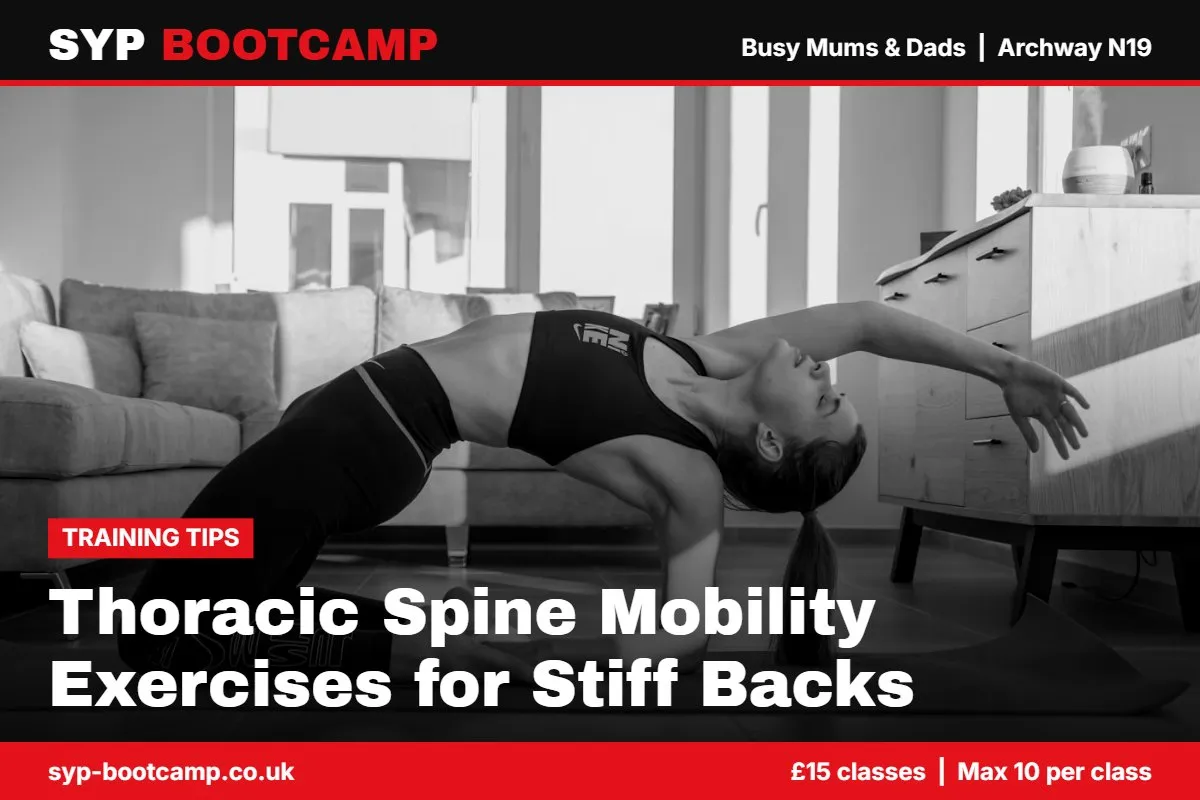
Thoracic Spine Mobility Exercises for Stiff Backs
Think about your posture right now. Chances are you are hunched over a phone, a laptop or a steering wheel. Add pushing a buggy, leaning over a cot and bending to do up tiny shoes, and your upper back spends most of the day curled forward. Over time it stiffens. Then your neck aches, your shoulders feel jammed when you reach overhead, and your lower back does the twisting your upper back should be doing. These thoracic spine mobility exercises are the short routine I give parents to undo some of that.
What is the thoracic spine?
Your spine has three main sections. The neck (cervical), the lower back (lumbar), and the middle and upper back (thoracic). The thoracic spine is the part your ribs attach to. It is designed to rotate and to extend (arch back) a fair amount.
When it gets stiff, the areas above and below pick up the slack. That is why a stiff upper back so often shows up as a sore neck, tight shoulders or a grumpy lower back.
Signs your upper back is stiff
- You cannot lift your arms fully overhead without arching your lower back.
- Turning to look over your shoulder when reversing feels tight.
- Your shoulders roll forward and your head pokes ahead of your body in photos.
- You feel a dull ache between your shoulder blades after a long day at a desk.
Quick self-test: the seated twist
Sit on a chair, feet flat, a broom handle across your shoulders (or arms crossed on your chest). Keep your hips facing forward and rotate your upper body each way. Most people with healthy rotation can turn around 45 degrees. If one side is clearly tighter, or you can barely turn, the drills below should help.
Thoracic spine mobility exercises: the 10-minute routine
Do this daily or on most days. It works well first thing in the morning, after a long sit or as a warm-up before training. Move slowly and breathe. Mobility work should feel like a stretch or effort, never sharp pain.
1. Cat-cow (1 minute)
On hands and knees. Breathe in as you let your chest drop and look slightly forward. Breathe out as you round your upper back up towards the ceiling. Focus the movement between your shoulder blades rather than your lower back. 8 to 10 slow reps.
2. Open book (2 minutes)
Lie on your side, knees bent to 90 degrees and stacked, arms straight out in front of you, palms together. Keep your knees glued together and sweep your top arm up and over to the other side, following your hand with your eyes, until your back is flat on the floor if it will go. Breathe out as you open. Pause, then close. 8 reps each side.
3. Thread the needle (2 minutes)
On hands and knees. Slide one arm under your body along the floor, letting your shoulder and ear come towards the mat. Then reach that same arm up to the ceiling, turning your chest. 8 reps each side.
4. Foam roller or towel extension (1 to 2 minutes)
Lie on your back with a foam roller (or a tightly rolled bath towel) across your upper back, just below your shoulder blades. Support your head with your hands, keep your bum on the floor, and gently arch back over the roller. Move it up a few centimetres and repeat. Never roll on your lower back or neck. 3 or 4 positions, 5 slow arches each.
5. Wall angels (1 to 2 minutes)
Stand with your back against a wall, feet a little way out, knees soft. Try to keep your lower back, upper back and head touching the wall, with your arms in a “goal post” shape. Slide your arms up and down slowly. If you cannot keep everything on the wall, step your feet further out or make the range smaller. 8 to 10 reps.
6. Prayer stretch on a chair or sofa (1 minute)
Kneel facing a sofa, elbows on the seat, palms together. Sit your hips back towards your heels and let your chest sink towards the floor. Hold for 30 seconds, rest, repeat.
Build it into your day
A stiff upper back is mostly a habit problem, so small habits help most:
- Push the buggy with your arms close to your body and the handle at roughly hip height. Lean less.
- Raise your laptop on a stack of books so the screen is near eye level.
- Every phone call is a walk-and-reach. Stand up, reach your arms overhead, and turn side to side.
- Do 5 open books on the floor while the kids play nearby. They will probably copy you.
My post on posture tips for busy parents has more everyday fixes, and the 10-minute mobility routine covers hips and ankles too.
Strength matters too
Mobility drills open up your upper back. Strength keeps it there. Pair this routine with two strength sessions a week that include rows and band pull-aparts, which train the muscles between your shoulder blades. Even 2 sets of 15 band pull-aparts a day is a good start. You can slot one of these drills between strength sets as a superset to save time.
When to see a professional
Most upper back stiffness is down to posture and lack of movement. But see your GP or a physio if you have pain that wakes you at night, numbness or tingling in your arms, pain after a fall, or pain with fever or unexplained weight loss. The NHS page on back pain lists when to get urgent help. If you have osteoporosis, check with your GP or physio before doing loaded spinal extension or twisting.
Where bootcamp fits
We include upper back mobility in the warm-up of almost every class, because almost everyone who walks in has spent the day hunched over something. Our SYP Unlock hip and back mobility class goes deeper, with a full session on opening up stiff backs and hips, mixed with gentle strength work.
FAQs
How long does it take to improve thoracic mobility?
Many people feel looser after one session. Lasting change usually takes a few weeks of regular practice, plus better daily habits.
Can thoracic mobility help neck and shoulder pain?
For many people it helps, because a stiffer upper back puts extra load on the neck and shoulders. If pain persists, get it checked by a physio.
Should I foam roll my lower back too?
No. Keep the roller on your upper back, between the bottom of your shoulder blades and the top of your shoulders.
Is it OK to do these every day?
Yes. They are gentle enough for daily use. Stop any drill that causes sharp or worsening pain.
Book your first class
If your back feels like it belongs to someone twenty years older, come and move it with us. SYP Bootcamp runs 45-minute small-group classes in Archway N19, indoors, max 10 people, £15 a class, with an easier and harder option for every exercise. Book your £15 class here or call or WhatsApp me on 07301 512215. If you live up the hill, I also offer 1-1 personal training in Highgate.
About the author
Artem Olekhnovych is a personal trainer in Archway and the founder of SYP Fitness and SYP Bootcamp. He has coached clients in Archway, Highgate and across North London for over 10 years, and runs small-group bootcamp classes for busy mums and dads. Read reviews from his 1-1 clients.
