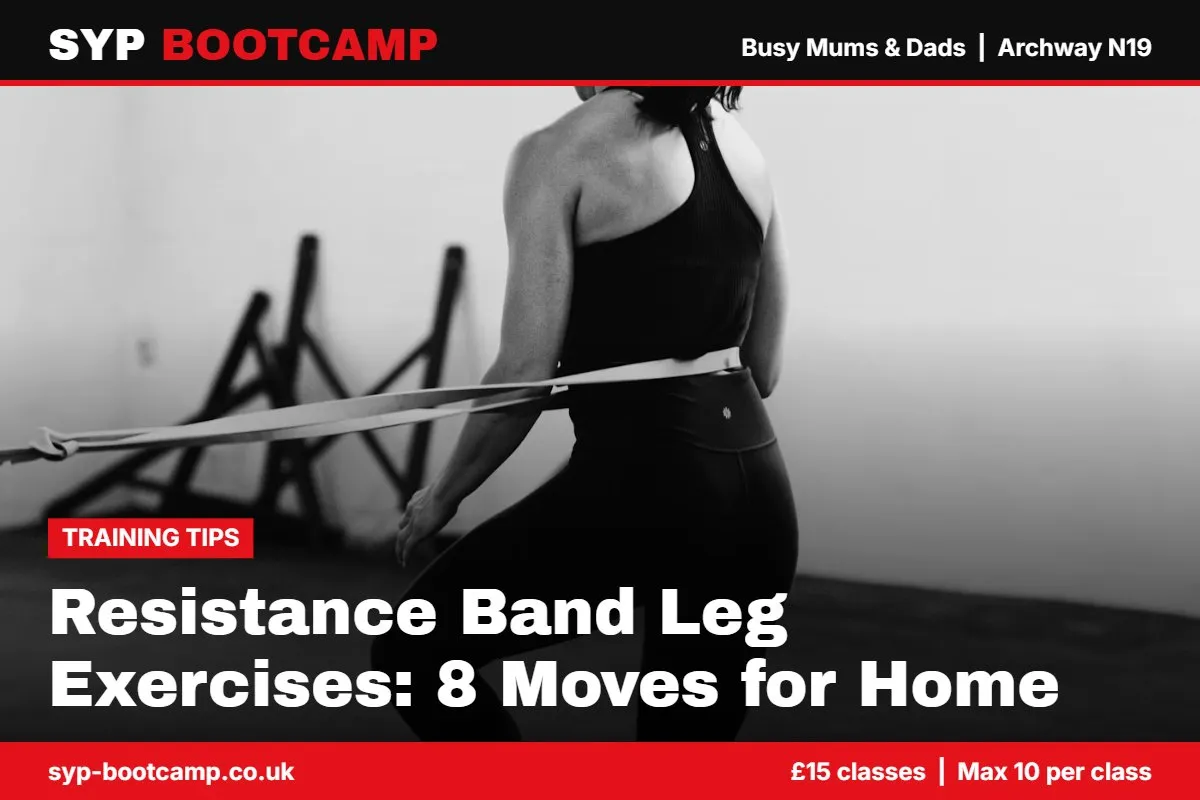
Resistance Band Leg Exercises: 8 Moves for Home
Resistance bands are the most underrated bit of kit in any parent’s house. They cost very little, fit in a drawer, make no noise when the baby is asleep upstairs, and can give your legs and glutes a proper workout. The problem is most people buy a pack of bands, try a few random moves from social media, and then the bands end up in the toy box. This guide gives you eight resistance band leg exercises I actually use with clients, with sets, reps and exactly which band to choose for each one.
I coach busy mums and dads in Archway, and a lot of them train at home between classes. Bands are often the thing that makes that possible.
Which resistance band should you use?
There are two main types you will see:
- Mini loop bands: small, flat loops that go around your thighs, knees or ankles. Great for glutes and hips.
- Long loop bands (or tube bands with handles): longer bands you stand on or anchor. Good for squats, hinges and calves.
Colours and strengths vary between brands, so do not rely on colour alone. Check the label, which usually says light, medium, heavy and so on. As a guide:
| Move type | Band to start with |
|---|---|
| Small hip moves (clamshells, side steps, kickbacks) | Light mini loop |
| Squats and bridges with a loop above the knees | Medium mini loop |
| Hinges, split squats and calf raises standing on the band | Medium to heavy long band |
The right band lets you finish the reps with good form but makes the last 2 or 3 feel genuinely hard. If you can do 25 easily, go heavier. If your knees cave in or you lose control, go lighter.
8 resistance band leg exercises (with sets and reps)
1. Banded squat
Band: medium mini loop just above the knees. Feet hip to shoulder-width. Sit back and down, pushing your knees gently out against the band. Stand up tall. 3 sets of 12 to 15.
Cue: the band is there to remind your knees to track over your toes, not to collapse inwards.
2. Lateral band walk
Band: light to medium mini loop around the knees or ankles (ankles is harder). Half squat, chest up, step sideways 10 steps, then back 10 steps. 3 sets of 10 steps each way.
Cue: keep the band tight the whole time. Do not let your feet snap together.
3. Banded glute bridge
Band: medium mini loop above the knees. Lie on your back, knees bent, feet flat. Push through your heels and lift your hips until your body is in a straight line from shoulders to knees. Pause, lower slowly. 3 sets of 15.
Once this feels easy, try lifting one foot off the floor for a single-leg bridge.
4. Clamshell
Band: light mini loop above the knees. Lie on your side, knees bent, heels together. Keeping your feet touching, lift the top knee without rolling your hips back. Lower slowly. 2 to 3 sets of 15 each side.
These look easy and burn a lot. They are great for parents with tired hips from carrying a child on one side. More on these in my clamshells guide.
5. Standing kickback
Band: light mini loop around the ankles. Hold a chair or worktop. Keep your standing knee soft, then push one leg straight back a short way, squeezing your glute. Do not arch your lower back. 3 sets of 12 each leg.
6. Banded Romanian deadlift
Band: medium to heavy long band. Stand on the middle of the band with feet hip-width, holding one end in each hand. Soft knees, push your hips back and lower your hands down your shins with a flat back. Stand back up by squeezing your glutes. 3 sets of 12.
Cue: think “hips back”, not “bend down”. You should feel it in the back of your thighs.
7. Banded split squat
Band: medium long band. Step into a split stance with the band under your front foot, holding the ends at your shoulders. Lower your back knee towards the floor, then push up through your front foot. 3 sets of 8 to 10 each leg. Hold a wall for balance if you need to.
8. Banded calf raise
Band: medium to heavy long band under the balls of your feet, ends held at your shoulders. Rise up onto your toes, pause, lower slowly. 3 sets of 15 to 20. Strong calves help with walking, running and all those stairs.
Put it together: a 25-minute band leg workout
You do not need all eight in one session. Here are two simple workouts to alternate during the week:
Workout A: banded squat, banded Romanian deadlift, lateral band walk, clamshell.
Workout B: banded split squat, banded glute bridge, standing kickback, banded calf raise.
Do 3 sets of each exercise with 45 to 60 seconds rest. Start with a 5-minute warm-up of marching, hip circles and bodyweight squats. Two sessions a week, alongside walking, ticks off the strength part of the NHS physical activity guidelines, which recommend strengthening activities on at least 2 days a week. For an upper and lower body version, see my resistance band workout at home.
Safety tips
- Check your bands before every session. Small nicks or tears can lead to the band snapping. Bin any damaged ones.
- Keep bands away from small children. Store them out of reach and never leave a band looped where a child could get caught in it.
- Knee or hip pain? Stop and get it checked by a GP or physio. The NHS page on knee pain explains when to see someone, and my knee-friendly workouts post has gentler options.
- Recently had a baby? Wait for your GP postnatal check, usually around 6 to 8 weeks after birth, before starting new exercise. The NHS explains the 6-week postnatal check.
Where a bootcamp class fits
Bands are perfect for keeping things ticking over at home, but at some point most people need heavier loads to keep getting stronger. In my classes we mix bands with kettlebells and bodyweight work, with an easier and harder option for every move. If your hips and lower back always feel tight, the SYP Unlock hip and back mobility class pairs really well with the glute work above.
FAQs
Do resistance band leg exercises actually build muscle?
Yes, especially for beginners, as long as the band is challenging enough and you gradually make things harder with a stronger band, more reps or slower lowering.
Should the band go above or below the knee?
Above the knee for most squats, bridges and clamshells, as it is kinder on the knee joint. Around the ankles makes side steps and kickbacks harder.
How often should I do band leg workouts?
Two or three times a week, with a rest day between sessions, is plenty for most people.
Why does my mini band keep rolling up?
Thin latex loops tend to roll. Fabric mini bands stay flatter and are more comfortable on bare legs.
Book your first class
Want to learn these moves with someone watching your form? SYP Bootcamp runs 45-minute small-group classes indoors in a church hall in Archway N19, max 10 people, £15 a class, for every fitness level. Book your £15 class here or call or WhatsApp me on 07301 512215. If you would prefer a one-to-one plan, my personal training for women in Archway is built around exactly this kind of strength work.
About the author
Artem Olekhnovych is a personal trainer in Archway and the founder of SYP Fitness and SYP Bootcamp. He has coached clients in Archway, Highgate and across North London for over 10 years, and runs small-group bootcamp classes for busy mums and dads. Read reviews from his 1-1 clients.
