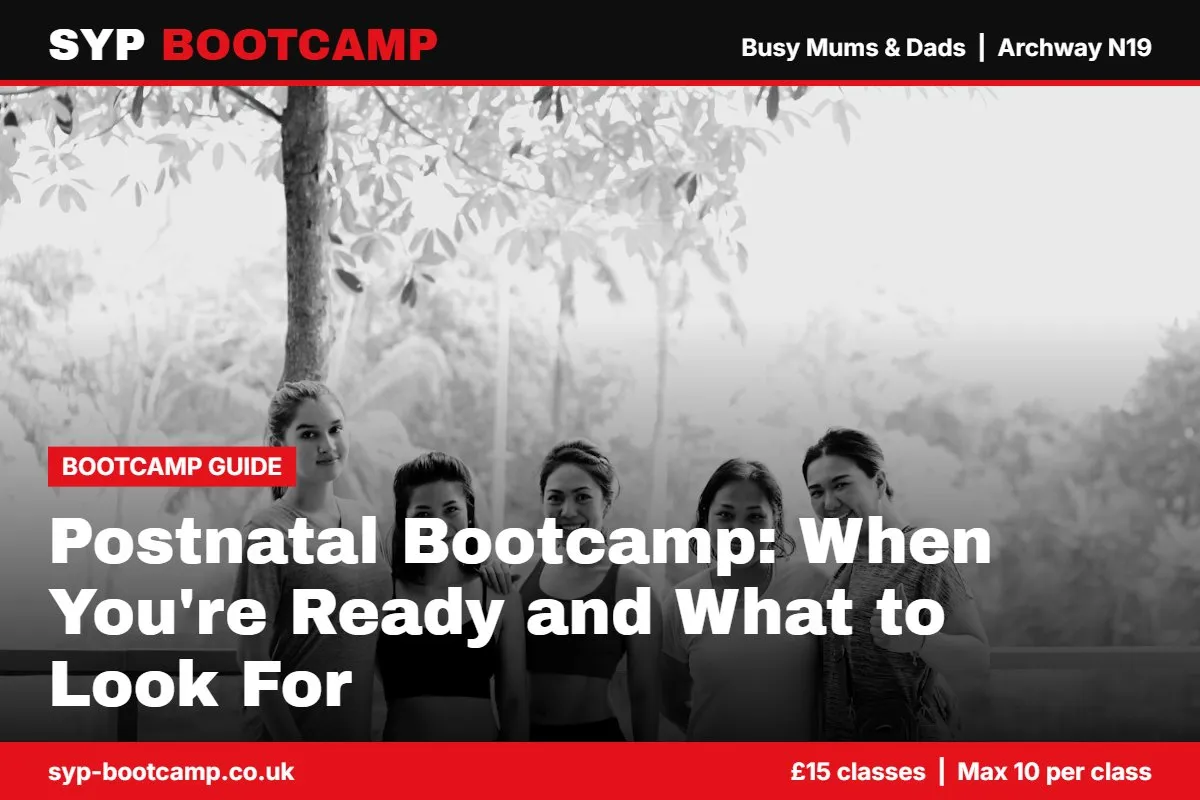
Postnatal Bootcamp: When You're Ready and What to Look For
You have a baby who wakes at 2am and 5am, a body that feels like it belongs to someone else, and a quiet wish to feel strong again. Maybe a friend has mentioned a postnatal bootcamp and you are wondering if you are allowed, if you are ready, and if you will cope. I coach a lot of mums in Archway, and this is the honest guide I give them: when to consider it, what to check first, and what a good class should look like for a body that has just done something huge.
First things first: the GP check
Before any structured exercise after birth, you need the all-clear from your GP. The NHS postnatal check usually happens around 6 to 8 weeks after the birth, and it is the right moment to ask, “Am I OK to start exercising again, and is there anything I should avoid?”
That check is a starting point, not a finish line. Gentle walking and pelvic floor exercises can usually start much earlier, and the NHS guidance on keeping fit with a baby covers this. But jumping, heavy lifting and fast-paced circuits are a different level, and most bodies need longer than 6 weeks to be ready for them.
If you had a caesarean, recovery takes longer. The NHS page on C-section recovery explains that you should avoid strenuous exercise and heavy lifting until you feel ready and have spoken to your GP. My post on exercise after a C-section goes into more detail on the early weeks.
If anything feels wrong, such as pain, heavy bleeding, a bulge in your tummy, a dragging feeling low down or leaking you cannot control, please speak to your GP or ask to be referred to a women’s health physio before you join any class.
Signs you might be ready for a postnatal bootcamp
Every recovery is different, but these are good signs:
- You have had your postnatal check and your GP is happy for you to exercise.
- You can walk briskly for 30 minutes without pain or heaviness.
- You have been doing pelvic floor exercises most days and can feel the muscles working.
- You can do 10 slow bodyweight squats and a 20 to 30 second gentle plank on knees without leaking, pain or doming along the middle of your tummy.
The Chartered Society of Physiotherapy has backed postnatal return-to-running guidance that suggests waiting until at least 12 weeks before running or high-impact work. That is a useful benchmark for bootcamp too, because jumping jacks and fast skipping put the same load on your pelvic floor.
A 4-week bridge plan before your first class
Once your GP says yes, this is the simple plan I give mums to do at home, 3 times a week, before they come to class. Each session takes about 15 minutes.
- Breathing and pelvic floor connection - lie on your back, knees bent. Breathe in and let your belly and pelvic floor relax. Breathe out and gently lift your pelvic floor as if stopping wind. 10 slow breaths.
- Glute bridge - breathe out as you lift your hips, 2 sets of 10.
- Box squat to a chair - sit back to the chair, stand up tall, 2 sets of 10.
- Wall push-up - hands on the wall, body in a straight line, 2 sets of 8 to 10.
- Side-lying clam - 2 sets of 12 each side.
- Bird dog - slow and controlled, 2 sets of 6 each side.
In weeks 3 and 4, add a light weight (a full nappy bag or a 2 to 4kg dumbbell) to the squats and do 3 sets. The goal is to check nothing leaks or hurts under light load, not to get breathless.
For leaks, the NHS has practical tips to stop bladder leaks, and pelvic floor training is at the top of the list. My guide to pelvic floor and exercise classes explains how to manage this during a session.
What to look for in a class
Not every bootcamp suits a new mum. The shouty, “everyone does burpees until they drop” style is the opposite of what you need. Look for:
- Small groups, so the coach can actually see you and adjust things.
- A low-impact option for every exercise, for example step-backs instead of jump squats, marching instead of skipping.
- A coach who asks about your birth and recovery before you start, not one who ignores it.
- Freedom to rest without anyone making you feel you are slacking.
- Strength work, not just cardio. Lifting and carrying a baby all day is a strength job.
In my classes, I keep groups to a maximum of 10 and every exercise has an easier and a harder version. If you tell me you are 4 months postnatal, you will get low-impact options without having to ask in front of everyone. Our SYP Unlock hip and back mobility class is a gentle place to start, because so many new mums have stiff hips and an achy lower back from feeding and carrying.
How to pace your first few weeks back
Come once a week for the first 2 or 3 weeks. Choose the easier option on anything with jumping or heavy load. Notice how you feel the next day, not just during the class. Leaking, pelvic heaviness, pain in your scar or a tummy that domes during effort are signals to scale back and speak to a physio.
Also be kind to your head. Broken sleep, feeding and the mental load of a new baby are real. If you are feeling low for more than a couple of weeks, the NHS has guidance on postnatal depression and your GP or health visitor can help. Exercise can lift your mood, but it is not a replacement for support. For more on easing back in, read my post on returning to exercise after a baby.
FAQs
How soon after giving birth can I do a bootcamp?
Not before your GP has checked you, which usually happens around 6 to 8 weeks. Even then, most mums do better building up with gentle strength work at home for a few weeks first, and holding off high-impact moves until at least around 12 weeks, as the physio guidance suggests.
Can I do a bootcamp after a C-section?
Yes, eventually, but check with your GP first and expect a slower build-up. Avoid heavy lifting and intense core work until your scar has healed and you feel ready. A good coach will give you alternatives to crunch-style moves.
What if I leak when I jump?
It is common, but it is not something you just have to put up with. Swap to low-impact options and ask your GP to refer you to a women’s health physio, who can assess your pelvic floor properly.
Book your first class
When your GP has given you the go-ahead, SYP Bootcamp is a calm, friendly place to rebuild. Classes run for 45 minutes in a warm, dry church hall in Archway N19, with a maximum of 10 people, all fitness levels welcome and £15 a class. The timetable is sent when you book. Book your £15 class here or call or WhatsApp me on 07301 512215 and tell me a little about your recovery first. If you would rather have a plan built just around you, I also offer personal training for women in Archway.
About the author
Artem Olekhnovych is a personal trainer in Archway and the founder of SYP Fitness and SYP Bootcamp. He has coached clients in Archway, Highgate and across North London for over 10 years, and runs small-group bootcamp classes for busy mums and dads. Read reviews from his 1-1 clients.
