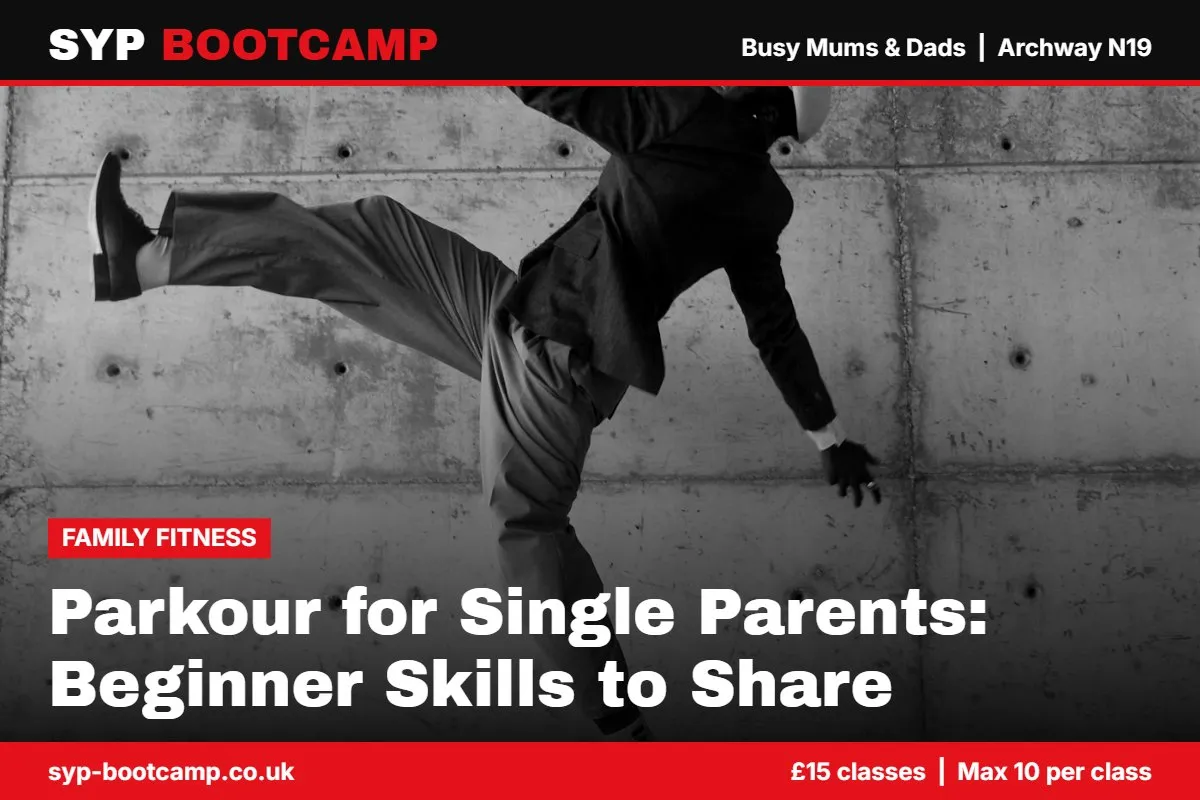
Parkour for Single Parents: Beginner Skills to Share
Your eleven-year-old has discovered parkour videos. Now every wall on the walk home is a challenge, every bench is a vault, and you spend half the journey saying “careful!” Here is another option: join in. Parkour for single parents does not mean leaping between rooftops. At beginner level it is about landing softly, getting over low obstacles smoothly and moving through a park with confidence. It is brilliant fitness, it costs nothing, and it gives you something to do with an older child that they actually think is cool.
I coach busy parents in Archway, and I like parkour basics because they train the things adults lose first: jumping, landing, balance and the confidence to move quickly. This guide is for parents with kids roughly 8 and up. Younger children can join the balance games but should skip the jumps and vaults.
Parkour for single parents: ground rules first
When you are the only adult, an injury to you is an injury to the whole household. So set rules before you set off:
- Low and slow. Nothing higher than knee height for the first month. Nothing higher than hip height without proper coaching.
- Check every surface. Push on walls and rails before using them. Look for wet leaves, moss and broken glass.
- Never on private property, roofs, or near roads. Parks and playgrounds outside busy hours only.
- Stop if it hurts. Sore muscles the next day are normal. Joint pain, a twisted ankle or a jarred wrist mean you rest. The NHS page on sprains and strains explains what to do and when to get help.
If you have knee, ankle or back problems, are recovering from an injury, or are pregnant or postnatal, check with your GP or a physio before trying any jumping.
Skill 1: the landing (learn this before anything else)
Every parkour skill ends with a landing, so this is where you both start. Practise on grass.
- Stand tall, then do a small jump on the spot.
- Land on the balls of your feet first, then let your heels come down.
- Bend knees and hips together, like sitting into a chair, with knees tracking over toes.
- Make the landing as quiet as possible. Quiet means your muscles are absorbing it. Loud means your joints are.
Do 3 sets of 8 small jumps. Turn it into a contest: whoever lands most quietly wins. Then progress to stepping off a low step (a kerb in the park, not on a road) and landing the same way. My guide to box jumps for single parents has more on safe landing mechanics.
Skill 2: balance on a line
Find a low kerb, a log or the edge of a raised flower bed, no higher than a shin.
- Walk it forwards, arms out, eyes ahead not down. 4 lengths.
- Walk it backwards. 2 lengths.
- Walk it and pause on one leg for 3 seconds every few steps.
- Quadrupedal version: walk along it on hands and feet like a cat. Much harder than it looks.
Skill 3: the safety vault
This is the first vault most parkour coaches teach because one hand and one foot are always in contact with the obstacle. Use a low, solid bench or wall, around knee to mid-thigh height.
- Walk up to the bench and place both hands on top.
- Put one foot on the bench between or beside your hands.
- Swing the other leg over the top, then step through and down on the far side.
- Land softly using your landing technique.
Do 5 to 6 slow reps each side. Speed comes much later. If your wrists or shoulders feel uncomfortable, stick to stepping over the obstacle for now. That is still a skill.
Skill 4: precision jumps (tiny ones)
Pick a crack in the path or a line of chalk. Jump from both feet and land exactly on the line, both feet together, and hold the landing for 2 seconds without wobbling. Start with gaps of half a metre. Only progress to jumping onto low obstacles once both of you can stick a landing on flat ground every time.
Honest note: the bigger precision jumps and drops you see online are not for beginners. Adults in particular should build leg strength and landing control for months before trying anything with real height.
A 30-minute family parkour session
- Warm-up (5 min): jog around the field, skips, arm circles, 10 squats, 10 calf raises.
- Landings (5 min): quiet-landing contest.
- Balance (5 min): line walks, forwards, backwards, cat walk.
- Vaults (8 min): safety vaults on a low bench, taking turns.
- Route (5 min): link it up. Balance along a kerb, vault the bench, run to the tree, land a precision jump on a line. Time each other.
- Cool-down (2 min): walk and stretch calves and thighs.
Local green spaces such as Whittington Park have plenty of grass for landings and low features for balance work. Respect other park users and playground rules, and never use play equipment meant for younger children while they are on it. My guide to parks in Archway lists more options, and my active games for kids in the park are good warm-ups.
Why it works for solo parents
Parkour gives you and an older child a shared project that is not screens. It builds leg power, coordination and grip, and because you are learning alongside them, it puts you on the same team. For a lot of the single parents I coach, that connection matters as much as the fitness. For more ways to fit exercise into solo parenting, see my single parent fitness guide.
Where does bootcamp fit? My small-group classes build the strength underneath parkour: squats, lunges, step-ups, core and the conditioning to keep going. Stronger legs mean safer landings.
FAQs
Is parkour safe for adults?
Beginner parkour on low obstacles, with good landings and a sensible pace, is reasonably safe for most healthy adults. The risk comes from height, speed and ego. Keep all three low at first.
What age can kids start parkour?
Children of most ages can do balance and crawling games. For vaults and jumps, many clubs start around age 7 or 8. Supervise closely and keep things low.
Do I need special shoes?
A pair of flexible trainers with good grip is enough. Avoid worn-out soles, which slip on walls and wet surfaces.
Is parkour good exercise?
Yes. It combines running, jumping, climbing, balance and upper body work, so it trains strength, coordination and fitness at the same time.
Book your first class
Want stronger legs and safer landings before you take parkour further? SYP Bootcamp runs 45-minute small-group classes in Archway N19, indoors in a church hall, max 10 people, £15 a class, all levels welcome. Book your £15 class or call or WhatsApp me on 07301 512215 and I will send you the timetable. If you would prefer one-to-one coaching on jumping and landing technique, take a look at my private personal training in Archway.
About the author
Artem Olekhnovych is a personal trainer in Archway and the founder of SYP Fitness and SYP Bootcamp. He has coached clients in Archway, Highgate and across North London for over 10 years, and runs small-group bootcamp classes for busy mums and dads. Read reviews from his 1-1 clients.
