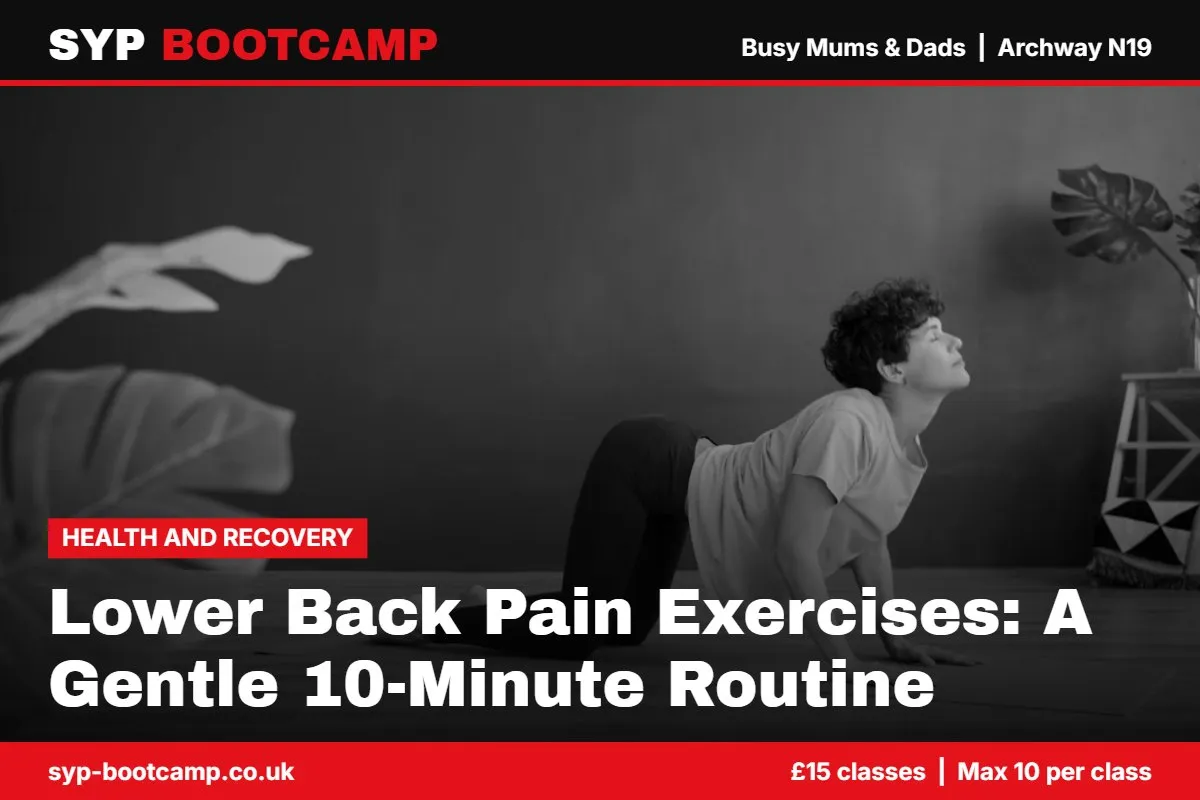
Lower Back Pain Exercises: A Gentle 10-Minute Routine
You bend to pick up a lunchbox, a car seat or a toddler who has gone floppy on the pavement, and your lower back lets you know about it. For many parents, a stiff, achy back is just part of the week. The good news is that for everyday stiffness, gentle movement usually helps more than resting on the sofa. In this post I share the lower back pain exercises I use most with tired parents, a simple 10-minute routine, and clear guidance on when you need a GP or physio rather than a workout.
Important: this is general advice for everyday stiffness, not a treatment plan. If your pain is severe, came on after an injury, or is not improving, please check with your GP or a physiotherapist before starting.
What the NHS says about back pain
The NHS page on back pain explains that it is very common and usually improves within a few weeks or months. Its key self-help message is to stay as active as possible and keep up your normal daily activities, as resting for long periods tends to make things worse. It also suggests exercises and stretches, heat packs, and talking to a pharmacist about pain relief.
That matches what I see. People who keep moving gently usually feel better sooner than people who stop everything and wait.
Why parents’ backs get stiff
It is rarely one thing. More often it is a combination of:
- Long periods sitting at a desk, in the car or on the sofa
- Lots of bending and lifting, often in awkward positions (car seats, cots, bath time)
- Carrying a child on one hip
- Poor sleep and stress, which can make pain feel worse
- Weak or tight hips, which leave the lower back doing extra work
I wrote a whole post on back pain from lifting kids with tips on lifting technique. This post is about the movement side.
My 10-minute lower back pain exercises routine
Do this once a day, ideally in the morning or after a long period of sitting. Move slowly, breathe normally, and stay in a comfortable range. Mild stretching sensations are fine. Sharp pain, or pain that spreads down the leg, is a sign to stop.
1. Knee rocks (1 minute)
Lie on your back with knees bent and feet flat. Let both knees fall gently to one side, then the other, keeping your shoulders on the floor. Small range to start.
2. Pelvic tilts (10 slow reps)
Same position. Gently flatten your lower back into the floor by tilting your pelvis, then let it arch slightly away. This gets the lower spine moving without load.
3. Single knee to chest (3 x 20 seconds each side)
Hug one knee towards your chest while the other foot stays on the floor. Swap sides.
4. Cat and cow (10 slow reps)
On hands and knees, round your back up like a cat, then let your belly drop and lift your chest. Move through the whole spine, not just the lower back.
5. Child’s pose (45 seconds)
Sit back towards your heels with arms stretched forward. Breathe into your back. Widen your knees if it is more comfortable.
6. Glute bridge (2 sets of 10)
Lie on your back, knees bent. Squeeze your bum and lift your hips until your body is in a line from shoulders to knees. Lower slowly. Strong glutes help take load off the lower back.
7. Bird dog (2 sets of 6 each side)
On hands and knees, reach one arm forward and the opposite leg back, keeping your hips level. Hold for 2 seconds. This trains the trunk to stay steady.
8. Kneeling hip flexor stretch (30 seconds each side)
Kneel on one knee, other foot in front. Tuck your pelvis slightly under and shift forward until you feel a stretch at the front of the back hip. My hip flexor stretches for desk workers post has more variations.
Little habits that help through the day
- Break up sitting. Stand up and walk for a couple of minutes every 30 to 45 minutes.
- Walk daily. Even 15 to 20 minutes of easy walking helps many people with back stiffness.
- Lift close. Bring the child or bag close to your body before you lift, and bend your knees.
- Switch hips. If you carry a toddler on one side, swap regularly.
- Use heat. A heat pack or warm bath before your routine can make movement feel easier.
When to see a GP or physio
The NHS advises seeing a GP if back pain has not improved after a few weeks, stops you doing day-to-day activities, is very severe or getting worse, or if you are worried about it. In many areas you can also refer yourself straight to an NHS physiotherapist.
Get urgent medical help (A&E or 999) if you have back pain with any of these:
- numbness around your genitals or bottom
- loss of control of your bladder or bowels, or trouble peeing
- numbness or weakness in both legs, or unsteadiness on your feet
- chest pain, a high temperature, or pain after a serious fall or accident
These are rare, but they need checking straight away. If you are pregnant or recently had a baby, talk to your GP or midwife before starting new exercises.
Where bootcamp fits in
Once everyday stiffness is easing, getting stronger is the best long-term protection. My classes include plenty of hip and core work, and every exercise has an easier option, so you can work around a sensitive back. If stiffness is your main issue, SYP Unlock focuses on hip and back mobility in a calm, controlled way. Just let me know before the class about any pain you have, and I will adjust things for you.
FAQs
Should I rest or exercise with lower back pain?
For most everyday back pain, the NHS advises staying active and keeping up normal activities as much as you can. Long periods of bed rest usually make it worse. If pain is severe or followed an injury, see your GP first.
Is walking good for a stiff back?
For many people, yes. Start with short, easy walks on flat ground and build up. Stop if pain gets sharper or spreads down your leg.
Should I use heat or ice?
The NHS suggests heat packs for back pain. Many people also find a warm bath helps. My post on ice or heat for sore muscles covers when each is useful.
Can I still lift weights with back pain?
Often yes, once the worst has settled, with lighter loads and good technique. Get advice from a physio if you are unsure, and avoid anything that makes the pain sharper.
Book your first class
Want to build a stronger, more comfortable back alongside other parents? SYP Bootcamp runs 45-minute small-group classes in Archway N19, maximum 10 people, £15 a class, indoors and suitable for all fitness levels. Book your £15 class here or call or WhatsApp me on 07301 512215. If you live up the hill and want closer attention, I also work as a personal trainer in Highgate.
About the author
Artem Olekhnovych is a personal trainer in Archway and the founder of SYP Fitness and SYP Bootcamp. He has coached clients in Archway, Highgate and across North London for over 10 years, and runs small-group bootcamp classes for busy mums and dads. Read reviews from his 1-1 clients.
