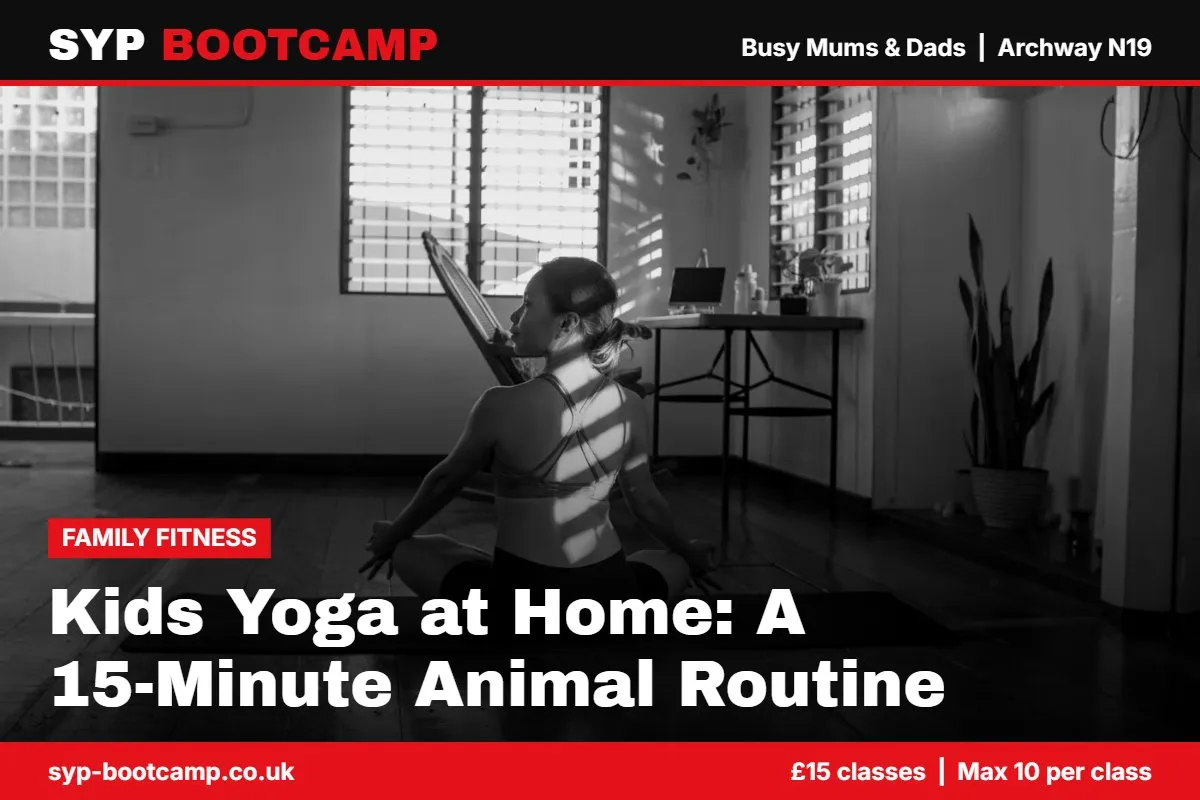
Kids Yoga at Home: A 15-Minute Animal Routine
Bedtime in a lot of homes I hear about goes like this: bath, pyjamas, one more story, and then a child who is suddenly wide awake and doing forward rolls on the bed. If that sounds like your house, try kids yoga at home. Not a serious class with chanting and perfect poses, but a 15-minute animal routine that gets wriggly children stretching, balancing and breathing slowly. I have shared this with parents in my Archway classes, and the feedback is that it works best when you do it with them, on the floor, in your comfy clothes.
It suits children aged roughly 4 to 10. Younger ones will copy you in their own wonderful way. Older ones can lead it.
Why kids yoga at home helps
Children are designed to move, but a lot of their movement is fast and bouncy: running, jumping, climbing. Yoga gives them something different:
- Balance. Standing on one leg as a flamingo is harder than it looks, and balance improves quickly with practice.
- Body awareness. Holding a shape and noticing where their arms and feet are helps coordination in every other sport.
- Calm. Slow movement and long breaths are a natural signal to wind down, which is why I like it as a bedtime ritual.
- Time together. Fifteen minutes on the floor with a parent, no screens, is a big deal to a child.
It does not replace the active, out-of-breath play that children need most days. Think of it as the cool-down to their day.
Setting up
- A clear patch of floor, with a rug, towel or yoga mat each.
- Bare feet, so they do not slip.
- Lights dimmed a little, and quiet music if you like.
- No full tummies: leave at least half an hour after dinner.
Tell them the story first: “We are going on a walk through the jungle, and we are going to meet some animals.” That turns poses into a game.
The 15-minute animal yoga routine
Hold each pose for 3 to 5 slow breaths (count them out loud together), or roughly 20 to 30 seconds. Make the animal noises. They matter more than the shapes.
Warm-up: the waking bear (2 minutes)
- Bear stretch: stand tall, reach both arms up high and yawn like a bear waking up. Three times.
- Bear walk: hands and feet on the floor, bottom up, and walk slowly around the room for 30 seconds.
- Shake off the sleep: shake hands, arms, legs and whole body for 10 seconds.
The jungle walk (10 minutes)
- Tree: stand on one leg, place the other foot against the ankle or calf (never press on the knee), and hands together at the chest. Sway like a tree in the wind. Both sides.
- Flamingo: stand on one leg and lift the other knee up high, arms out like wings. Both sides. Whoever wobbles first makes a flamingo squawk.
- Downward dog: hands and feet on the floor, push your bottom up to the ceiling, heels reaching down. Lift one leg and “wag your tail”.
- Cobra: lie on your tummy, hands under your shoulders, and gently lift your chest. Hiss like a snake. Keep hips on the floor and do not push too high.
- Cat and cow: on hands and knees, round your back up like a scared cat (meow), then let your tummy drop and look up like a cow (moo). Five of each.
- Frog: squat with feet wide and hands on the floor between your knees, then hop up gently and land back in the squat. Five ribbits.
- Butterfly: sit, put the soles of your feet together, hold your toes and flap your knees up and down like wings.
- Crocodile: lie on your tummy, arms stretched forward, and open and close your arms like a giant mouth. Snap!
- Lion: kneel, sitting back on your heels, hands on your knees. Breathe in deeply, then open your eyes and mouth wide, stick your tongue out and let out a big silent lion roar. Kids adore this one.
Wind down: the sleeping animals (3 minutes)
- Mouse (child’s pose): kneel, sit back on your heels and fold forward, forehead on the floor, arms by your sides. Tiny like a mouse.
- Starfish: lie on your back, arms and legs spread wide. Close your eyes.
- Balloon breaths: place hands on tummies. Breathe in through the nose and feel the balloon fill up, breathe out slowly through the mouth and let it go down. Five slow breaths.
Then straight to bed. Do not go back to the telly.
Making it work night after night
- Let them choose one animal. Each night, a child picks one pose to add or swap in.
- Go for “good enough”. Wonky trees and floppy cobras are fine. Never correct a child into a position.
- Keep it short when they are overtired. On bad nights, just do mouse, starfish and balloon breaths.
- Repeat it. Children love routine. After a week they will be reminding you.
If you want a longer stretch session for active kids after football or swimming, my stretching routine for kids is the next step. For the little ones, there are more calm and active ideas in my post on indoor activities for toddlers.
Safety notes
- Nothing should hurt. If a child says a stretch hurts, ease off.
- No pushing or pulling children deeper into a pose.
- Skip upside-down poses and anything involving the neck, such as headstands, for a home routine like this.
- If your child has a medical condition, joint problems or a recent injury, check with your GP or physio before starting new exercise.
What about your own tight hips and back?
Funny thing: many parents tell me that kids yoga made them realise how stiff they had become. If you struggled to get into downward dog or felt your hips complain in the frog, you are not alone. Years of sitting, driving and carrying kids does that. My SYP Unlock hip and back mobility class is built for exactly that. It is not yoga, but it will make getting on and off the floor with your kids feel a lot easier. For a quick daily version, try my 10-minute mobility routine.
FAQs
What age can children start yoga?
Toddlers can copy simple animal shapes from around 2 or 3 years old, just as play. A structured 15-minute routine like this one works best from about 4 years old.
Is yoga good for kids before bed?
Gentle stretching and slow breathing are a calm way to end the day, and many families find it helps their bedtime routine. Keep it slow and finish lying down, not with jumping.
Do kids need a yoga mat?
No. A rug or a folded towel is fine. The main thing is bare feet on a surface that does not slip.
How often should we do it?
Most nights if it helps your bedtime. Even two or three times a week will improve balance and flexibility over a few months.
Book your first class
The kids get their wind-down, so make sure you get your time too. SYP Bootcamp runs 45-minute small-group classes indoors in a church hall in Archway N19, maximum 10 people and £15 a class, with easier and harder options for every exercise. Book my £15 class, or call or WhatsApp me on 07301 512215 and I will send you the timetable. Mums wanting more tailored help can read about my personal training for women in Archway.
About the author
Artem Olekhnovych is a personal trainer in Archway and the founder of SYP Fitness and SYP Bootcamp. He has coached clients in Archway, Highgate and across North London for over 10 years, and runs small-group bootcamp classes for busy mums and dads. Read reviews from his 1-1 clients.
