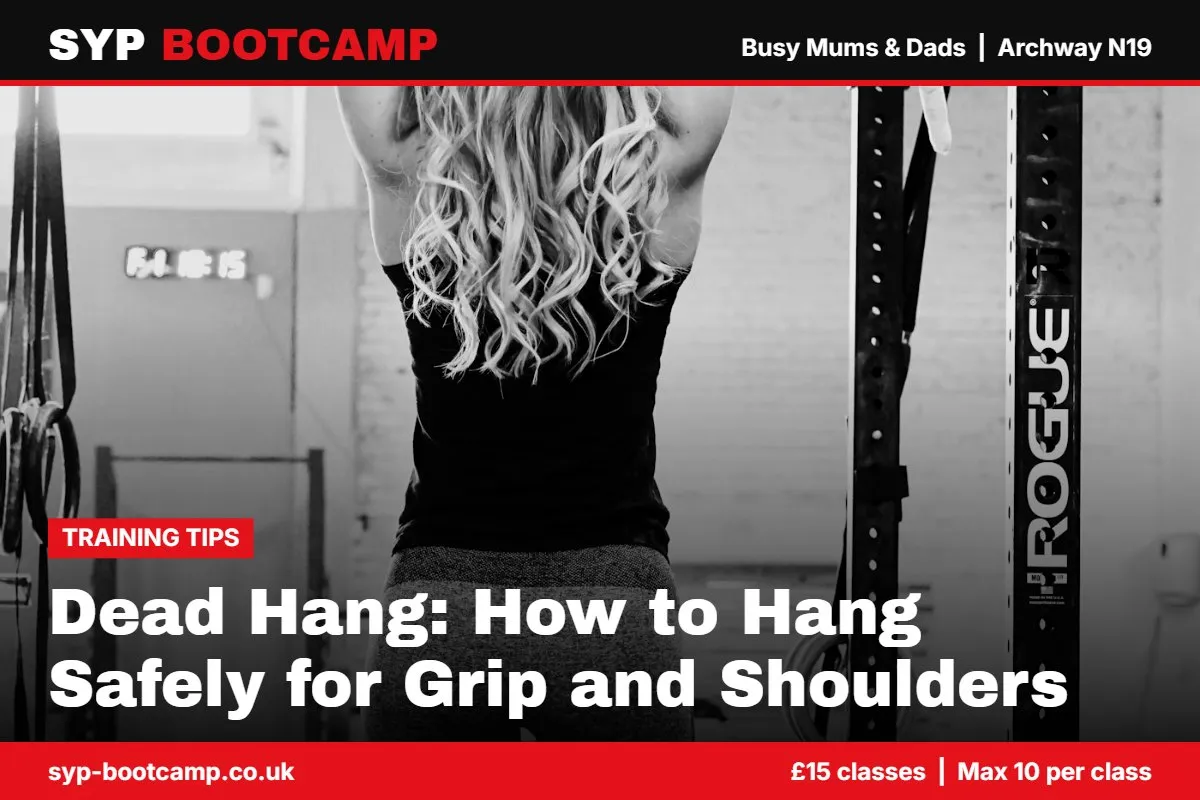
Dead Hang: How to Hang Safely for Grip and Shoulders
Remember swinging from the monkey bars as a kid without a second thought? Try it now, at the playground with your own children, and many parents last about five seconds before their hands burn and their shoulders complain. The dead hang, simply hanging from a bar, is one of the most underrated exercises for adults. It builds grip, gives your shoulders a gentle stretch after a day hunched over a laptop or a buggy, and is the first step towards a pull-up.
Here is how to do a dead hang safely, how to build up from assisted hangs if you cannot hold your bodyweight yet, and when to leave it alone.
What is a dead hang?
A dead hang is hanging from an overhead bar with straight arms, feet off the floor. That is it. No pulling, no swinging. Your grip holds you up while your shoulders and upper back support the position.
There are two main versions, and knowing the difference matters:
- Passive hang: you relax and let your shoulders rise towards your ears. It gives a big stretch through the shoulders, chest and upper back.
- Active hang: you gently pull your shoulders down away from your ears, without bending your arms. Your chest lifts slightly. This switches on the muscles around your shoulder blades and is the starting position for a pull-up.
Beginners should start with the active version and short passive holds only once the shoulders feel comfortable.
Benefits of the dead hang for busy parents
- Grip strength: carrying shopping, car seats and sleeping kids all rely on your hands. Grip is also one of the first things to fade with age if you do not train it. My post on grip strength exercises has more ideas.
- Shoulder mobility: hanging takes your arms overhead, a position many of us rarely reach during the day.
- Posture relief: a short hang is a nice counterbalance to hours of sitting, driving and looking down at phones.
- Pull-up foundation: you cannot pull yourself up until you can hold yourself up.
Is the dead hang safe for you?
For most healthy adults, yes, when you build up gradually. But hanging puts real load through your hands, elbows and shoulders.
Check with your GP or a physio first if you have a current or past shoulder injury, a history of dislocations, frozen shoulder, elbow or wrist pain, or if you are pregnant or recently postnatal. After birth, wait for your GP check, usually around 6 to 8 weeks, before returning to exercise. The NHS page on shoulder pain explains when to get help.
Stop if you feel sharp pain, pinching at the front or top of the shoulder, or tingling or numbness in your hands or fingers. Dull burning in the forearms is normal. Joint pain is not.
Dead hang progression: from assisted to full hangs
Work through these stages. Move on only when you can do the target comfortably on two separate days.
Stage 1: feet-supported hang
Use a bar low enough that your feet can stay on the floor or on a step. Hold the bar, bend your knees and let some of your weight hang through your hands. You choose how much weight your legs take.
Target: 3 holds of 20 seconds, resting 60 seconds between.
Stage 2: active shoulder shrugs with feet supported
Same position. Slowly pull your shoulders down and back, then let them rise again, keeping arms straight. This teaches the “active” position.
Target: 3 sets of 8 slow reps.
Stage 3: short active hang
Now take your feet off the floor, using a step to get up and down. Shoulders gently pulled down, ribs tucked, legs together and still.
Target: build from 5 x 5 seconds to 3 x 15 seconds.
Stage 4: longer active hang
Target: 3 holds of 20 to 30 seconds.
Stage 5: add passive hangs and variety
Once active hangs feel solid, add short passive hangs for the stretch, starting with 10 seconds. You can also try hanging with a mixed grip or with towels over the bar for extra grip work.
Target: 30 to 60 seconds total hanging time, broken into chunks.
Two or three sessions a week is plenty. Your hands need recovery time too.
Form cues for a safe dead hang
- Grip: hands about shoulder width, thumbs wrapped round the bar, palms facing away.
- Get on and off with control: step up from a box or bench, and step down rather than dropping, especially if you are new or heavier.
- Stay still: no kicking or swinging. Squeeze your legs together and your bum lightly.
- Breathe: slow breaths through the nose. Holding your breath makes everything feel harder.
- Stop before your grip fails: end the hold while you still feel in control, not when your hands peel off.
Where to hang if you have no pull-up bar
A doorway pull-up bar is cheap, but check the frame is sturdy and fit it exactly as the instructions say. Many playgrounds have monkey bars or climbing frames, and some parks have outdoor gym equipment. My guide to playgrounds near Archway and Highgate lists local spots. Always let the kids have priority on play equipment, and check that it is designed to take an adult’s weight. Never use door frames, shelves or banisters.
From dead hang to pull-up
Once you can hold an active hang for 30 seconds, you are ready to start working on pulling. The next steps are slow lowering from the top (negatives) and band-assisted pull-ups. I explain these step by step in pull-ups for single parents.
Dead hangs in a bootcamp class
In my classes, I use supported hangs and grip work as part of the strength stations, always with a step-down option. In the SYP Built To Last strength class we pair hanging with carries and rows to build strong hands, shoulders and upper backs for everyday life.
FAQs
How long should I be able to dead hang?
There is no official standard. For a beginner, 20 to 30 seconds of controlled active hanging is a solid goal. Many fit adults build to 60 seconds or more over time.
Is hanging good for your spine?
Many people find a gentle hang relieving after sitting, but it is not a treatment for back problems. If you have back pain, ask your GP or physio before using hanging as part of your routine.
Why do my hands hurt when I hang?
Burning in the forearms and skin pinching on the palms are normal at first. Shorten your holds and build gradually. Sharp pain in the fingers, wrists or elbows means stop and rest.
Should I do a dead hang every day?
Short, easy hangs most days are fine for many people once they are used to it. When you are building up, two or three sessions a week with rest days between is safer for your hands and elbows.
Book your first class
Want to build grip and shoulder strength with a coach beside you? SYP Bootcamp runs 45-minute small-group classes indoors in a church hall in Archway N19, max 10 people, £15 a class, with easier and harder options for every exercise. Book your £15 class here or call or WhatsApp me on 07301 512215. If you have a shoulder history and want careful one-to-one progressions, look at my injury-safe personal training at SYP Fitness.
About the author
Artem Olekhnovych is a personal trainer in Archway and the founder of SYP Fitness and SYP Bootcamp. He has coached clients in Archway, Highgate and across North London for over 10 years, and runs small-group bootcamp classes for busy mums and dads. Read reviews from his 1-1 clients.
