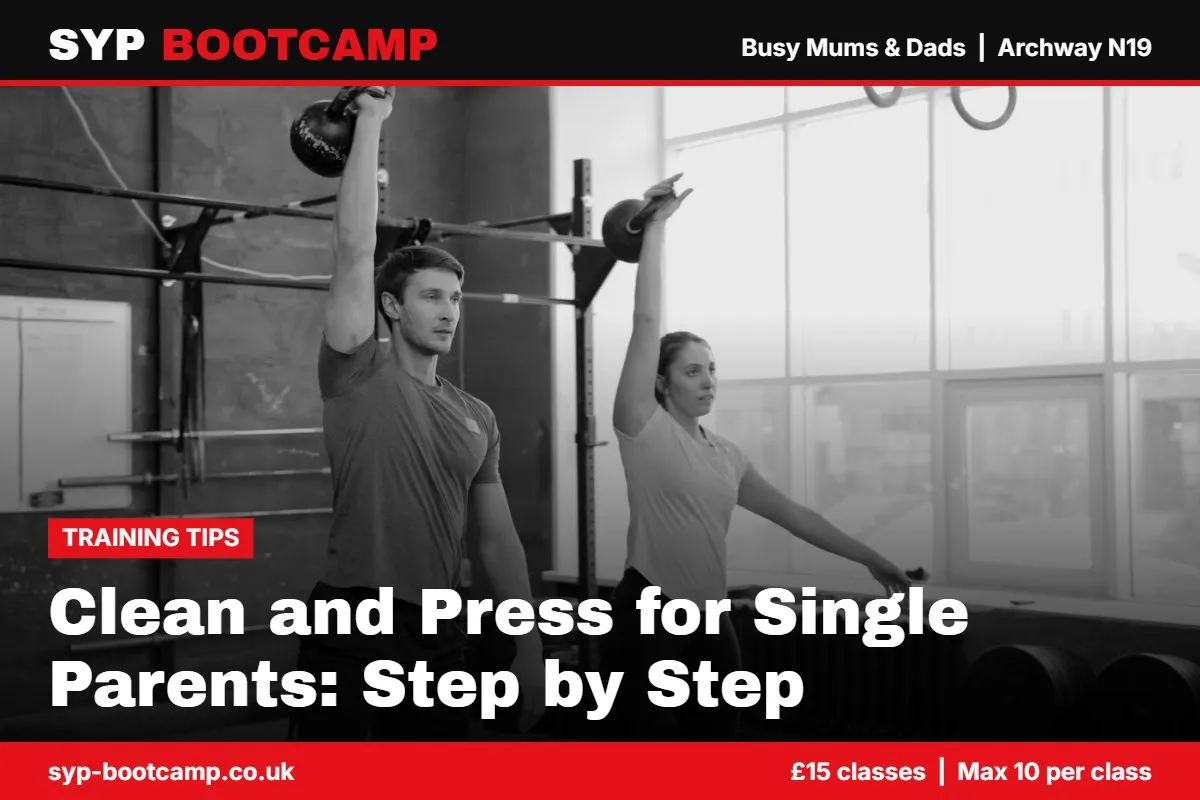
Clean and Press for Single Parents: Step by Step
If you could only do one exercise for the rest of the year, I would put the clean and press near the top of the list. You pick a weight up off the floor, bring it to your shoulder and push it overhead. Legs, hips, back, core, shoulders and grip all get a turn, in a pattern that looks a lot like lifting a sleepy child from the floor and putting a bag onto a high shelf. That makes the clean and press for single parents a brilliant choice when your time is short and you want one move that trains everything. The catch is that it is technical. So in this guide I break it into simple steps you learn one at a time, with a kettlebell or a dumbbell.
Why break it into pieces?
The full clean and press happens in about two seconds. If you try to learn it all at once, the usual result is a weight that swings out, bangs into your forearm, and gets pressed with a bent back. Not ideal when you are the only adult who can do the nursery run tomorrow.
Instead, I teach it as four building blocks. Each is a decent exercise on its own. Once each one is tidy, you join them together.
Clean and press for single parents: the 4 building blocks
Block 1: The deadlift (picking it up)
Weight on the floor between your feet. Feet hip width. Push your hips back, bend your knees, keep your back flat and grip the handle. Stand up by pushing the floor away, then lower it the same way. This is the foundation, and the same movement you should use to lift a toddler or a laundry basket.
Practise: 3 sets of 8. Keep the weight close to your shins all the way up.
Block 2: The rack hold (where the weight lives)
With a kettlebell, the “rack” is the bell resting against the outside of your forearm and upper arm, handle in your palm, wrist straight, elbow tucked into your ribs, fist near your chin. With a dumbbell, rest one end on your shoulder, palm facing in. Stand tall and hold it there.
Practise: 3 x 20 seconds each side, walking slowly round the room if you like.
Block 3: The clean (floor or hang to shoulder)
Start with the weight hanging between your legs after a deadlift. Hinge slightly, then snap your hips forward. As the weight floats up, keep it close to your body, like zipping up a jacket, and let your elbow drop and tuck so the weight lands softly in the rack. With a kettlebell, the bell should rotate around your hand rather than flip over and smack your wrist. With a dumbbell, guide it up close to your body to the shoulder.
Practise: 3 x 5 each side with a light weight. If it bashes your arm, keep it closer and do not grip so tight at the top. A guide on kettlebell cleans for single parents covers this step in depth.
Block 4: The press (shoulder to overhead)
From the rack, brace your middle, squeeze your glutes and press the weight straight up until your arm is locked and your bicep is near your ear. Do not lean back or sideways. Lower it under control back to the rack.
Practise: 3 x 5 each side.
Putting it together
Once each block feels tidy, join them: deadlift, clean to the rack, pause for a breath, press, lower to the rack, lower to the floor. That is one rep.
The pause in the rack is important. It stops you using a big back-bend to “throw” the weight up, and gives you a moment to check you are braced. Later on you can flow more smoothly, but pauses are your friend while learning.
Choosing a weight
Your press will be the weak link. Choose a weight you can press 5 times with good form, not one you can clean. For many women starting out that is a 6 to 8 kg kettlebell or dumbbell; for many men, 10 to 12 kg. Everyone is different, so start lighter than you think. If in doubt, go down a size and earn the next one.
A 4-week clean and press plan
Twice a week, after a 5-minute warm-up of hip hinges, arm circles and bodyweight squats.
- Week 1: blocks 1 to 4 separately, 3 sets each. About 15 minutes.
- Week 2: deadlifts 2 x 8, then clean and press 4 x 3 each side with a pause in the rack.
- Week 3: clean and press 5 x 4 each side, rest 60 to 90 seconds.
- Week 4: clean and press 5 x 5 each side, or an EMOM: 3 reps each side at the start of every minute for 10 minutes.
That 10-minute EMOM is the “one move that trains everything” workout I recommend for busy solo parents once the technique is solid.
Safety for a tired parent
- Clear the floor of toys and keep children well away. A dropped kettlebell can do real damage, so do this after bedtime or with older kids at a safe distance.
- Train on a mat or a carpet, never a glass-topped table area.
- If you are exhausted, do the deadlift and press separately with lighter weight. Fatigue and technical lifts do not mix.
- If you have shoulder, back or wrist pain, or are postnatal, check with your GP or a physio first. The NHS page on back pain explains when to get advice. Stop if anything hurts.
For the bigger picture of how to fit training into a solo household, start with the hub guide on single parent fitness.
Where a bootcamp class fits
The clean is the hardest piece to teach yourself from a screen. A coach can see in one rep whether the weight is drifting away from you or your wrist is bending. In my SYP Built To Last functional strength class, we build exactly these patterns, hinge, carry and press, with kettlebells and dumbbells, and I give you the easier or harder version you need on the day.
FAQs
Is the clean and press good for beginners?
It can be, if you learn it in parts. Many beginners are better off doing deadlifts and presses separately for a few weeks before joining them together.
Kettlebell or dumbbell for clean and press?
Both work. A dumbbell is easier to learn because it does not flip around your wrist. A kettlebell sits more comfortably in the rack once you have the technique.
Why does the kettlebell hit my wrist?
Usually because it is travelling in a big arc away from your body. Keep it close, punch your hand through at the top and loosen your grip slightly as it lands.
How heavy should I go?
Use a weight you can press overhead 5 times with good form. The clean is usually stronger than the press, so the press decides.
Book your first class
Want hands-on coaching for lifts like this? SYP Bootcamp runs 45-minute small-group classes in Archway N19 with no more than 10 people, so you get real attention, at £15 a class. Book your £15 class or call or WhatsApp me on 07301 512215. If you live up the hill and prefer one-to-one, I also work as a personal trainer in Highgate.
About the author
Artem Olekhnovych is a personal trainer in Archway and the founder of SYP Fitness and SYP Bootcamp. He has coached clients in Archway, Highgate and across North London for over 10 years, and runs small-group bootcamp classes for busy mums and dads. Read reviews from his 1-1 clients.
