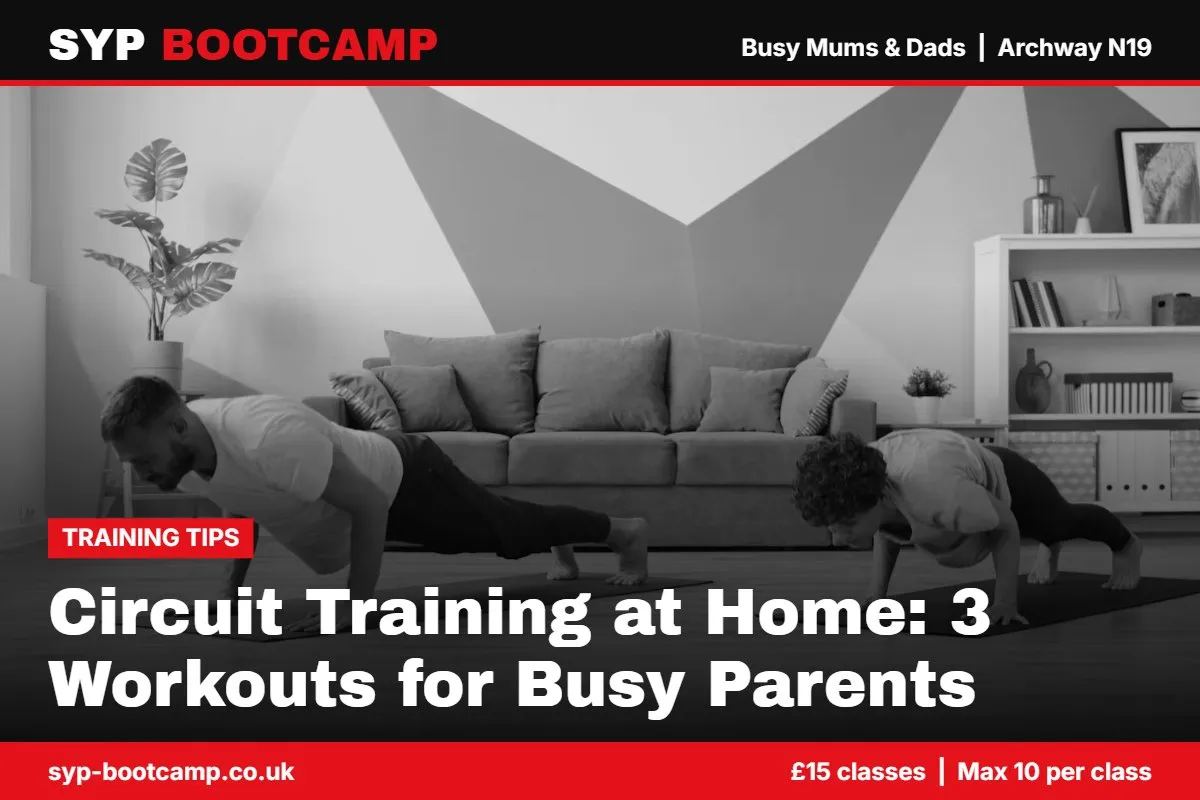
Circuit Training at Home: 3 Workouts for Busy Parents
The gym is a 20-minute round trip, the kids need picking up at 3:15, and by the time dinner is done you have about half an hour and a living room full of Lego. That is exactly why I love circuit training at home. No travel, no kit you do not already own, and you can fit a proper full-body session in the gap between bath time and the washing-up. Below are three home circuits I give to busy parents, plus how to set up your space and keep progressing.
Set up your space in 2 minutes
You need less than you think:
- A clear patch of floor about the size of a yoga mat. Shove the toys to one side.
- A sturdy chair without wheels, pushed against a wall.
- The bottom stair or a solid step.
- Something to lift: a backpack with books in, two full water bottles or a bag of potatoes. A resistance band is a cheap upgrade.
- A timer on your phone. A free interval timer app saves a lot of clock-watching.
If you have little ones around, keep weights and bands out of reach when you are not using them, and choose a spot where nobody can run into you.
Circuit training at home: three workouts
Always warm up first for 4 to 5 minutes: march on the spot, roll your shoulders, swing your arms, do a few slow squats and lunges. Then pick one of these.
Circuit A: the quiet after-bedtime circuit (20 minutes)
No jumping, so the kids and the downstairs neighbours stay asleep. 40 seconds work, 20 seconds rest, 4 rounds.
- Squat to a chair (harder: hold the backpack to your chest)
- Push-up on the kitchen worktop (harder: on the floor)
- Backpack row: hinge forward, pull the bag to your belly
- Reverse lunge holding the chair (harder: no support)
- Plank from the knees (harder: full plank)
Circuit B: the 12-minute cardio burst
For mornings when you need waking up. 30 seconds work, 15 seconds rest, 4 rounds of 4 moves.
- Fast march or jog on the spot
- Step-ups on the bottom stair, alternating legs
- Standing punches, fast and light (great for stress)
- Skater steps side to side (harder: small hops)
Circuit C: the strength builder (25 minutes)
Reps instead of time. Do 3 to 4 rounds, resting 60 to 90 seconds between rounds.
- Goblet squat with backpack or bottles, 10 reps
- Band or backpack row, 12 reps
- Single-leg glute bridge, 8 each side
- Incline push-up, 8 to 12 reps
- Split squat, 8 each leg (hold the chair if needed)
- Dead bug, 6 each side
Want more ideas without kit? My no equipment home workout has extra moves you can swap in. If you have a band, my resistance band workout at home goes deeper.
How often, and how to progress
The NHS physical activity guidelines for adults recommend strength activities that work all the major muscle groups on at least 2 days a week. Two or three home circuits a week cover that nicely.
To keep getting fitter, change one thing at a time:
- Add a round (3 rounds becomes 4)
- Add reps (10 squats becomes 12)
- Add load (more books in the backpack)
- Cut rest (20 seconds becomes 15)
- Use a harder version of one move
Write your rounds and reps on a note on your phone. Seeing the numbers go up over a month is very motivating.
Making it work with kids at home
- Turn them into coaches. Kids love shouting “Go!” and “Stop!” on the timer.
- Let them join in on the safe moves: marching, squats, bridges and punches.
- Use their screen time. One episode of their programme is about 20 minutes, which is a whole circuit.
- Do not aim for perfect. If you get interrupted, pause the timer and carry on. Two rounds still count.
If you have a health condition, an injury or you are pregnant or postnatal, please check with your GP or physio before starting a new routine. The same NHS guidelines include specific advice for pregnant women and new mothers.
When home training stops being enough
Home circuits are brilliant, but they have limits. It is easy to drift into the same moves, skip the hard ones, or let form slip when nobody is watching. That is where a small-group class adds something. In my classes you get heavier kettlebells, pads and slam balls you probably do not have at home, a coach correcting your technique, and the energy of other parents working alongside you. If your home sessions have become a way to burn off stress, you might enjoy my SYP Release stress relief class with pads and slam balls.
FAQs
Can you do circuit training at home with no equipment?
Yes. Squats, lunges, push-ups, bridges, planks and step-ups make a full-body circuit. A backpack with books in adds load when bodyweight gets easy.
How long should a home circuit workout be?
Between 12 and 30 minutes is plenty for most parents. A short session done regularly is more useful than a long one you keep putting off.
Is circuit training at home effective?
It can be very effective if you progress it over time, by adding rounds, reps or load. The key is consistency and gradually making it harder.
What is a good beginner circuit?
Five or six simple moves such as chair squats, wall push-ups, bridges, step-ups and marching, done for 2 to 3 rounds. My guide to circuit training for beginners has a full 4-week plan.
Book your first class
When you are ready to add a coached session to your home training, come and try one. SYP Bootcamp runs 45-minute small-group classes in Archway N19, max 10 people, £15 a class, indoors so rain never cancels. Book your £15 class here or call or WhatsApp me on 07301 512215. If you would like a home plan written for you and checked every week, see online coaching with SYP Fitness.
About the author
Artem Olekhnovych is a personal trainer in Archway and the founder of SYP Fitness and SYP Bootcamp. He has coached clients in Archway, Highgate and across North London for over 10 years, and runs small-group bootcamp classes for busy mums and dads. Read reviews from his 1-1 clients.
