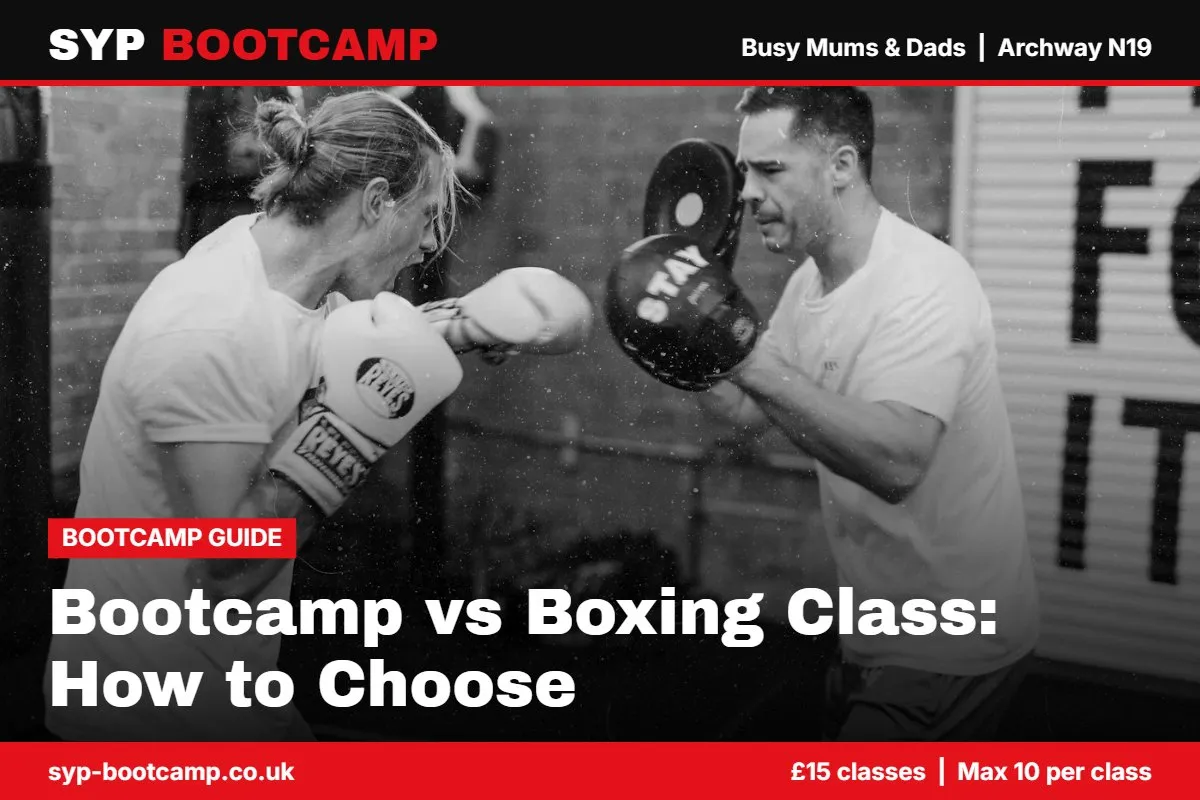
Bootcamp vs Boxing Class: How to Choose
Maybe you have watched a boxing fitness class through a gym window and thought “that looks amazing, but I would look ridiculous”. Or you have been told a bootcamp is “basically the same thing”. They are not quite the same. If you are trying to decide on bootcamp vs boxing class, the right choice comes down to two things: what you want to get out of it, and how confident you feel walking into a room full of strangers. I run both styles of session in Archway, so here is how I help parents choose.
What happens in each class
A boxing fitness class
A boxing fitness class (not a fight club, there is no sparring) is built around punching technique. You learn a stance, a jab, a cross, hooks and uppercuts, then put them into combinations on pads, bags or shadow boxing. In between rounds there is usually skipping, footwork drills and core work. Rounds are often timed like a real fight, for example 2 or 3 minutes on, 1 minute off.
A bootcamp class
A bootcamp is broader. You might do kettlebell swings, squats, rows, lunges, carries, a little bit of cardio and some core. It is a mix of strength and conditioning, designed to make you fitter all round. If you want the full picture, here is a sample bootcamp workout like the ones I run.
Bootcamp vs boxing class: what each is best for
| Goal | Better choice | Why |
|---|---|---|
| Getting stronger (legs, back, arms) | Bootcamp | You lift and carry progressively heavier weights |
| Fitness and stamina | Both | Both use intervals that get you breathing hard |
| Stress release | Boxing | Hitting pads is hard to beat after a bad day |
| Coordination and reaction | Boxing | Combinations and footwork train your brain as well as your body |
| Shoulder and core endurance | Boxing | Hundreds of punches with a braced trunk |
| Variety and all-round fitness | Bootcamp | Covers more movement patterns in one session |
Choosing by confidence
This is the part people do not say out loud. Lots of parents I meet are nervous about boxing because they think it is aggressive, or that they will be paired with someone who hits too hard. Others are nervous about bootcamp because they picture someone shouting at them while they do burpees in the mud.
Here is what I tell them:
- If you have never done any exercise class, either is fine as long as it is beginner friendly and small. Look for groups of 10 or fewer, a coach who asks about injuries, and easier options for every move.
- If you feel awkward about coordination, a bootcamp might feel easier at first. The moves are simpler to pick up.
- If you want something that feels like a skill, boxing is very satisfying. You can see yourself improving week to week.
- If you are worried about being hit, choose a class with no sparring. In my SYP Box Fit beginner boxing class, nobody spars. You hit pads and bags, not people.
Five questions to ask yourself
- Do I want to lift weights and get stronger, or learn a new skill?
- Do I need to burn off stress, or build overall fitness?
- How are my wrists and shoulders? (Boxing puts more demand on them.)
- Do I enjoy repetition and getting better at one thing, or do I prefer variety?
- Will I actually go every week? That matters more than anything else.
If most of your answers lean towards strength and variety, start with a bootcamp. If they lean towards stress relief and skill, try boxing fitness. If it is a split, do one of each a week. They work brilliantly together because boxing hammers the upper body and core, while bootcamp builds the legs and back.
Safety basics for beginner boxing
Boxing fitness is safe for most people when it is coached properly. A few things I always teach:
- Wrap your hands or wear well-fitting gloves. Your wrists need support when you hit pads.
- Keep your wrist straight and punch with the first two knuckles. A bent wrist on impact is the most common beginner injury.
- Do not lock your elbow out hard. Snap the punch back rather than slamming to full extension.
- Breathe out on every punch. Holding your breath makes you tired fast.
- Stop if anything hurts sharply. Wrist, shoulder or elbow pain is a signal to rest and get it checked, not to push through.
If you have high blood pressure, a heart condition or a recent injury, check with your GP or physio before starting a high-intensity class of either kind. The NHS has a helpful page on sprains and strains if you pick up a knock.
Want to try a few punches before you commit? My boxing workout at home for beginners is a gentle place to start, and if a tough week has you wound up, try the punch bag workout for stress.
FAQs
Is boxing fitness good for beginners?
Yes, if the class is non-contact and coached. You learn the basic punches first and build up slowly. Most beginners love it within a couple of sessions.
Do I need my own gloves?
It depends on the class. Many provide gloves. If you go regularly, your own pair is more hygienic and fits better. Ask before you book.
Which burns more energy, boxing or bootcamp?
Both can be very demanding. How hard you work matters far more than which one you choose.
Can women do boxing classes?
Absolutely. Many of the people in boxing fitness classes are women, and plenty of mums I coach say it is their favourite session of the week.
Book your first class
Not sure which to try? Come to one of my sessions and see. SYP Bootcamp runs 45-minute small-group classes in an indoor church hall in Archway N19, max 10 people and £15 a class, including SYP Box Fit for beginner boxing. Book your £15 class here or call or WhatsApp me on 07301 512215. If you would feel more confident training with a friend first, look at partner personal training at SYP Fitness.
About the author
Artem Olekhnovych is a personal trainer in Archway and the founder of SYP Fitness and SYP Bootcamp. He has coached clients in Archway, Highgate and across North London for over 10 years, and runs small-group bootcamp classes for busy mums and dads. Read reviews from his 1-1 clients.
