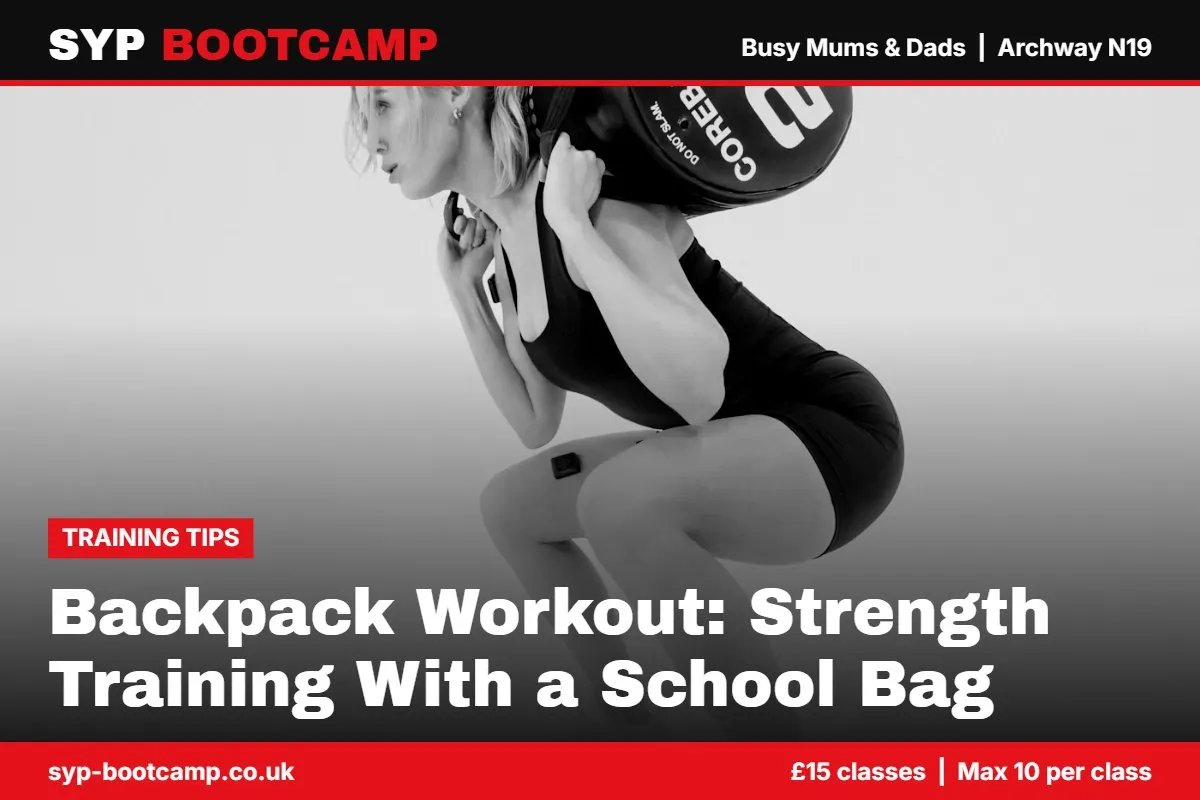
Backpack Workout: Strength Training With a School Bag
Every school night, there is a bag of books by the front door. Before it goes back in the hallway, borrow it. A backpack workout turns a rucksack and a few heavy books into a surprisingly good set of weights, and you can adjust the load in seconds by adding or removing a book. No gym, no buying kit, no clutter.
Here is how to load the bag safely, how heavy to go, and a 25-minute full-body routine.
How to load a backpack for training
The way you pack the bag matters more than you would think. A loose, floppy bag swings around and pulls you off balance.
- Use the sturdiest bag in the house. A school rucksack with two padded straps and a top grab handle is ideal. Check the seams and straps first. Old or thin bags can split.
- Pack heavy items flat against the back panel. Hardback books, a bag of rice or a few full water bottles laid flat. Keep the weight high and close to your spine.
- Fill gaps with a towel or jumper so nothing shifts.
- Weigh it. Stand on the bathroom scales with and without the bag. Write the number down so you can track progress.
- Do the straps up tight for moves where you wear it, so it sits snug on your back.
How heavy should the bag be?
Go by feel, not by a number from the internet. As a rough starting point:
- Complete beginner or returning after a long break: start with 3 to 5kg. That is roughly a few hardback books or three 1.5 litre water bottles.
- Some training experience: 5 to 10kg.
- Regular strength trainers: 10kg or more for squats, deadlifts and carries, lighter for presses.
Choose a load where the last 2 or 3 reps of each set feel hard but your form stays clean. Most people find they want a heavier bag for legs and a lighter bag for shoulders, so you might take a couple of books out mid-session. If you have back problems, a heart or blood pressure condition, or you are pregnant or recently postnatal, check with your GP or physio before adding load. The NHS has guidance on back pain and when to get it checked.
The 25-minute backpack workout
Warm up for 3 minutes with marching, arm circles, 10 bodyweight squats and 10 hip hinges. Then do 3 rounds of the circuit, resting 60 to 90 seconds between rounds.
1. Backpack front squat (12 reps)
Hug the bag to your chest with both arms, straps hanging down. Feet shoulder-width, sit down between your heels with your chest up, then stand. Holding the weight in front helps you stay upright, a bit like a goblet squat.
2. Bent-over backpack row (10 reps)
Hold the bag by both straps or the top handle. Hinge forward with a long back, knees soft. Row the bag to your belly button, squeezing your shoulder blades, then lower slowly. Keep the bag close to your legs.
3. Backpack Romanian deadlift (10 reps)
Hold the bag by the top handle in front of your thighs. Push your hips back, let the bag slide down your legs to just below the knee, then squeeze your glutes to stand. This is where you can go heaviest.
4. Push-ups wearing the backpack (6 to 10 reps)
Wear the bag with straps tight. Do push-ups on the floor, on your knees or with hands on the sofa, whichever lets you keep a straight body line. The bag adds load to your chest, shoulders and triceps.
5. Backpack reverse lunge (8 per side)
Wear the bag on your back or hug it to your chest. Step back, lower your back knee towards the floor, drive through your front heel to return.
6. Overhead press (8 to 10 reps)
Hold the bag by its sides at chest height and press it overhead, keeping your ribs down. Use a lighter bag for this one. If it feels awkward, do a floor press lying on your back instead.
7. Backpack carry (1 minute)
Hug the bag to your chest and walk around the house or up and down the hallway, standing tall. Or hold it by one strap for a one-sided carry, 30 seconds each side.
Take it outside: the backpack walk
On days you cannot fit in the circuit, simply walking with a loaded rucksack is a great workout. It is often called rucking, and I explain how to build it up in rucking for single parents. Start with a light bag on a walk you already do, like the school run. My post on walking the school run has ideas for turning that journey into exercise.
Common backpack workout mistakes
- Swinging the bag. Use slow, controlled reps. If you need momentum, the bag is too heavy.
- Rounding your back on rows and deadlifts. Keep your chest proud and your back long, and stop the movement when your hamstrings feel tight.
- Using a bag with a broken strap. Check it every time. A strap snapping mid-press is not fun.
- Going too heavy too soon on walks. Your feet, knees and back need time to adapt. Add a book a week, not the whole bookshelf.
Do the circuit two or three times a week. If you want a version with no load at all for travel days, try my no equipment home workout.
Where a bootcamp class fits
A backpack is a great way to start strength training, but there is a limit to how much you can load one and how comfortable it is to grip. In class you can move on to kettlebells and dumbbells of the right weight for each move, with coaching on your form. The SYP Recharge class uses circuits like this one with proper kit, and it is a good next step if your home sessions have become a habit.
FAQs
Is a backpack workout as good as lifting weights?
For beginners, it can be very effective. You can build strength in every major muscle group. As you get stronger you may need heavier weights than a bag can hold, especially for legs.
How much weight should I put in my backpack?
Start with 3 to 5kg if you are new to strength training and increase gradually. Choose a weight where the last few reps feel hard but your form stays good.
Can I use my child’s school bag?
Yes, if it is sturdy with two strong straps. Check the seams and empty out anything fragile first. Put it back as you found it so there are no tears the next morning.
Is walking with a weighted backpack bad for your back?
Not if you start light, keep the weight high and close to your back and build up slowly. If you have existing back pain, check with your GP or physio before adding load.
Book your first class
When you are ready to swap the school bag for kettlebells, come along. SYP Bootcamp runs 45-minute small-group classes indoors in a church hall in Archway N19, maximum 10 people, all fitness levels, £15 a class. Book your £15 class here or call or WhatsApp me on 07301 512215. If you would like a coach to plan your training around your home kit, take a look at my online coaching.
About the author
Artem Olekhnovych is a personal trainer in Archway and the founder of SYP Fitness and SYP Bootcamp. He has coached clients in Archway, Highgate and across North London for over 10 years, and runs small-group bootcamp classes for busy mums and dads. Read reviews from his 1-1 clients.
