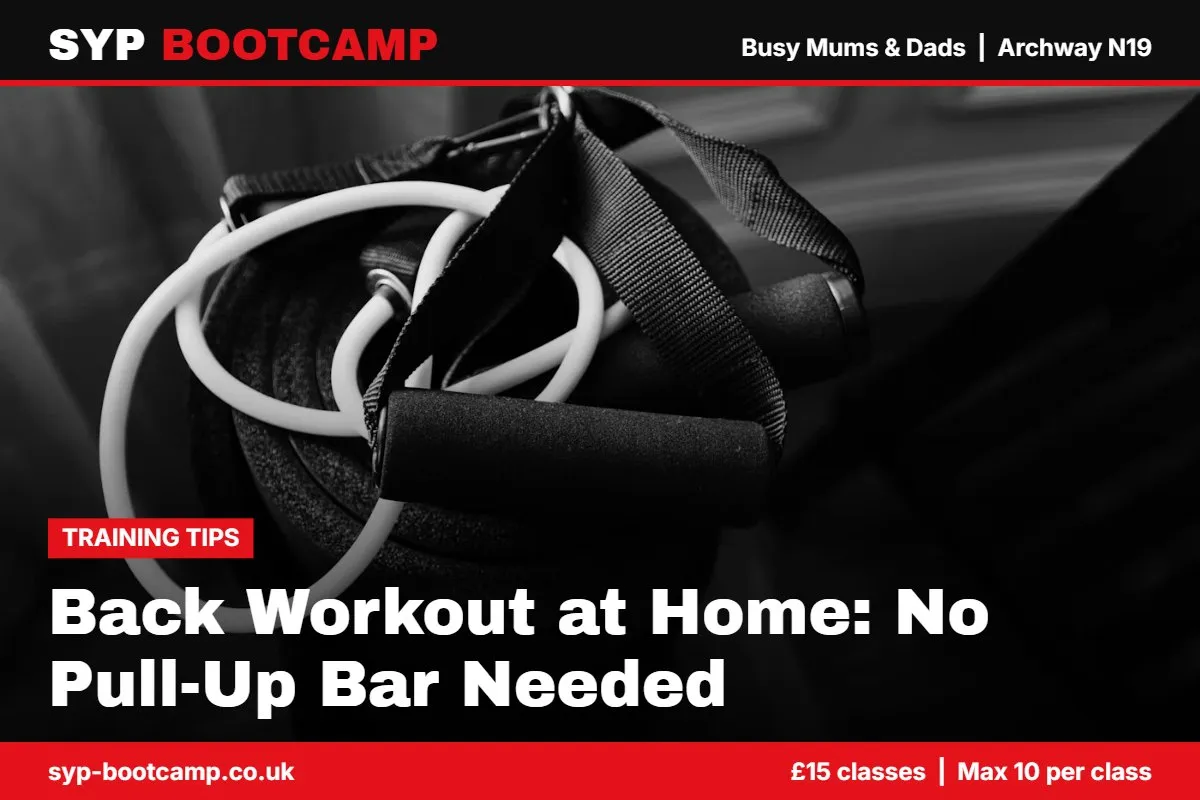
Back Workout at Home: No Pull-Up Bar Needed
The back is the hardest part of the body to train at home. Pushing is easy (drop and do a push-up), legs are easy (stand up and squat). But pulling, the movement that builds your back, normally needs a pull-up bar, a cable machine or a rowing machine, none of which fit in a London flat. So most home routines skip it, and parents end up with strong-ish fronts and weak, achy backs. This back workout at home fixes that using a towel, a door and, if you have one, a cheap resistance band.
I give a version of this to almost every parent who trains with me from home. It takes about 25 minutes and it is the session most likely to make carrying, lifting and sitting at a desk feel easier.
Why your back needs its own workout
Your back muscles hold you upright, keep your shoulders in a good position and help you lift things off the floor without strain. Busy parents put huge demands on them: car seats, buggies up the steps, sleeping children carried up to bed. At the same time, we spend hours hunched forward over phones and screens, which leaves the upper back weak and stretched.
Training the back is not only about looking better in a T-shirt. Stronger back muscles help you lift your kids without back pain and sit and stand taller without having to think about it.
Kit you can use instead of machines
- A bath towel: for rows on a door, and for “pull-down” holds.
- A solid door: one that closes firmly, with a sturdy handle. Always stand on the side the door opens away from, so pulling closes it more tightly rather than opening it. Check both handles are tight first.
- A resistance band: a long loop band costs about the same as a takeaway and makes a huge difference. My resistance band workout at home shows how to anchor one safely.
- A rucksack: loaded with books, it becomes a weight for bent-over rows.
The 25-minute back workout at home
Warm up with 2 minutes of arm circles, shoulder rolls and cat-cow on all fours, then 10 slow band or towel pull-aparts. Do each exercise for the sets listed, resting 45 to 60 seconds between sets.
1. Towel door row (3 sets of 10)
Loop the towel round the door handle and hold one end in each hand. Feet close to the door, lean back with straight arms until your body is at an angle. Pull your chest to your hands, leading with your elbows and squeezing your shoulder blades together. Lower slowly. The more upright you stand, the easier it is; walk your feet closer to the door to make it harder.
2. Rucksack bent-over row (3 sets of 10)
Hold a loaded rucksack by its top handle or both straps. Hinge forward from the hips with a long back, knees soft, until your chest is about 45 degrees to the floor. Row the bag towards your lower ribs, pause, lower. If your lower back is sensitive, do one arm at a time with your other hand resting on a table.
3. Towel lat pull-down (3 sets of 8, 3-second squeeze)
Hold a towel overhead, hands wide, and pull it tight as if trying to rip it apart. Keeping that tension, pull your elbows down and back until the towel is behind your head at about ear level (or in front of your face if your shoulders are stiff). Squeeze hard for 3 seconds, then return. With a band, anchor it high in a door and do proper pull-downs instead.
4. Prone Y-T-W (2 rounds of 6 each)
Lie face down, forehead on a folded towel. Lift your arms into a Y shape (overhead), then a T (out to the sides), then a W (elbows bent and tucked in), 6 reps each, thumbs pointing to the ceiling. Small lifts are fine. These hit the small upper-back muscles that most people never train.
5. Superman hold (3 holds of 15 to 20 seconds)
Still face down, lift your arms, chest and legs slightly off the floor. Keep your neck long. If this bothers your lower back, do a bird dog on all fours instead.
6. Suitcase carry (3 rounds of 30 seconds each side)
Hold the rucksack (or a heavy shopping bag) in one hand by your side and walk up and down the hallway, standing tall without leaning. This trains the muscles down the side of your back and your grip.
Progressing your back workout over 6 weeks
- Weeks 1 to 2: do the routine as written, twice a week.
- Weeks 3 to 4: add 2 reps to each rowing move, and lower slowly for 3 seconds.
- Weeks 5 to 6: make the towel row harder by walking your feet closer, add more books to the rucksack and do one-arm rows.
Once you have a band, swap the towel pull-down for band pull-downs and add band face pulls.
Back pain? Read this first
Many people with general back ache feel better when they get stronger, and the NHS notes that keeping active helps with back pain. But see your GP or a physio before starting if your pain followed an injury or fall, spreads down your leg, comes with numbness or tingling, or is getting worse. During any exercise, mild muscle effort is fine; sharp or shooting pain means stop.
Where a bootcamp class fits
In class we have kettlebells, bands and dumbbells, so you can row and pull with more load than you can at home. Every session I run includes pulling work to balance out the pushing, and in the SYP Unlock mobility class we pair back strength with mobility for the hips and spine. If you are a desk worker, my posture tips for busy parents are a useful extra.
FAQs
How can I work my back at home without equipment?
Use a towel on a solid door for rows, prone Y-T-W raises, superman holds and towel pull-downs. A loaded rucksack adds weight for bent-over rows and carries.
How often should I do a back workout at home?
Two sessions a week is enough for most people. You can also do a few sets of pull-aparts or Y-T-W raises on other days as a posture break.
Is it safe to do door rows?
Yes, if the door closes firmly, the handle is tight and you pull towards the side that closes the door. Never pull on a door that opens towards you, and do not use it if the handle is loose.
Will a back workout fix my posture?
It helps. A stronger upper back makes it easier to sit and stand tall, but posture also depends on how long you sit and how often you move. Combine back training with regular breaks from your desk.
Book your first class
When you are ready to train your back with real kit and a coach watching, come to a class. SYP Bootcamp runs 45-minute small-group classes in a church hall in Archway N19, for all fitness levels, with a maximum of 10 people, at £15 a class. Book your £15 class here or call or WhatsApp me on 07301 512215. If you and your partner want to train together with your own coach, see my partner personal training in Archway.
About the author
Artem Olekhnovych is a personal trainer in Archway and the founder of SYP Fitness and SYP Bootcamp. He has coached clients in Archway, Highgate and across North London for over 10 years, and runs small-group bootcamp classes for busy mums and dads. Read reviews from his 1-1 clients.
