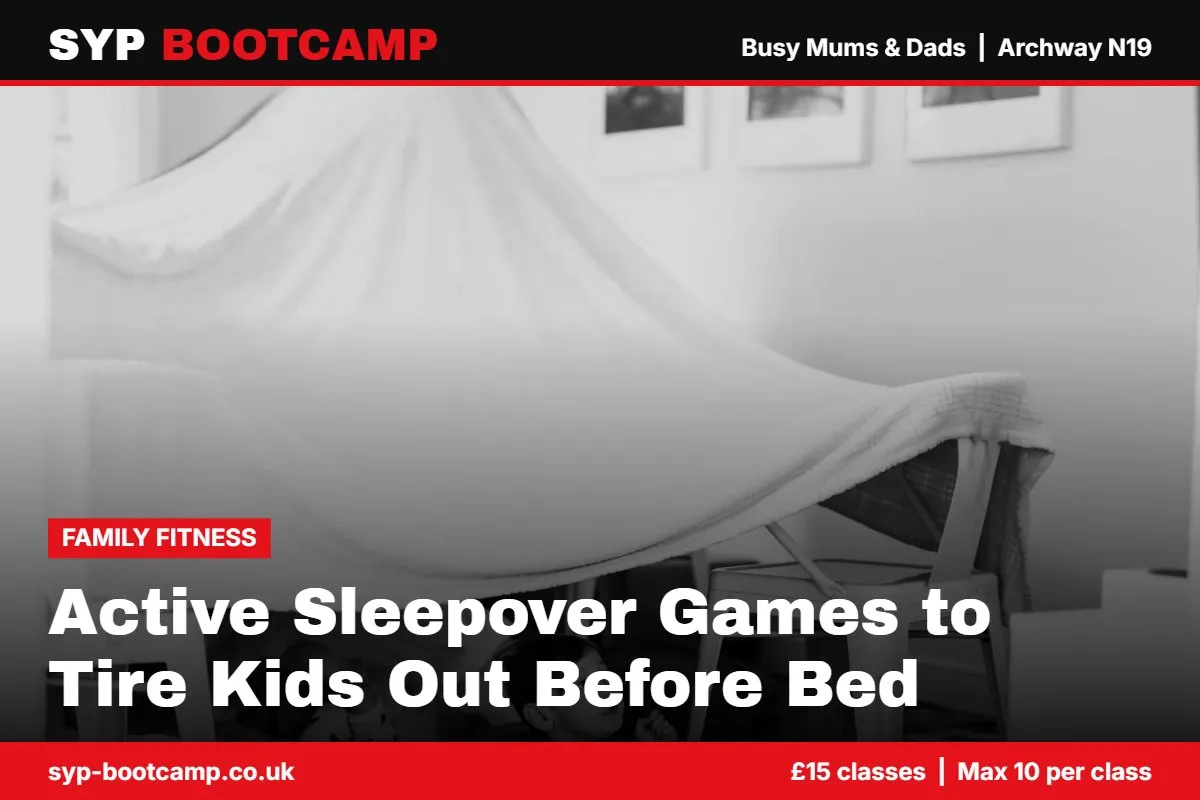
Active Sleepover Games to Tire Kids Out Before Bed
It is 10.30pm. Four eight-year-olds are bouncing off the walls, someone is crying because they lost at a board game, and you are wondering why you ever said yes to a sleepover. I hear this story from parents in my classes most weeks. The trick that works best is simple: get the energy out early. A run of active sleepover games between about 6pm and 8pm means tired, happy kids by lights out, and a much calmer night for you.
Below is the plan I suggest to parents, with games that work in a normal London flat or house, plus a wind-down routine that actually gets them into sleeping bags.
The sleepover timeline that works
Think of the evening in three blocks:
- Arrival to dinner (high energy): the big, noisy, movement games. Get them in the garden or park if it is light and dry.
- After dinner (medium energy): team challenges and games with rules, still moving but less chaotic.
- Last hour (low energy): calm games, stretching, film, bed.
The mistake most of us make is saving the exciting stuff for late in the evening. Flip it. Busy bodies first, quiet bodies last.
High-energy active sleepover games (before dinner)
Sock wars
Every child gets three rolled-up pairs of socks. Split into two teams with a “line” (a rope or tape) down the middle of the room. On “go”, everyone throws socks across. After 60 seconds, stop: the team with fewer socks on their side wins. Play 5 rounds. Socks are soft, so nothing gets broken, and kids are constantly bending, picking up and throwing.
Musical statues with exercises
Play music. When it stops, you shout an exercise and a number: “5 frog jumps!”, “10 seconds plank!”, “3 star jumps!”. Anyone still wobbling when they freeze does the next exercise first. It is a classic with a fitness twist and works for ages 4 to 11.
Pillow case sack race
Each child steps into a pillow case and hops along a hallway or garden lawn to a marker and back. Run it as a relay. Clear the route of toys and furniture first, and keep it on carpet or grass rather than slippery floors.
Torch tag (garden, at dusk)
If you have a garden and it is getting dark, one child is “it” with a torch. If the beam lands on you, you are caught. Play in short rounds of 2 minutes. Keep the area small and clear, with an adult watching.
Medium-energy games (after dinner)
Give food 20 to 30 minutes to settle before anything jumpy. These games keep kids moving without whipping them back up.
Pillow fort build-off
Two teams, 10 minutes, cushions, blankets and chairs. The best fort (judged by you) wins. Lots of lifting, dragging and problem solving, and the forts become the sleeping zones later.
Balloon keepy-uppy
Everyone stands in a circle and keeps one balloon off the ground. Add a rule each round: only elbows, only heads, only your weaker hand. Count touches as a team. For more ideas, see my post on balloon games for kids.
Animal relay
Teams race across the room as different animals: crab walk, bear crawl, frog hop, penguin waddle. Slower, crawling movements are tiring but less wild than running. They are also brilliant for shoulders and core.
Charades with actions
Act out sports and activities only: swimming, boxing, rowing, climbing a ladder. The guesser has to copy the action 5 times before the next turn.
Low-energy wind-down (last hour)
- Sleeping lions: everyone lies perfectly still. One person walks around trying to make them laugh (no touching). Moving means you are out.
- Slow-motion race: the slowest person to cross the room wins. It is very hard and surprisingly calming.
- Five-minute stretch: lie down in a star shape and breathe in for 4 counts, out for 6. Then knees to chest, gentle twist to each side, and child’s pose.
- Film or story once they are in sleeping bags.
Plenty of daytime activity tends to help children settle at night. I look at this in more detail in does exercise help kids sleep.
Tips for active sleepover games in a small flat
- Clear one room fully. Push the sofa back, move lamps, put breakables away.
- Use soft kit only: socks, balloons, cushions, foam balls.
- Warn the neighbours and keep jumping games before 8pm.
- Swap jumps for crawls if you live upstairs. Bear crawls and crab walks are quiet and just as tiring.
- Use a timer for every game. Short rounds stop arguments and keep energy high.
For even more ideas on tight spaces, my guide to indoor games to keep kids active is a good back-up list.
And for the grown-up in charge
Hosting a sleepover is a full-body workout for the nerves. If the week before was just as hectic, you might like my SYP Release stress relief class, where we hit pads and slam balls for 45 minutes. It is the most satisfying way I know to let a long week go.
FAQs
What age are sleepovers usually OK?
There is no fixed rule. Many families start around 7 or 8, often with a “late-over” first, where kids come for the games and film but go home to sleep. Go with your child’s confidence and the other family’s comfort.
What time should kids go to sleep at a sleepover?
Agree a lights-out time with the other parents beforehand and stick close to it. Most kids will chat after lights out, so plan for an extra 30 minutes. That is exactly why the active games should happen early.
How do I stop sleepover games getting out of hand?
Set rules at the start (no hitting with pillows, stop when the music stops), use a timer, and give each child a job like scorekeeper or referee. Switching to a calmer game quickly works better than shouting.
What are good quiet games for the end of a sleepover?
Sleeping lions, slow-motion races, whispered stories, or a short stretch with slow breathing. Keep screens for the very last step, once everyone is in bed.
Book your first class
Once the sleepover is done, it is your turn. SYP Bootcamp is a 45-minute small-group class for busy parents in Archway N19, held indoors in a church hall, with a maximum of 10 people. Every exercise has an easier and a harder option, and it costs £15 a class. You get the timetable when you book. Book my £15 class here, or call or WhatsApp 07301 512215. If you want to see what one-to-one coaching looks like before committing, have a look at how my personal training works.
About the author
Artem Olekhnovych is a personal trainer in Archway and the founder of SYP Fitness and SYP Bootcamp. He has coached clients in Archway, Highgate and across North London for over 10 years, and runs small-group bootcamp classes for busy mums and dads. Read reviews from his 1-1 clients.
